19 October 2026
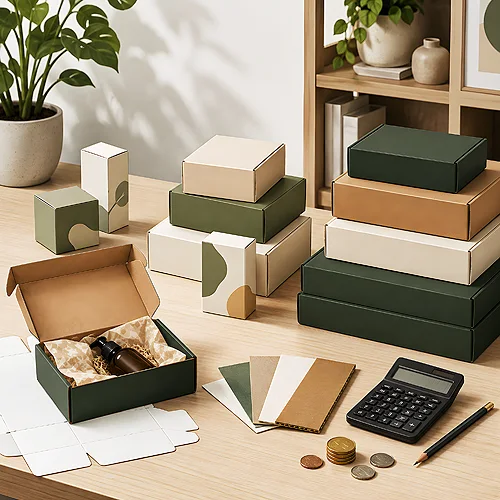
What packaging really costs at 50, 200 and 1000 units
At fifty units you mostly pay for preparation, at a thousand for material. We show how to read a packaging quote and where the real savings actually are.
Read articleTopic
7 articles
A modest budget does not have to mean random giveaways. The material here shows how to build a promotional set from a few small items so it reads as a considered gift rather than leftovers handed out in passing.
19 October 2026
At fifty units you mostly pay for preparation, at a thousand for material. We show how to read a packaging quote and where the real savings actually are.
Read article
28 September 2026
A postcard looks like the simplest print there is, but the run decides whether the job adds up. We walk through format, paper, lamination and the order of decisions.
Read article
04 September 2026
New packaging looks great on screen, but the real test comes in a customer's hands. We show how to split a launch into a prototype, a trial run and a revision.
Read article
31 August 2026
A plotter cuts the shape without a die, so a short run becomes realistic. We look at the runs and uses where it wins, and when ordering a bigger batch simply makes more sense.
Read article
14 August 2026
The most expensive trade show material is the one that comes back unopened. We show what is genuinely worth taking, in what quantities and what to leave unprinted.
Read article
31 July 2025
Order too few and you run out. Order too many and part of it becomes a cost. We show you how to realistically estimate your run, when to reach for digital or offset, and how to plan a buffer and reprints.
Read article
13 February 2025
Three well-chosen little items in one box can do more than a single expensive gadget. See how to assemble a coherent promotional pack without inflating the budget.
Read articleSeveral small things given together usually make a better impression than one costlier but random item. There is a single condition: the set needs an idea holding it together, rather than being whatever happened to be left in the store cupboard.
Start with the situation in which somebody will use it. Every other decision then follows on its own.
Save on the number of items and the size of the order, not on what people see and touch. A crooked print or a pen that refuses to write is remembered far longer than the rest of the set. Fewer items that work properly beat more that do not, and a simple thing made well always looks better than a fancy one made badly.
It is also worth preparing two versions: a smaller one handed out widely at events, and a larger one for selected guests. The base can stay the same, with one extra item and different packaging making the difference. Everything still looks like one family, and you end up ordering fewer separate things at a time.
Other topics
Back to all postsPrivacy
