A postcard looks like the simplest print you could possibly order: one piece of board, two sides, done. In practice it is a job in which the decision about the print run weighs more than the design itself, because it determines whether the whole thing adds up economically or is merely a charming idea.
This article looks at the postcard from the production side. It is not about who to send it to or what to write on it, but about the four questions that come up with every order: how many copies, which format, which paper and whether to laminate. Answer them in that order and the quote stops being guesswork, while the artwork stops coming back for corrections.
- The print run is the first decision, not the last - the format and the paper are chosen to suit it.
- With a small run the preparation weighs the most, because it is spread across fewer copies.
- Advertising postcards are always double sided, so the reverse is not a bonus and has to be designed.
- A6 is the classic card, while DL looks like a premium leaflet and fits a standard envelope.
- Several designs in one job is simpler than several separate orders placed weeks apart.
When printing postcards makes sense
A postcard does not justify itself by being attractive. It justifies itself when you have somewhere to put it. Before you count anything, check whether a channel exists through which these cards will genuinely leave the box.
- You have a fixed point of distribution - a stand, a reception desk, a counter, a trade fair stall or parcels sent out to customers.
- You have something to show - a good photograph, an illustration or a recognisable motif that survives being enlarged to full format.
- The design will not date within a month - if the content changes weekly, that is a job for a different kind of print.
- You know how many people will actually receive it - a list, an address database or a known number of guests.
If any of these points has nothing behind it, it is worth pausing. A postcard ordered without a distribution plan sits in a box until the end of the year, and that is the most common way this particular print fails to pay for itself.
Why a small run costs more per copy
This works the same way in every kind of printing, but with postcards it is especially visible, because the unit itself is cheap. Before the press produces a single sheet, the files have to be prepared, the stock selected and the machine set up. That work is almost identical for a hundred copies and for five thousand - the only difference is how many cards it is spread across.
The conclusion is simple: with a small series the preparation weighs the most and the unit cost is high. With a larger one it drops, but a different risk grows - boxes of unused stock and a design that has had time to date. We took apart where the sensible middle ground lies in our piece on how to plan a print run without overpaying.
A6 or DL, and what follows from it
There are two formats to choose from and they differ not only in size, but also in how they are distributed.
- A6 - the classic postal card. More room for a photograph, it looks right on a stand and in the hand, and it reads instinctively as a postcard.
- DL - a slim rectangle that looks more like an elegant leaflet than a card. It fits a standard envelope and slides comfortably into a parcel next to a product.
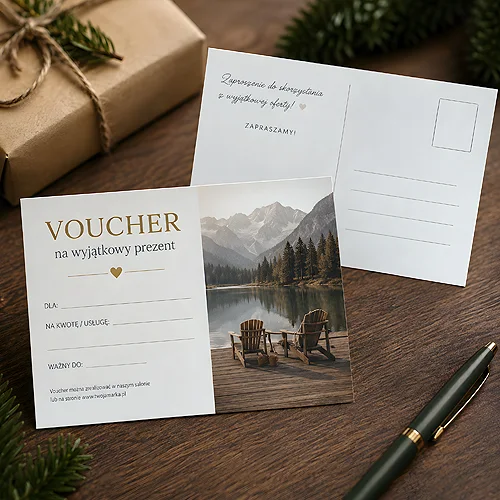
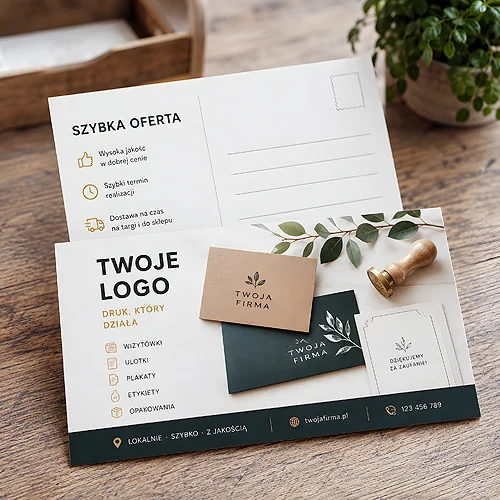
If you are torn between them, the same criteria we described when choosing a leaflet format will help: what counts is not the aesthetics but the way it is handed over. It is also worth remembering something buyers usually discover at the design stage: a postcard is always double sided. The reverse is not an extra you can leave blank - if you do not design it, you are paying for a surface that does nothing.
Coated board or Arktika
Two stocks, two different routes. Stiff coated board keeps the ink on the surface, so photographs come out sharp, colours stay saturated and the whole thing looks much as it did on screen. That is the choice for a postcard whose job is to show a view, a product or an interior.
Elegant Arktika board goes the other way. It has a calmer, more subdued surface and a more pleasant feel, while colours settle deeper into it and shout less. It works where the postcard is meant to be a card with character rather than a carrier for a photograph. You will find more about the differences between stocks in our guide to materials and papers.
Lamination: when it protects and when it is redundant
Lamination is a thin layer applied over the printed sheet - gloss, matt or Soft Touch. It makes sense when the postcard has to survive something: posting without an envelope, several hundred touches on a display stand, damp air or a journey in a pocket. It protects the edges and keeps the card from picking up fingerprints straight away.
It can also be redundant. If the postcard travels in an envelope, slips into a parcel or is handed over in person and goes straight onto a desk, lamination adds little beyond appearance. In that case it is better to put the effort into the paper or into an extra design.
If somebody is meant to write on the reverse by hand, check that the finish you have chosen allows it. A smooth, glossy surface can refuse to take a ballpoint pen, and that is the kind of surprise that only shows up with the first card.
Several designs in one job
This is one of the decisions that changes the arithmetic the most. If you are planning a series - four views, two seasons or separate designs for two groups of recipients - order them together in a single job rather than placing several separate orders at intervals.
- One preparation instead of several - the same paper, the same format, one production setup.
- Consistent colour - designs printed together look like one collection rather than a pile of unrelated cards.
- Easier planning - you know at once how much of each you have, instead of adding designs on impulse.
If the postcard is meant to be part of a bigger set, we described the same way of thinking in our piece on how to put together an affordable promotional pack from a few small items.
The order of decisions before the quote
- Work out the run from a real distribution channel rather than from an optimistic assumption.
- Choose the format: A6 for a stand and for the hand, DL for envelopes and parcels.
- Settle the paper: coated board for photographs, Arktika board for feel and a calmer character.
- Design both sides - the reverse from the start rather than at the end, because it decides how useful the card is.
- Resolve the lamination according to what the postcard has to survive, not according to what looks better in a mock-up.
- Prepare the files and check our ordering guide to see what the rest of the process looks like.
The rest of the postcard offer starts in exactly this place: with the number of copies, with the format and with where these cards are meant to end up. A postcard is one of the few prints you can plan on a sheet of paper in five minutes, and one of those that suffer the most when nobody does. Count the run with a cool head, choose everything else to match it, and only then sit down to the design.