
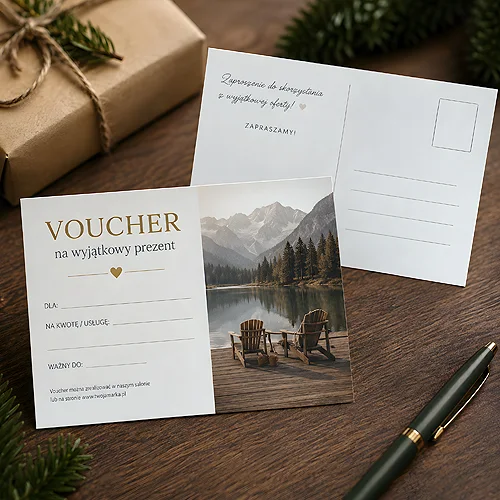
The idea is tempting and it keeps coming back: since you are sending customers a card with a view anyway, let that same card carry a discount on their next visit. One print, one run, one campaign. Sometimes it works beautifully, and sometimes it ends in a card that is neither an attractive keepsake nor a working voucher.
The line between the two is sharper than it looks, and it can be described in one sentence: a postcard will carry the role of a voucher when the redemption mechanism fits into two lines. Anything that calls for filling in details, numbering or keeping records immediately goes beyond what this format can do. Below we break that down into concrete cases.
- The combination works with a simple mechanism: one condition, one date, one way of redeeming it.
- A named voucher, a voucher for an amount or anything requiring records is a job for a separate print.
- The expiry date matters more here than on an ordinary voucher, because the card gets kept as a keepsake.
- The reverse of a postcard is occupied by definition, so you have to decide what gives way.
- A separate coupon added to the card is the middle path: the condition leaves, the image stays.
When one card really is enough
The combination makes sense when the postcard would have reached the recipient anyway and the discount comes along with it, rather than the other way round. A few situations where it works:
- Accommodation - a card with a view of the area sent after a stay, with a simple discount on the next visit out of season.
- Mail order shops - a card added to a parcel, with thanks on one side and an invitation to order again on the other.
- Venues and salons - a card handed over on the way out, valid for one specific service.
- Seasonal campaigns - a single campaign, closed in time, for a group of recipients you already know.
The common denominator is always the same: the mechanism needs no individual data, nobody has to account for single copies, and the whole rule can be said out loud in one sentence. If explaining how it works takes three sentences and the word probably, that is a sign the card will not carry it.
Where the line runs
There are situations in which combining functions is not a saving but a problem postponed. It is worth knowing them in advance.
- A named voucher - it needs space for details and certainty that one person will use it. A postcard offers neither.
- A voucher for an amount - this is a document with a value. It needs a number, control over issuing and order in the paperwork, and a card circulating on fridge doors provides none of that.
- A voucher given as a gift - here the form and the moment of handing it over matter. A card with a view of a town looks like a holiday souvenir in that role rather than a present.
- Anything you have to record - if you need to know how many copies came back, you need a print designed for controlled issuing, such as tickets.
In those cases a separate print is not an extravagance but a condition of the whole thing being manageable. We described how to build such an offer from the sales side in our piece on gift vouchers in a service business.
What has to be on the card for it to work
A postcard in the role of a voucher usually fails not on the graphics but on gaps in the wording. Four things are obligatory and none of them can be guessed.
- The condition - what exactly the discount covers and what it does not. One sentence, with no asterisks and no small print.
- The expiry date - an actual date, not a phrase about a limited period.
- How to redeem it - where to present the card, to whom, and whether it has to be announced in advance.
- Who issued it - a name and an address, so that six months later it is clear whose card this is.
Why the expiry date matters more than usual
An ordinary voucher lies in a drawer and has one job. A postcard gets kept for a different reason: because it is attractive. It ends up on a fridge, on a shelf, in a box of mementoes, and reappears a year later during a clear-out. That is when the conversation nobody wants happens: a customer brings in a card that looks current and is not.
So set the date clearly, at the same size as the rest of the condition, and put it where the eye will certainly land rather than in the bottom corner beside the contact details. That one sentence protects both sides and saves awkward moments at the counter.
How not to turn a postcard into a form
The biggest risk in combining functions is that the card gradually turns into an official document. It starts with terms in small print, then comes a box for a signature, a field for a date, a space for a stamp - and the postcard is gone.
Keep the proportions: the image stays the hero and the condition is a note. Advertising postcards are always double sided, so the reverse is included anyway - but it is also the only surface for text, so you have to decide what gives way. Usually it is the long company description, because in this role it does nothing. We wrote about what really decides whether this kind of print works in our piece on designing a voucher that catches attention.
Write the condition as though you were explaining it over the phone to somebody who does not know your offer. If the sentence contains the name of an internal package or an abbreviation used only inside your company, the customer at the counter will ask anyway - which means the card did not do its job on its own.
A separate coupon as the middle path
There is a variant that resolves the main conflict between keepsake and voucher: a small coupon added to the postcard. The recipient hands it over when redeeming, and the more attractive part stays with them. You get a physical trace that somebody used it, and you can simply count them.
This solution costs one more print, though. Design the coupon together with the postcard rather than adding it at the end, so both pieces share one style. It is also worth remembering that the coupon needs its own set of information, because it lives on its own from the start. We gathered the variants of this mechanism in our piece on leaflets with a tear-off element.
The order of decisions
- Test the mechanism - say it out loud in one sentence. Cannot be done? You need a separate print.
- Fix the expiry date as an actual date, before you start designing.
- Decide what the hero is: the image or the offer. One of the two, not both at once.
- Plan the reverse and delete everything from it that does not serve redemption.
- Consider a separate coupon if you want to count returns.
- Keep the condition and the date away from the edge, and leave clear space around the QR code - small text right against the trim and a code squeezed into a corner are the two most common corrections on cards like this. The rest of the guidance is in our file preparation guide.
Combining functions on one print is a good idea for exactly as long as it makes life simpler for the recipient. The moment it starts to complicate things - because something has to be filled in, noted down or explained - it stops being a saving and becomes a source of misunderstandings. One card, one condition, one date. The rest is already a job for a separate voucher.


