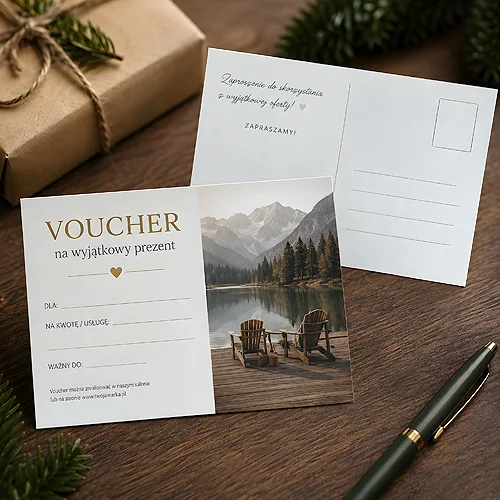
A client walks into a salon, clinic or restaurant and says: "I am looking for a gift, but I do not know exactly what to choose". That is the best moment to hand them a voucher. For a service business, a gift voucher is one of the few tools that at once solves the client's problem, brings sales upfront and attracts new people. And it is a simple, printed product that you can introduce quickly, without heavy machinery.
- A voucher is a sale upfront - you get the funds now, you deliver the service later.
- It is a client-acquisition tool - the person who receives a voucher often comes to you for the first time.
- Types: amount-based, for a specific service, time-limited (e.g. valid until a date) - each fits a different situation.
- A good voucher has a number or code, an expiry date, a short set of terms and consistent branding.
- The finish makes a difference - good paper and enhancement make the voucher look like a gift, not a receipt.
Why it pays to offer vouchers
The first and most tangible benefit is cash now. By selling a voucher, you receive funds at the moment of purchase and perform the service only when the client comes to redeem it. For a service business that usually earns "for work done", this is a financial boost in advance - especially valuable in periods when gifts are bought en masse.
The second benefit is even more interesting: a voucher brings new people. Someone who receives a voucher as a gift very often comes to you for the first time. If they like the service, there is a chance they will return of their own accord - which means one voucher sold can turn into a regular client. It is hard to find a cheaper way to win someone new.
The third thing is simplicity from the buyer's point of view. People often do not know what to give - they are afraid of missing the mark. A voucher removes that problem: the recipient chooses what and when to redeem. That is why vouchers sell so well around holidays, birthdays, Mother's Day or Valentine's Day. It is a gift that is practically never a miss.
A voucher is the only gift a client buys with relief that they do not have to guess - and you make the sale before you deliver the service.
Types of vouchers - which suits you
There is no single universal voucher. Depending on the service you offer and how your pricing works, a different type will fit best. It is worth knowing the three basic variants so you can pick the one that suits your business best.
Amount-based voucher
The most flexible - it carries a set value that the recipient spends on any service or product. It works great where the offer is broad: in a salon with many treatments, in a restaurant, in a shop with services. The buyer does not have to decide for the recipient, and the recipient picks whatever they fancy.
Voucher for a specific service
A voucher for a clearly described service - a massage, a tasting dinner, an inspection, a particular treatment. This is a good choice when you want to promote a specific item from your offer or when the service itself is an attractive gift. The recipient knows exactly what they got, and you know what you will deliver.
Time-limited voucher
A voucher valid until a set date or for a set period - for example a seasonal offer valid for a few months. The expiry date encourages use and helps plan capacity. It is just worth keeping it within reasonable limits, so as not to discourage the recipient with too short a window.
If you are just starting, go for an amount-based voucher - it is the simplest to handle and the most universal. You can add vouchers for specific services later, once you see what clients buy most eagerly. You do not have to introduce every type at once.
When and to whom to offer vouchers
A voucher sells best when someone is facing a specific gift decision - and there are plenty of such moments in the year. It is worth having vouchers ready and visible before the busier periods begin, because that is when a client most often reaches for a ready solution instead of wondering what to choose.
- Gift periods - holidays, Valentine's Day, Mother's Day, Women's Day, the birthday season. These are the natural peaks of demand for vouchers.
- Clients looking for a gift - when someone asks about something for a loved one, a voucher is the simplest and safest answer.
- Regular clients - they often buy vouchers for friends, because they know and like your service themselves. It is worth reminding them of the option.
- Companies and teams - vouchers make a convenient gift for employees or a form of reward. That is a separate, valuable sales channel.
It is not about pushing a voucher on everyone - it is enough that it is visible at the point of sale, on the website and in conversation when it genuinely fits. A well-displayed voucher often sells itself, because it meets a ready need of the client.
What a good voucher must include
A voucher is not just nice graphics - it is a document that has to work in practice when the recipient comes to redeem it. A few elements are simply mandatory, because without them the voucher is awkward to handle or open to misuse.
- A unique number or code - lets you identify a specific voucher, record its redemption and avoid the same piece being used more than once.
- An expiry date - a clear date until when the voucher can be used. It tidies things up both for you and for the recipient.
- A short set of terms - a few sentences on the rules: whether it combines with other promotions, whether it is refundable, how redemption works. It does not have to be long, but it has to be there.
- Company details and branding - logo, name, colours, contact. The voucher is a business card - it should say straight away who it comes from.
- Space for the value or service name - clearly displayed, so there is no doubt what the voucher covers.
It is also worth thinking about safeguards. A unique number is the basis, but you can add, for example, a space for a signature or a stamp at redemption, which makes copying harder and helps you keep track of vouchers in circulation. You do not need to roll out elaborate systems at once - a numbered voucher with recorded redemption already gives you plenty of control.
Design and finish that raise the impression
A voucher is a gift, so it should look like a gift - not like a printout from an office printer. How the voucher is made affects how the recipient receives it, and indirectly how they perceive your whole business. Cheap paper lowers the value of even an expensive service; a good finish works the other way.
Thicker, good-quality paper instantly raises the sense of solidity. Enhancements - gloss, matt or velvety Soft Touch film - make the voucher pleasant to hold and give it an exclusive look. It is not about opulence, but about consistency: a well-made voucher signals that the service itself is up to standard. If you want the design to truly catch the eye, look at our guide on how to design a voucher that draws clients' attention. The base here is the stock - thank-you vouchers are printed on coated paper or on Arktika GC1 board, and the sense of solidity starts with that choice.
Keep the design consistent with the rest of your identity - the same colours, the same style as your website, interior or sign. A voucher that looks like part of the brand builds trust from the first glance. A mismatched style works the opposite way: it signals that something was done in a hurry.
Preparing for print
Once you have planned the voucher types, their content and the design, one last step remains - preparing the files correctly. This is where it is decided whether the voucher comes out the way you designed it. A few things are worth checking before the file goes to production.
Make sure the graphics have the right resolution, the right colours (prepared for print, not for the screen) and safe margins for the most important elements from the edge, so nothing gets clipped at the cut. If the vouchers are to be numbered, decide in advance how the numbering should look - a detail easy to forget and hard to add after the fact. We gathered all the rules of a correct file in the file preparation guide.
Gift vouchers are one of those products that pay off quickly - you sell them upfront, they bring new clients and solve the age-old problem of "what to buy as a gift". You just need to pick the right type, take care of the mandatory elements and a proper finish. You will find ready solutions and inspiration in our vouchers section. And if you want to discuss how to prepare vouchers for your specific service, simply get in touch - we will help you choose the format, paper and finish so the voucher works for your sales from day one.