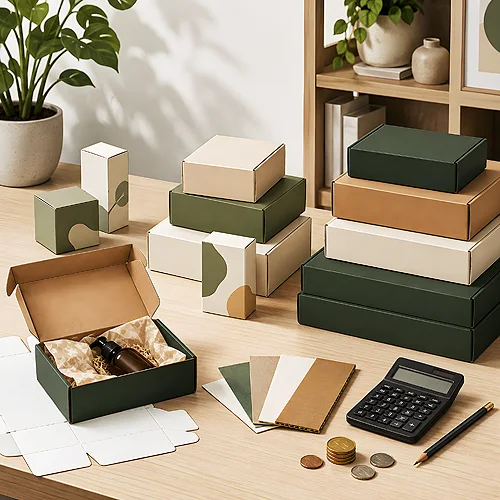
New packaging always looks good on screen. The real test comes only when a customer picks it up, opens it, puts it on a shelf and drops it into a bag. Between those two moments there is now a space that barely existed until recently: a small run on which you can calmly check whether the idea works.
Digital printing and flatbed plotter cutting changed one fundamental thing here. Previously, to see your packaging actually made, you had to order a cutting die - a tool built for one specific shape - and commit to a quantity counted in thousands. When the shape is cut by a plotter there simply is no such tool, so a few dozen pieces becomes a sensible, self-contained production run.
This text is about the process, not the technology. About how a brand launching a product can split the packaging launch into stages: prototype, trial run, collected feedback, revision - and only then a bigger production.
- The first version of packaging is almost never the final one, and that is completely normal.
- A prototype answers questions about construction, a trial run answers questions about the market.
- Release the small run where you have direct contact with the recipient: your own shop, a fair, shipments to regular customers.
- Collect feedback separately from three people: the customer, the person packing and the seller.
- Move to a bigger production once several batches pass without a new revision appearing.
- At large and stable quantities, classic production with a cutting die still comes out better.
Why the first version is rarely the final one
A design on screen has one flaw: it shows appearance, not behaviour. You cannot feel its weight, the resistance when opening, or how the board reacts after a week of being carried in a bag. You also cannot see scale, because packaging displayed across a full monitor actually fits in your palm.
The things that only emerge on a physical piece are always more or less the same:
- Proportions in the hand - what looked slender on the monitor can look squat on the table.
- Resistance when opening - a tab that is too tight is irritating, one that is too loose feels careless.
- Behaviour in transit - whether the product shifts inside and whether the corners survive the journey.
- Appearance in context - packaging standing next to others, not on a white background in a design program.
- Packing time - a construction that takes half a minute longer to fold makes a real difference across a hundred orders.
Stage one: the prototype, a single piece in your hand
A prototype is one piece, or a few, whose job is not to sell but to answer questions about construction. At this stage the artwork can still be a working version. What counts is the shape, the internal dimension and whether everything fits and closes.
What you are looking for in a prototype
Take the product that is meant to go inside and actually put it in, not in your imagination. Close it, open it, shake it, leave it for a day, take it out again. Note down everything that annoyed you, even small things. The three things that most often need correcting after a first prototype are internal slack, closing strength and the spot you have to grip in order to open it.
If you are torn between two constructions, make both. Comparing two physical pieces takes a minute and ends a discussion that in meetings can drag on for weeks.
Prototype together with whatever will end up on the packaging anyway: the label, the band, the tag. Very often it turns out that the carton itself is fine and the problem is a sticker that lands on a fold or covers the gripping point. Checking that separately costs you one extra round. Order the tag for that test as a die-cut hang tag - you pick the shape from the ready cutting dies and match the paper to the product you are packing.
Stage two: the trial run in customers' hands
Once the construction holds up, it is time for a trial run - one that genuinely reaches recipients. This is the moment when small-scale production shows its full value: a few dozen pieces are enough to cover one fair, one delivery to a shop or a month of shipments to regular customers.
Choose a channel where you get feedback. Selling in your own shop, a stand at a local fair or shipments to customers who reply to messages will give you more than anonymous distribution. If you sell several variants of a product, release the trial run with two versions of the labelling and see which one people reach for first. Along the way you will test whether your tags and the descriptions on the packaging are readable to someone seeing the product for the first time.
A trial run has one more, less obvious advantage: it gives you photographs. Real packaging in real light is material for your online shop, social media and conversations with wholesale buyers. And all of that happens before you even decide on a large quantity.
How to collect feedback that leads somewhere
The biggest mistake at this stage is asking whether people like it. Almost everyone will say yes, and nothing will come of it. Ask about behaviour, not taste.
- Ask about the first second - what the customer saw first and whether they immediately knew what was inside.
- Ask about opening - whether it went smoothly or they had to look for where to grip.
- Ask the person packing - they will spot fastest that a construction is one movement too difficult.
- Ask the seller or the stand crew - they hear comments a customer would never put in a message.
- Check what comes back - transit damage and complaints are the hardest data you will get.
- Write everything in one place - a remark repeated independently by three people stops being someone's opinion and becomes a revision to make.
Not every remark deserves a change. React to the ones that repeat independently, and to the ones that genuinely cost you - damage, mistakes and packing time.
The revision and the moment to move to bigger production
The second version should answer the feedback you collected, not become an excuse to redesign everything from scratch. Change one thing at a time, otherwise you will not know what worked. With small runs you can afford that rhythm, because each next version is a separate, modest order rather than a decision for the whole year.
When should you stop testing? The signal is simple: several batches in a row pass without a new revision, sales are predictable and the product does not change format. At that point moving to a larger quantity stops being a risk and starts being a saving, because at large and repeatable volumes classic production with a cutting die comes out better and should take over. We break that decision down in our post on planning a small or a large print run.
Print technology is, incidentally, a decision separate from the cutting itself. Short runs naturally favour digital, large and repeatable ones favour offset. We compared the differences in our post on how digital printing differs from offset.
Test the whole thing, not just the box
Packaging rarely works on its own. The customer receives a set: the carton, the product, the labelling, sometimes a small extra and a thank-you card. If you are testing a launch, test that whole set at once, because otherwise you will fix the box and only notice a year later that the insert was the problem. For smaller products, sleeves work well as a complementary element, and we gathered ideas for small extras in our post on an inexpensive promotional bundle.
If you are not sure where to start, write to us through the contact form and describe the product you want to pack. We will suggest which construction is worth checking on the first prototype and what to watch during the trial run.
Testing packaging has stopped being a privilege of large brands. The point is not to get it right first time, but to be able to get it wrong cheaply and quickly - and then move into bigger production with a design proven in real hands, not only on screen.