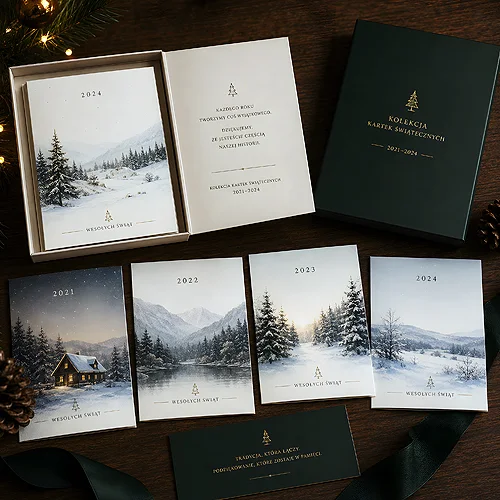
A ready Christmas card template has one huge advantage - it is available instantly. You pick a graphic from the catalogue, type in your greeting, add your logo and the matter is closed. For many companies that is perfectly enough, and there is nothing wrong with it. There are situations, though, in which the very same card sent by half the industry does your brand more harm than good - and that is when a bespoke design is worth considering.
Choosing between a ready template and a design from scratch is not a question of what is better in general, but of what is better for you in this particular year and for these particular recipients. Sometimes common sense points to the catalogue, and sometimes a custom design is the only option that truly captures the character of the company. Below we show how to recognise which situation you are in.
Before we get to the signals - why are company greetings sent at all? It is not a calendar duty, but a tradition that genuinely builds relationships with clients, employees and partners. The more that relationship matters to you, the stronger the argument for a design made from the ground up.
- A ready template is quick and saves time - great when you mainly care about a warm gesture and keeping in touch.
- A design from scratch is worth considering when you have a strong, recognisable brand, a special occasion or key recipients you want to stand out for.
- A custom design gives full control over colour, composition, paper and finishing - the card becomes part of your identity, not a random add-on.
- The process is simpler than it seems: brief, concept, design, revisions, print - and the designer takes on most of the work.
- The biggest risks are overloading the card and starting too late - both are easy to avoid by planning ahead.
A ready template - when it is perfectly enough
Ready templates exist for a reason. It is a fast, predictable and usually the least labour-intensive solution - and time in December is a scarce commodity. If what you care about most is remembering your client and sending a warm gesture, the catalogue is perfectly enough.
There are situations where a ready template is simply the sensible choice:
- You send greetings to a broad, fairly uniform base and the fact of contact is what counts.
- The brand is young or only just building its visual style - there are no strong elements yet that would need to be reproduced faithfully.
- Budget and time are tight, and the card is one of many December duties.
- You want a simple, classic effect that a good template delivers without risk.
Even a ready template can be adjusted - add a logo, match the accent colour to the brand, write your own greeting instead of the standard formula. How to do this elegantly, we describe in our guide on how to design an elegant Christmas card with a company logo.
Signals that it is worth designing from scratch
The more of the list below fits your situation, the stronger the argument to leave the catalogue and make a card that is exclusively yours.
- You have a strong, recognisable brand. If your colours, logo and style are used consistently everywhere, a random catalogue graphic simply does not match them and breaks the coherence.
- It is a special occasion. An anniversary, a round jubilee, a breakthrough year for the company - such moments deserve a card that speaks about them, not a universal design good for any winter.
- You want to stand out in a flood of greetings. Towards the end of the year a client receives dozens of similar cards. A custom design is a chance for yours to be noticed and remembered.
- You are writing to key recipients. Your most important clients, strategic partners, people whose relationship truly matters - they are worth sending something that looks prepared especially for them.
It is worth remembering that a well-designed card is also a subtle marketing tool - it does not shout an offer, but it stays in memory and reminds people of the company in a good, warm context.
What a bespoke design actually gives you
The biggest advantage of a custom design is control. You do not fit the company to a ready graphic, but the graphic to the company. In practice you gain a few concrete things:
- Full control over composition and colour - a palette exactly as in your identity, with no compromises.
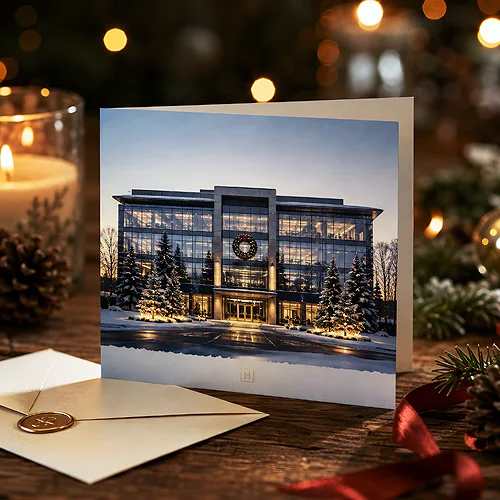
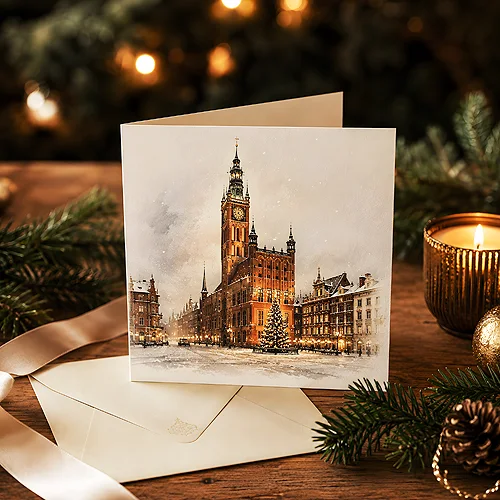
- A motif matched to the company - your premises, city, product or people, rather than a generic tree sent by half the market.
- Freedom in choosing paper and finishing - thick card stock, decorative or eco paper, matte or velvety Soft Touch lamination, a folded or single-card format.
- Coherence with your other materials - the card looks like part of the family with your company letterhead and business cards, not like a detached extra.
A card designed from scratch works best when it reflects the character of the company - greetings from a law firm look different from those of a creative studio. Before you choose a direction, it is worth deciding whether the brand is rather elegant, friendly or bold - one decision that puts all the following ones in order.
What the design-from-scratch process looks like
It sounds serious, but in practice it is simpler than it seems - and the designer does most of the work. Your role comes down to a good brief and decisions at a few stages.
- Brief - you describe the company, the tone, the occasion and what you want to convey. The more specifics, the more on-target the first sketch.
- Concept - the designer proposes a direction or a few variants. You pick the one that best fits the brand.
- The actual design - the chosen direction turns into a finished layout with the greeting, logo and motif.
- Revisions - you fine-tune the details: text, colour, arrangement of elements. This is where it pays not to spare your comments.
- Paper and finishing - you decide on the type of card stock, a folded or single-card format and any finishing.
- Print - the approved design goes into production and you receive finished cards ready to send.
Start the conversation about the design earlier than common sense suggests. December is the busiest period at a print house, and a good card from scratch needs room for the concept and calm revisions. The earlier you begin, the more freedom you have in choosing paper and finishing - and the fewer nerves at the finish.
What to watch out for
A custom design gives freedom, but that freedom can be treacherous. A few traps come up most often:
- Overloading. Since we are designing from scratch, there is a temptation to add everything at once. The effect is often the opposite - the card becomes chaotic. One strong idea works better than five average ones.
- Too little brand or too much. A logo half the size of the card looks like an advert, while no trace of the company at all looks like an ordinary shop card. It is worth hitting the subtle middle.
- Starting too late. The best idea loses out when it is made in a panic at the last minute. A design from scratch needs a calm head start.
- A lack of coherence with other materials. A card in different colours from your website and business cards looks like it is from another company. Stick to one palette.
A ready template and a design from scratch are not competitors, but two tools for different jobs. If you simply want to remember the contact, the catalogue works great. If the brand matters to you, the occasion is special and the recipients are key - a custom design pays off in the impression it makes. Take a look at our range of Christmas cards, think about which situation you are in this particular year, and choose deliberately rather than out of habit.