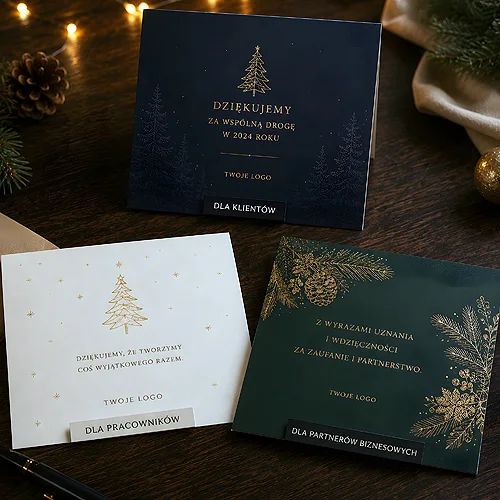
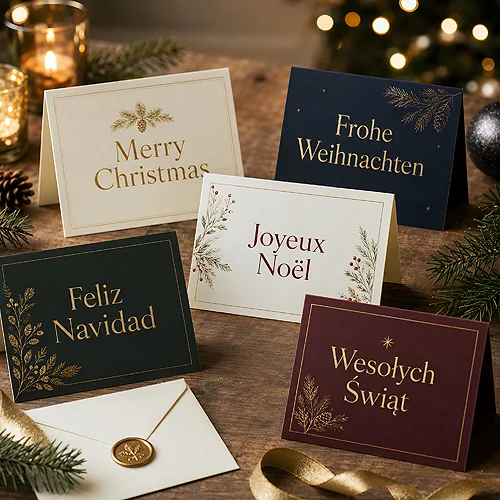
Sending corporate Christmas cards looks like an old, perhaps slightly unfashionable tradition. And yet it still works - better than many a modern channel. In times when inboxes burst with copy-paste greetings, a plain paper card becomes something rare. And rare draws attention. It is a gesture that says "we thought of you" without a single word about selling. Let us look at why this tradition still builds relationships and how to do it well.
- A paper card is tangible - you can hold it and stand it on a desk.
- An email gets lost in the crowd, a card stays and reminds people of you all through the season.
- What matters most is what you write - a few honest words beat an empty cliche.
- The card should look like your company - the same colours, logo, the same style.
- Send it early, so it arrives before the festive rush.
Before the specifics, one thought. A Christmas card is not an advert. It is a thank you. You do not send it to sell something, but to appreciate someone who was with you through the year. And that is exactly why it works - because people feel the difference between a request and an honest gesture.
Why a paper card beats an email
An email with festive greetings lands in the inbox alongside dozens of others. It is opened for a second, maybe two, and closed. Even a nice animated banner disappears after one click. A card works differently. You can hold it, feel the paper, stand it on a desk or pin it to a board. It stays in view for many days.
There is something even more important in this. A paper card takes effort - it has to be designed, printed, addressed and sent. The recipient senses that. They know someone gave their time just for them, rather than clicking "send to everyone". That small effort is a sign of respect, and it is what builds the relationship.
The point is not to write off digital channels entirely. The point is that in a sea of electronic messages, something tangible simply stands out. And standing out in a good way is exactly what building a client relationship is about.
A card and an email do not have to exclude each other. Send a paper card to your most important clients and partners - where the relationship truly counts. You can add short emailed greetings for the rest of your contacts. That way you combine a warm gesture with reach, losing nothing of either.
What to write so it is not an empty cliche
The nicest card will not work if the inside holds only "Merry Christmas and a Happy New Year". Everyone has seen that line a thousand times and passes it by indifferently. The power of a card lies in what you write yourself. It does not have to be long. It has to be real.
Write as if you were speaking to a specific person, not to an address list. Thank them for the past year of working together. If there was a shared project or a nice moment, mention it in one sentence. Say you look forward to another year together. That is enough to turn the card from a formality into a gesture.
People forget what exactly you sent them. They remember that you thought of them at a good moment. That feeling lasts longer than any graphic.
A few simple rules for the message that always work:
- Write in your own voice, in the first person - "thank you", "we are glad", not impersonally.
- Avoid selling. No offers, no discounts, no "come and shop in the new year".
- If you can, add at least one line by hand - a signature or a short "see you soon".
- Short and honest beats long and artificial. Two heartfelt sentences are enough.
A handwritten note makes a huge difference. Even one word written with a pen shows the card passed through someone's hands. It is the simplest way to make a bulk send sound personal.
The card should look like your company
A Christmas card is your brand too - only in a warm, festive edition. That is why it is worth keeping it consistent with how the rest of your materials look. The same colours, the same logo, the same character. The recipient should feel at once that it is from you, even before reading the signature.
Consistency does not mean stiffness. A festive theme can be warmer and more celebratory than an ordinary business card or flyer, yet it should still speak your visual language. If your brand is elegant and restrained, let the card be so too. If it is lively and colourful - let it stay that way. The point is for the card to fit you, not a random template.
Before you order a run, look at the design on paper, not just on screen. Colours on a monitor and in print can differ, and paper has its own character - it looks different on a smooth stock than on a textured one. A well chosen surface makes even a simple card look tidy and thought through right away.
When to send and to whom
With timing there is one simple rule: better too early than too late. December is the busiest time at print shops and at the post, so the closer to the holidays, the greater the risk the card arrives late. Plan it with a margin. Order early, address it calmly and send it so the cards land with recipients before the festive rush.
Who to include? Start with those whose relationship matters most to you. Regular clients, key partners, suppliers you work well with. You do not have to send to everyone at once - it is better to send fewer cards, but thoughtful ones, than to flood the market with a template. A well chosen list means every gesture lands where it counts.
It is also worth treating Christmas cards as part of a bigger whole. If at year end you plan small gifts for partners, a card can be their natural companion - we wrote about this in the piece on how printed gifts build relationships. And if you want to look at cards more from the angle of first impression and design, see the post on how Christmas cards make a good impression.
Summary - a small gesture, a big difference
A corporate Christmas card will not sell a single thing for you - and that is exactly the point. Its role is something harder and more valuable: to remind a client that you remember them and appreciate them. In a world of automated messages, such an honest, tangible gesture stays in memory for a long time.
If you want your cards to truly work on relationships, take a look at our cards and plan the send-out in advance. And if you need help with the design, the paper or the timing - simply write to us. We will gladly help match everything so your card says exactly what you want to convey.