A company grows and so does its contact list. Suddenly, next to a client from Poznań, there is a partner in Berlin, a customer in Amsterdam and an office in Prague. And then comes the question that returns every November: one card in Polish for everyone, one in English for everyone, or separate versions for each market? The answer is less obvious than it seems, because a Christmas card is not only text - it is also a gesture, and that gesture reads differently in different countries.
The good news: preparing cards in several language versions is neither difficult nor demanding. It does require one thing, though - a decision made at the very start, rather than at the moment the design is finished and a second language has to be squeezed in. Below we walk through it step by step: from strategy, through wording and layout, to the print file and splitting the run.
- Decide at the start: one neutral version for everyone or separate runs per language - this affects the design, the file and how you split the mailing.
- New Year and "end of the year" wishes work more broadly than strictly Christmas ones and are safer for a varied recipient list.
- Two languages fit comfortably in one design - across a spread, on two sides of the card, or on an insert.
- Prepare files with foreign text using embedded fonts or text converted to outlines, so no diacritical marks go missing.
- Split the run into versions before printing and allow noticeably more time for international shipping than for domestic.
One version for everyone or separate runs?
This is the first decision and the most important one, because everything else follows from it. In practice companies choose one of three routes.
- One neutral version - usually in English, sometimes bilingual Polish and English. It works when you have a dozen or so international recipients from different countries. Simple to produce, simple to send, a single run.
- Two versions: domestic and international - Polish for the local market, English for everyone else. This is the most common choice for small and medium companies and usually enough.
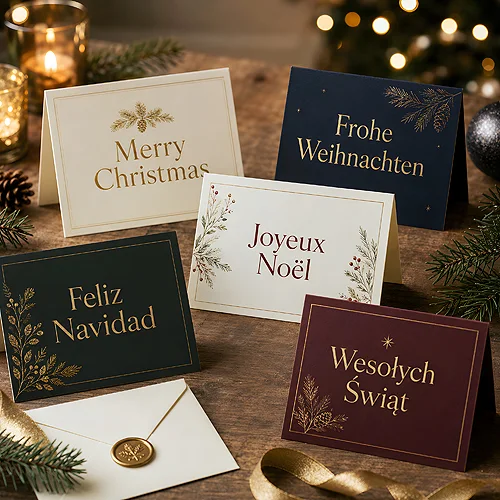
- Separate versions per market - Polish, German, Czech, English. It makes sense when a given country holds a group large enough to justify the effort and the relationships are close. The gesture is then genuinely noticeable.
A practical hint: you do not have to go for full localisation right away. If you have three key partners in Germany and single contacts elsewhere, it is more sensible to produce an English version for everyone and add a few handwritten words in German to those three cards. A handwritten note does more than a perfectly translated print.
What to write so it sounds natural everywhere
The wording is harder here than the design. Wishes that sound warm and natural in Polish can, translated word for word, come out stiff or oddly effusive. It pays to write short and concrete - the fewer flourishes, the fewer chances to stumble.
Christmas or the end of the year
Classic Christmas wishes are obvious in Poland, but they will not land on every contact list. A safer and perfectly natural alternative is New Year wishes or an "end of the year" formula - thanks for the past year of working together and a kind word for the next one. Such a card suits practically any recipient, and it does not read as an evasion, because thanking someone for their cooperation is always appropriate.
If you are looking for ready phrases to build your own from, take a look at our post on the best wording for corporate Christmas cards - many of those lines transfer easily into a neutral version.
Calendars and cultural sensitivity
It is worth remembering that holiday calendars differ. In some countries Christmas Eve matters most, elsewhere the day after Christmas, and elsewhere again New Year itself. This is not knowledge you need at your fingertips - one rule is enough: the more varied the recipient list, the more universal the wording. Instead of naming specific dates, write about a calm time, some rest and a good year ahead.
The same rule applies to the graphics. Symbols tied to one particular tradition are lovely, but they narrow the reception. A winter motif, geometry, a detail nodding to your industry, or simply an elegantly handled logo work everywhere. We cover the visual side more widely in our post on how to design an elegant Christmas card with a company logo.
Before you send the text to print, have it read by someone who uses that language every day - ideally your local representative or a partner from that country. One look from a person who feels the language will catch in a minute what no dictionary will. This is a task on your side, so plan a few days for it.
Two languages in one design
You do not always have to split the run. Very often two languages fit comfortably on one card, and that solution is simply more practical - one design, one run, no need to track which envelope gets which version.
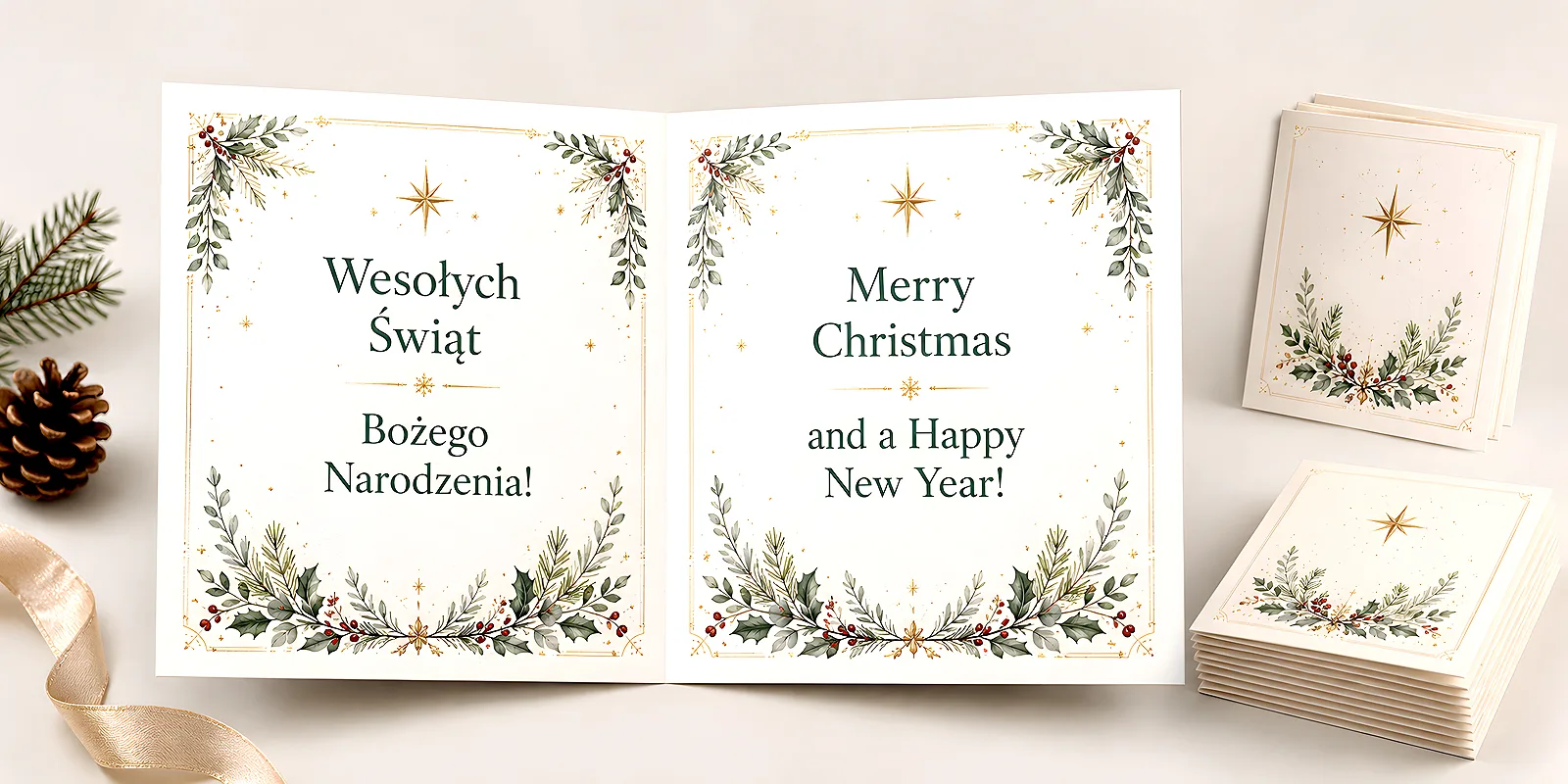
- A spread - in a folded card, the left page in Polish and the right in English. The reader sees both versions at once and picks their own.
- Double-sided print - one version on the front of the inside, the other on the back. Elegant and uncrowded, because each language gets a full page.
- Main version plus a smaller one - one language set larger as the main text, the other smaller underneath. This looks good when one version is clearly the lead.
- An insert - a separate slip with the translation tucked inside the card. It gives the most freedom, because the card design itself stays untouched.
With two texts on one page, watch the breathing room. A bilingual card densely packed with letters stops looking like wishes and starts looking like a memo. Better to cut the message to two sentences in each language than to cram in five.
The recipient's name
If you want to address the recipient by name, check in advance what form is customary in that country - somewhere the first name alone is natural, somewhere a title and surname. Leave the space for the recipient blank in the design and fill it in by hand. A handwritten signature under the wishes works equally well in every language, and it is the element that keeps the card from looking like a mass mailing.
A print file with text in a foreign language
This is where small mishaps happen most often, because foreign characters like to disappear along the way. A few simple habits solve the problem from the start.
- Convert the text to outlines - the safest method. Letters become shapes and no longer depend on whether a given font is installed anywhere.
- Or embed the fonts in the PDF - if you prefer to keep the text editable, make sure the export embeds full typefaces, not just a subset of characters.
- Check the diacritical marks - German umlauts, Czech carons, French accents, the Spanish tilde. Not every typeface carries a full character set, and a missing character can turn into an empty box or vanish without a trace.
- Preview it on another device - open the finished PDF on a second computer or a phone. If anything has shifted, you will see it immediately.
- Keep the bleed and margins - a longer text in a foreign language is often longer than the Polish original, so check that it still sits safely inside the frame.
The technical details, formats and how to prepare artwork so it goes to print without corrections are gathered in our file preparation section. If you have any doubt about a particular typeface or its characters, write to us - it is easier to check before printing than after.
Splitting the run and shipping abroad
When you decide on separate versions, split the run before you place the order. Count the recipients in each language, add a margin for slips of the pen while signing and for contacts that will come to mind at the last minute. A spare stack of cards always comes in handy, and it is better to have a dozen too many than to be one short for an important partner.
It is also worth deciding in advance how the versions will be marked during packing. The simplest way: separate boxes or coloured dividing slips. When signing several dozen cards it really is easy to slip up, and an English version in an envelope addressed to Prague is a small thing that still catches the eye.
International shipping is a chapter of its own. A parcel to another country takes longer than a domestic one, and December is the busiest month of the year for postal services and couriers. The practical rule is: send the international cards first and the domestic ones right after. We describe how to spread the whole process over time in our post on when to order Christmas cards to make the mailing on time, and we cover wording and sending more broadly in the post on Christmas cards for clients and employees.
A card in the recipient's own language is one of those gestures that cost little and are remembered for a long time. It is not about perfect localisation or a separate design for every market - it is about the person on the other side feeling that someone thought of them, rather than sending out one more item from a list. If you want to see what such a project can be built on, take a look at our range of Christmas and New Year cards and plan the versions calmly, well ahead of time.