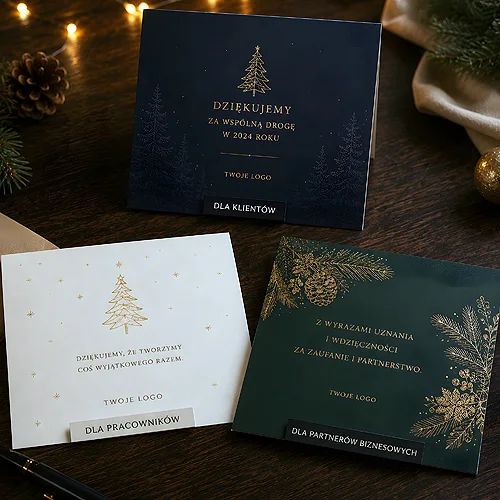
The same company Christmas card reaches a client and an employee - and each of them reads it in a completely different way. A client looks for a signal that the cooperation is appreciated. An employee - that someone noticed them as a person, not just as a job title. That is why one universal formula rarely works well for both. In this guide we show how to match the message, style and delivery so that every recipient feels the card was thought up just for them.
- Clients and partners - a professional, warm tone, with a subtle thank-you for the cooperation and elegant branding.
- Employees - a more personal, heartfelt tone, less corporate, appreciating the team and leaving room for a handwritten touch.
- Match the message to the relationship, avoid clichés, add personalisation - a name, a reference to something you share.
- A paper card sent by post or handed over in person makes a better impression than an email.
- Plan ahead - a recipient list, envelopes, addressing and a time buffer for printing and delivery.
First, a question: who are you writing to?
Before you settle on a single word, split your recipients into groups. A card to a client you speak with once a quarter sounds different from one to a colleague at the next desk.
The simplest, proven split is two worlds: business relationships on the outside and relationships inside the team. The point is not to print twenty different versions. The point is to decide, consciously, that the client gets a different tone than the employee - and to make that choice visible.
A card for clients and partners - professional, but warm
A client does not need effusiveness. They need a signal that their company matters to you, and that a year of cooperation is more than the sum of invoices. The tone should be elegant and calm, with a clear but unobtrusive thank-you.
A good business card says it briefly: thank you for being with us, and we look forward to another year. Instead of a generic "best wishes for the holidays", it is worth referring to something real - a shared project, a good year, trust. It is exactly that small, concrete detail that tells the recipient the card did not go out on autopilot to a contact database.
Visually, stick to your brand. Colours, logo, typography - everything should be consistent with what the client already knows from your materials. Keep the branding subtle: a logo in the corner, a muted palette, good paper. A card is not a flyer, so it should not shout an offer. If you want to make a truly good impression, go for a solid print and heavier paper stock - you can feel it from the first touch. You will find ready designs and paper types in our Christmas card offer.
If you have different client groups - long-standing partners, new contractors, VIP clients - consider two message variants on the same graphic design. The artwork stays consistent with the brand, and you tailor the wording to how close the relationship is.
A card for employees - more personal and heartfelt
Here the tone shifts. An employee is not a contractor - they are a person the company spends most of the year with. A card for the team can be warmer, less corporate, closer to the way you actually talk to each other day to day.
Instead of a corporate formula, go for a simple, human thank-you: for the commitment, for the harder months, for being someone others could count on. It is worth appreciating the team as a whole, and if the company is small - adding even a sentence aimed at a specific person. Nothing works like a line written by hand under the printed text. A handwritten signature or a short note in pen turns a mass-produced card into a personal gesture.
The visual style can be the same as in the client version or slightly different - warmer, less formal. Many companies make one design "for everyone", but separate variants for clients and the team are not a whim. They are a signal that you think about these groups separately, and each of them feels it.
A message that does not sound like an autoresponder
The most common mistake in company wishes is clichés. "Merry Christmas and a happy new year" read for the hundredth time no longer means anything. A few simple rules save the message from that trap:
- Personalise. The recipient's name at the start changes everything. "Dear Mark" reads differently than "Dear Sir or Madam".
- Refer to the relationship. One sentence about the shared year, project or cooperation makes the card about the two of you, not about the holidays in general.
- Write like a human. Short, warm, without stiff corporate language. A card takes a few seconds to read - let those seconds be pleasant.
- Mind neutrality. If your recipients differ in worldview or culture, it is safer to wish peaceful holidays and a good new year than to lean on a strongly religious accent.
If you are looking for specific phrasing and ready proposals, we gathered them in a separate piece on the best wishes for company Christmas cards.
Delivery - paper beats email
You can send the most beautiful wishes by email and they will vanish in the inbox among dozens of others. A paper card works differently - you have to pick it up, open the envelope, read it. That physical gesture makes it stick in memory, and often on a desk or windowsill until the holidays are over.
You have several good routes to reach people:
- By post. A classic that still makes the best impression on clients and partners. Take care of elegant envelopes and clear addressing - ideally with the recipient's first and last name, not just the company name.
- In person. If you meet a client or the team before the holidays, handing over a card yourself is the warmest possible form.
- With a gift. A card added to a holiday parcel or a small present rounds out the whole thing and gives it a personal character.
Whatever you choose, get the logistics right. Well-chosen envelopes, correctly written addresses and a recipient list with no gaps are the things that decide whether the card arrives on time and in good shape. If you are not sure how best to organise printing and delivery for a larger batch, just take a look at KartkiDlaFirm.pl - there you will choose the design, paper and print run.
Prepare a recipient list split into groups before you order the print. Right away you know how many cards of each variant you need, how to address the envelopes and whether you have missed anyone. That single table saves a lot of nerves in December.
Planning - the key to peaceful holidays
Christmas cards are the kind of task that is easy to put off - and that later usually turns out painfully too late. December is a busy time at print shops and post offices, so a time buffer is your ally.
A sensible rhythm looks like this: first set the recipient list and the group split, then refine the message and design, then order the print with a margin, and finally plan the delivery so the cards arrive before the holidays, not at the last minute. The sooner you start, the more room you have for good decisions - better paper, more careful wording, calm addressing.
It is an effort that pays off. A well-thought-out card builds relationships with clients, strengthens partner loyalty and improves the atmosphere in the team. It is a small gesture, yet it can stay in memory long after the tree is gone.
Summary
The secret of a good company Christmas card does not lie in a fancy design or flowery wishes. It lies in matching it to the relationship - you speak differently to a client than to an employee, and you give each of them the feeling that you thought about them separately. Add a paper form, a touch of personalisation and solid planning, and your wishes will truly build something that lasts longer than the holidays. When you are ready, take a look at our Christmas card offer - and if you want to understand why this tradition works so well, read also how company Christmas cards build relationships.