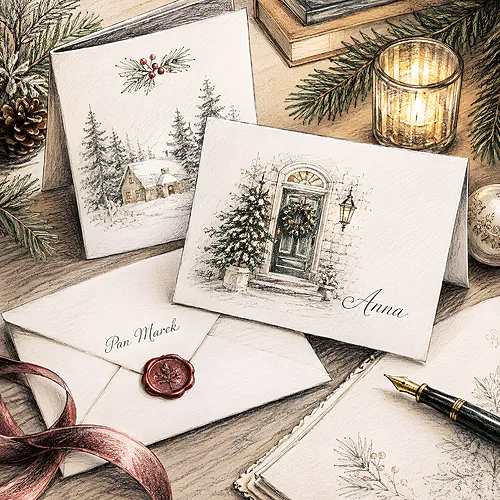
There are years a company remembers for a long time. Twenty years in business. The move into your own premises after years of renting. The first product line of your own. Or a year that simply had to be survived - and that the company survived, together with the people and clients who stayed. The Christmas card sent at the end of December is the one moment in the year when you can mention it naturally, warmly and without any strain.
There is only one trap: it is easy to overdo it. A card that turns into a summary of achievements stops being a set of wishes and becomes an information sheet with a picture of a tree on it. Below we show how to weave your company's story into a card so the recipient feels part of it, rather than the addressee of a report.
- An anniversary or a landmark year only needs one sentence within the wishes - the rest of the work belongs to the graphics.
- A number of years, a date or a discreet visual motif say more than a paragraph about successes.
- Good motif ideas: a timeline, an illustration of the new premises, a detail from production, the old and new logo side by side.
- A keepsake version gains from a heavier board, decorative paper, matt film or Soft Touch velvet lamination.
- If the story is genuinely big, split it up: a separate anniversary card in spring and an ordinary Christmas card in December.
Why the end of the year is a good moment
A December card has one advantage over any other form of communication: nobody treats it as advertising. The recipient opens the envelope with no expectations, in a calmer week than usual, and is willing to read a few sentences about the company that sent it. That is a rare situation and it would be a shame to waste it.
Second, the end of the year invites summing up anyway, so mentioning an anniversary or a move does not look like boasting - it looks like a natural part of the conversation. You write about what happened because you are closing the year, just as a friend would in a letter. You will find more on why this tradition works so well in business relationships in our post on corporate Christmas cards as a tradition that builds relationships.
One sentence instead of a paragraph
This is the single most important rule here. Your company's story should fit into one sentence woven into the wishes. Not three paragraphs, not a bulleted list of achievements, not a thank-you that drifts into a description of the new warehouse.
See how little it takes:
- Anniversary: "This year marked twenty years since we started - thank you for being with us along the way."
- New premises: "We spent this year at a new address and finally have the room to do more."
- New product line: "This was a year of launches for us - thank you for your trust with every one of them."
- A hard year: "The year was not an easy one, which makes it all the more valuable that we got through it together."
Each of these sentences says everything it needs to and takes no room away from the wishes. The rest - the emotion, the context, the weight of the event - can travel through graphics, which need no words at all. If you are looking for a starting point for the wording itself, take a look at our post on how to stand out with New Year cards and business wishes.
Write the full version first - everything you want to say, with no limits. Then keep cutting until one sentence remains. Whatever survives the cutting is usually exactly what is worth printing. The rest makes a fine separate post or an email in January.
Ideas for a visual motif
Graphics are where a company's story can come through without a single sentence. A few solutions work particularly well.
The number of years as a design element
The simplest and surprisingly powerful. A large, elegantly handled number of years woven into the composition - not as a stamp stuck in the corner, but as a deliberate part of the whole. You can set it against the founding year and the current one, or treat it typographically as the card's main motif. No words, full message.
A timeline
A delicate line with a few points: the starting year, a handful of key moments, today. It looks great in a folded card, across the spread, where the timeline has room to breathe. What matters is having a few points rather than a dozen - this should be a rhythm, not a chart.
An illustration of the new premises
A drawing of the building, the workshop or the new office in a simple, single-colour line looks far better than a photograph. An illustration carries a warmth that a photo of a facade usually lacks, and it is easier to match to your brand colours.
A detail from production
A close-up of a material texture, the shape of a tool, a part of a product - something people in your industry will recognise and everyone else will read as a nice pattern. This one is for companies that want to show who they are without saying it outright.
Whatever motif you choose, keep an eye on the balance between the story and the logo. We write more about placing your brand mark so the card still reads as wishes in our post on how to design an elegant Christmas card with a company logo.
The keepsake version - paper and finish
A card meant to be a keepsake should feel different from an ordinary one. That is the one signal content cannot fake: a person picks it up and immediately senses this is not a standard mailing.
- Heavier board - the simplest and most noticeable change. A stiff card sits differently in the hand and does not curl over time.
- Decorative or eco paper - texture under the fingers does its job before the recipient reads a word. Paper with a visible structure suits an anniversary character well.
- Matt film - it gives deep, calm colour and a surface that is pleasant to touch. Soft Touch velvet film goes a step further and stays in the memory.
- A folded card - more room for the anniversary motif and for the wishes, and the form itself sets it apart from a standard mailing.
- A custom shape from a cutting die - if the motif calls for it, a cut-out can turn a card into an object nobody wants to throw away.
When choosing the stock, it is worth checking how different papers behave with your design - a dark background looks one way on smooth board and another on a textured sheet. We have gathered an overview of the available options in our materials and papers section.
Copies for the company archive
This is almost always forgotten in December and regretted three years later. When ordering the run, add a dozen or so copies beyond the mailing list and set them aside straight away, before the signing starts. It is the cheapest way to build a company archive.
- A few blank copies - no signatures, no address, for the archive and for future materials.
- One signed by the team - with signatures from everyone who worked at the company that year. In ten years it will be priceless.
- A few for photos - to use on the website, on social media or at the next anniversary.
- A spare stack for late additions - there is always someone who was not on the list and should have been.
If you also think of the card in terms of brand presence rather than only as a keepsake, take a look at our post on Christmas cards as a subtle advertising tool - several tips there combine beautifully with an anniversary motif.
When it is better to separate the two occasions
Not every story fits into a Christmas card, and sometimes it is more honest to admit it. There are situations where two separate mailings work far better than one trying to cover everything.
- The anniversary falls in another month - if the round anniversary lands in May, send the anniversary card in May. December can then carry an ordinary, warm thank-you for the year.
- The story is too big - a move, a new product line and an anniversary in one year is too much for one card. Pick one thing and leave the rest for other occasions.
- The recipients differ - not every client knows who you were ten years ago. An anniversary story lands best with those who remember the beginnings.
- The card would lose its character - if adding the story leaves no room for the wishes, that is a sign you need two separate things.
Splitting them has one more advantage: an anniversary card sent outside the season reaches the recipient when their post is not crammed with correspondence from everyone at once. It then has far more space to be noticed.
A card that carries a piece of a company's history has a chance to outlast the season - it ends up on a shelf, in a folder or on an office wall. All it takes is one sentence, one good motif and paper that says by itself this is not an ordinary mailing. If you want to see what such a project can be built on, take a look at our range of Christmas and New Year cards and plan the anniversary version calmly, well ahead of time.