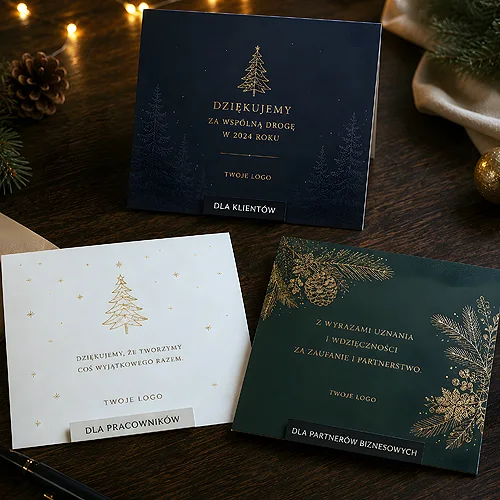
There is a difference between a card that starts with "Dear Sir or Madam" and one that carries your name. The first is nice. The second makes you feel, for a second, that someone thought of you in particular. That second is the whole secret of personalisation - and the reason it is worth considering as you plan company Christmas cards.
Printing the recipient's name or their company name sounds like a trifle, but it can change how a whole mailing is received. It does not always make sense to do it across the entire list at once, though. Below we suggest when personalisation genuinely pays off, how it works technically, where the limit of profitability lies, and what to watch out for so that a kind gesture does not turn into a slip-up with a wrongly inflected name.
- A printed name or company name turn a mass mailing into a gesture aimed at a specific person.
- Personalisation works most strongly with key clients and partners, and with smaller runs.
- Variable data printing lets you print many versions from one design, each with a different name.
- A handwritten signature is a simple alternative that adds a personal accent without variable data printing.
- Data accuracy, including name inflection, is crucial - an error ruins the whole effect.
What a printed recipient's name gives you
Personalisation works because it changes the relationship between sender and recipient. A card with a name stops being one of many - it becomes proof that someone spent a moment on this particular recipient. In business relationships, where an impression of mass production comes easily, such a gesture stands out and stays in the memory. Company Christmas cards have long been a tradition that builds relationships, and an added name only reinforces that effect.
There is also the image aspect. A card that can act as a subtle advertising tool does so even more gently with the recipient's name - because instead of talking about itself, it addresses the other side directly. This is personalisation in the service of a relationship, not self-promotion.
When personalisation pays off
A name on every card sounds lovely, but it is not always worth it. There are situations where the return on this effort is clear, and ones where it is better to stay with a shared version.
Key clients and partners
This is the first and most important group. The recipients you truly care about will appreciate a personal accent the most, and there are few enough of them that each card can be looked after. Here personalisation almost always pays off - also because it fits into building a long-term relationship.
Smaller runs
The shorter the list, the easier personalisation is and the more sense it makes. With a few dozen cards, adding names is realistic to manage, and the difference in reception is large. With very big mailings it is better to personalise a chosen segment of recipients rather than everyone at once.
Building relationships
Personalisation pays off wherever a card is meant to build something, not just tick off a formality. If you want the wishes to genuinely set your company apart, the recipient's name is one of the simplest ways to achieve it.
How variable data printing works
Technically, personalisation relies on variable data printing - and it is simpler than it sounds. The card design stays as one, and only the indicated field changes, for example the name or the company name. A ready list of recipients is supplied for printing, and each copy comes out with the right entry. This way one design yields many personalised versions without designing each separately.
It is the same logic we describe with personalised invitations for every guest - a specific element changes, the rest stays constant. Only one thing is crucial: the quality of the effect depends directly on the quality of the list you prepare. A clean, correct list means calm printing; a list with errors means errors multiplied on every card.
Effect versus workload
Personalisation is always a balance - a stronger effect on one side, more preparation on the other. The most work is taken not by the printing itself, but by gathering and tidying the data: names, company names, correct spelling. That is why it is worth assessing in advance for whom this effort will pay off.
You do not have to personalise the whole list. Split recipients into two groups: the key ones, who get a card with a name, and the rest, who receive a shared version on the same design. That way you combine a strong effect where it counts with a reasonable workload.
A handwritten signature as an alternative
If variable data printing feels like too big an undertaking for this year, there is a simpler route to the same goal - a handwritten signature or a short, handwritten dedication. A few words written by pen sometimes mean more than the best-set text, because they show a real gesture rather than an automated one.
This solution works brilliantly with key recipients: a shared, well-designed blank and the personal signature of a decision-maker. It can also be combined with print - a printed name in the text and a handwritten signature under the wishes give an effect that is hard to beat.
Data accuracy - inflection of names
Here lies the biggest trap of personalisation: a name entered or inflected incorrectly can spoil the whole gesture. A card that was meant to show you thought of the recipient shows the opposite after an error in the surname. That is why the data must be treated as seriously as the design.
A few rules that guard against a slip-up:
- Check the spelling at the source - take names and company names from a reliable list, not from memory.
- Watch the inflection - if a wish reads, for example, "Dear...", the name must be in the correct form. Sometimes it is simpler to phrase the text so the name appears in the nominative.
- Unify the form - decide whether you address people by first name or formally, and keep to that across the whole list.
- Review the list at the end - one review of the whole before printing catches typos that would otherwise land on every copy.
Ready-made company Christmas cards pair one coherent design well with room for such personalised data. If you want to keep the relationship going beyond the holidays, it is worth thinking about client cards, which remind people of the company all year round.
Printing the recipient's name is not a gimmick - it is a simple way to make a company card stop being a mass mailing and become a gesture aimed at a specific person. It pays off most where the relationship matters and the list is short enough to be looked after. Choose who you want to single out, prepare clean and correct data, and a good design will do the rest - or your own signature under the wishes.