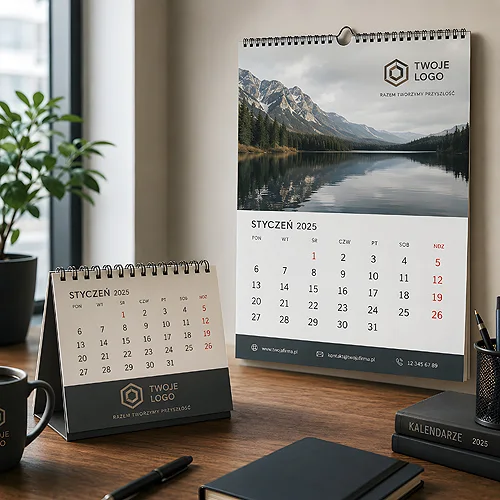
The first phone call about calendars usually sounds like this: we would like a hundred three-month wall calendars with our logo on them. It sounds like a single order, and it is in fact several, because a three-month calendar is not one product but a set of parts chosen separately.
None of this is complicated, on one condition: that you find out about it earlier than November. By then every decision is a decision made under pressure, and the calendar stays with the recipient for a whole year. It is the longest working piece of printed advertising you can order.
Below we take the three-month calendar apart and explain what goes with what.
- Three elements - the advertising header, three calendar blocks and the backer that everything sits on.
- The header is the only purely advertising surface and the only part you design from scratch.
- Two PLANO header sizes - 350 × 305 and 395 × 305 mm, printed on one side.
- Header paper - coated 250 g or Arktika 230 g; gloss or matt film on one side is optional.
- Pyramid backers are a separate item in two variants, on Arktika 300 g board, with one-sided film as standard.
- The season runs from October to December, so the artwork is best finished before it starts.
What a three-month calendar is made of
The name refers to three calendar blocks arranged one below another: the previous month, the current one and the next. That layout is practical, because it lets you plan without turning pages, and it is exactly why this calendar hangs in offices, workshops and reception areas.
Above the blocks sits the header, a horizontal rectangle carrying the advertising artwork. Underneath and around the blocks runs the backer, the stiff base that holds everything together and hangs on the wall. A small sliding window marking the current week completes the set.
Besides three-month calendars our range also includes single-block backers and backers for desk pyramids. A complete calendar with a date grid is made to order and quoted individually. If you are still choosing a type, start with our post on which company calendar to choose, and the whole range is waiting in the calendars section.
The header, the only purely advertising surface
The calendar blocks are the same for everybody, because they are a grid of dates. The backer holds the structure together. Your entire brand has to fit on the header, and that is the part hanging on a wall for twelve months.
This changes the way you design more than you might expect. Nobody looks at a header from thirty centimetres away the way they look at a leaflet. They look at it from the far side of the room, while checking a date. From two metres away a logo and one message are visible: not a paragraph, not a list of services, not three telephone numbers.
In practice this means a large, legible logo, one sentence or slogan, one way of getting in touch. If you really must add an address and a website, set them in small type along the bottom, where they do not compete with the rest.
Two header sizes
Headers come in two PLANO sizes: 350 × 305 mm and 395 × 305 mm. The difference is in the width, so the wider one gives more horizontal room: for a longer name, a panoramic photograph, a logo standing beside a slogan. The narrower one is calmer and looks better with sparing artwork. Printing is one-sided, since only the front is ever seen. You will find the details and the calculator on the calendar headers page.
Coated paper or Arktika
There are two papers to choose from: coated 250 g and Arktika 230 g. Coated paper has a smoother, more closed surface. Colours come out saturated on it and a photograph looks sharp and full of contrast. That is the choice for headers built around an image: a landscape, a product, an interior.
Arktika is a decorative board with a more restrained character. Colours settle into it more quietly and the whole thing reads as elegant rather than loud. It works for headers built on typography, a single background colour and a logo, which is the case for a law firm, a consulting room or an advisory business.
Film on one side, and what it is for on something that hangs for a year
The header can be covered with gloss or matt film on one side. It is an option rather than a requirement, but it is worth knowing what it gives you.
Film is a thin protective layer over the printed side. On a calendar hanging for twelve months it guards mainly against rubbing and grubby marks, and on photographs it adds depth. Gloss lifts saturation and suits photography. Matt kills reflections, so the header stays readable even when it hangs opposite a window or a lamp.
Before choosing a finish, ask where the calendar will hang. In a bright office with large windows matt is the safer answer, because a glossy surface can reflect the window exactly where the logo sits. In a darker workshop or warehouse gloss gives the artwork more life.
Pyramid backers, a separate item
The pyramid is a completely different calendar: it does not hang on a wall but stands on a desk as a triangular holder. Its backers are a separate item and come in two variants: 2 × 145 × 120 mm in the small version and 2 × 200 × 120 mm in the standard one. They are printed on Arktika 300 g board.
Here one-sided film is not an option but a standard, and there is a concrete reason for it. A pyramid stands on a desk, so it gets touched, pushed around and occasionally soaked in coffee. The film stiffens the board and makes the surface wipeable. Gloss, matt and Soft Touch, the velvety finish, are all available. We describe the variants on the pyramid backers page.
The season: October to December
The calendar season runs from October to December, and that is where the whole difficulty of this product lies. Everybody orders at the same moment, while the header artwork calls for decisions that cannot be taken in five minutes: which photograph, which slogan, which paper.
It pays, then, to separate two things: preparing the artwork and placing the order. The order of work that tends to succeed:
- Decide on the type of calendar - three-month or single-block for the wall, a pyramid for the desk. That settles which parts you are ordering.
- Choose the header size - narrower or wider, depending on how much content and what kind of artwork you want to use.
- Match the paper to the artwork, not the other way round: a photograph asks for coated stock, typography for Arktika.
- Prepare the file with bleed, meaning three extra millimetres of artwork beyond the trim, which the blade cuts away.
- Draw up the list of recipients and only then the quantity. Calendars are handed over by name, so the number follows the list rather than a hunch.
That last point tends to be skipped, and it is the easiest one to handle in summer, when nobody is thinking about December yet.
The calendar as a gift
A calendar differs from other company gifts in one respect: it does not end up in a drawer, because it has a function the recipient uses every day. It hangs where the work happens and quietly reminds people all year who gave it. We wrote about that difference in our piece on making a company gift that survives, and more broadly about the end of the year in our post on end of year company gifts.
There is one condition, and it comes back in every decision above: the header has to look good even to somebody who is only checking a date. It is the one piece of advertising a recipient hangs on their own wall. It would be a shame to waste it on a paragraph nobody will read.