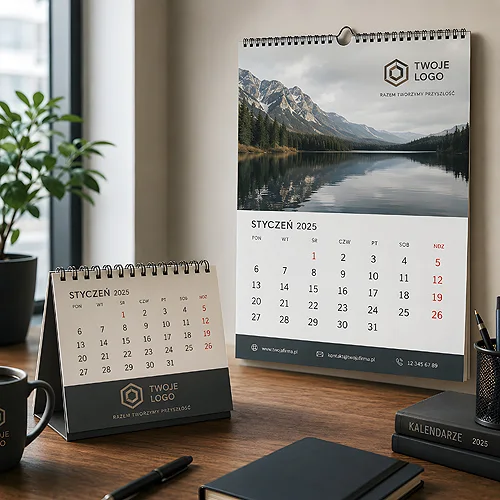
A good company calendar is one of the few gifts that stays with the recipient for twelve straight months. It hangs on an office wall or sits on a desk and, day after day, quietly reminds people of your brand. It is advertising you pay for once, yet it works all through 2026 - as long as you match the type and the quality to the audience.
- A company calendar acts like advertising present at your client all year - so it pays to match the type to the recipient.
- Wall and tri-fold calendars work in offices and receptions; book and desk formats fit daily work.
- Personalisation and brand consistency (logo, colours, photos) make the difference - the calendar should look like part of the company, not a promo insert.
- Autumn is the best time to order - you get room for design, print and delivery before the year ends.
Why a calendar is year-round marketing
Most promotional materials have a short life. A flyer gets a single glance, a banner is passed in a hurry, an email ends up archived. A calendar is different - the recipient chooses a place for it, looks at it every day and treats it as a tool rather than an ad. It is a rare case where a client happily keeps your logo in plain sight.
That presence has a value you cannot buy with a one-off campaign. For a full year your brand sits in the background of everyday decisions - planning meetings, noting deadlines, checking dates. That is why a calendar deserves to be treated as an investment, not a gadget from the tail end of the budget.
There is a purely practical angle too. A client who has your calendar at hand also has your contact details at hand. When the moment of decision comes - something to order, a question to ask, a cooperation to extend - your company is one glance at the wall closer than a competitor who only shows up on special occasions. It is a subtle but real advantage.
A calendar is the only advertising medium the recipient looks after all year - because they actually need it for something.
Wall calendar - a classic that always fits
The wall calendar is the most recognisable format and a safe choice when you do not know what the recipient prefers. It hangs in offices, kitchens, workshops or receptions - anywhere people need a quick glance at dates. The large surface also leaves room for striking graphics and photos.
Single-sheet
The whole year on one plane. It works where a bird's-eye view of planning matters - in design studios, production plants, shift work. The downside: little space to jot notes by a given day, since twelve months share one sheet.
Multi-sheet
A separate sheet for each month (or two), often with a large photo at the top. This format suits companies that want to show their projects, products or simply attractive shots from their field. Each month reveals a new image - and a new touchpoint with the brand.
If you care about the visual effect, go for a multi-sheet calendar with strong photos. Good shots can make the recipient keep the calendar on the wall because they like it - not only because it is useful.
Tri-fold calendar - the office standard with room for a logo
The tri-fold shows three month blocks stacked one below another: previous, current and next. You see the context of three months at once, which makes planning much easier. It is the favourite format of offices, secretariats and receptions - it hangs in view and works in everyday tasks.
For a company its strength is the wide advertising area at the top (the header) and around the date window. There you have space for your logo, contact details and brand colours, visible all year rather than only in the current month. It is a practical medium for B2B brands.
Book calendar and planner - for those who plan seriously
The book calendar (also called a manager's calendar) is a format for people who really keep a diary: sales reps, managers, business owners. It sits on the desk, travels to meetings, accompanies daily work - and elegantly presents a logo on the cover.
Planners and weekly calendars go a step further: they give plenty of room for notes, to-do lists and weekly planning. That makes a good gift for clients who value order and clarity. A nice finish and personalisation mean such a present does not land in a drawer, but stays on top.
A book calendar is a premium gift - it works well for a narrower, important group of recipients (key clients, partners). For a mass mailing, wall or tri-fold formats will serve you better.
Desk and poster calendars - for special tasks
Desk (pyramid, standing)
Small, it stands on the desk right in front of the recipient. Pyramid and standing formats are great for a short slogan, contact details or a mini campaign spread across the months. It is a discreet medium that is constantly in view - ideal as an add-on to a larger gift.
Poster calendar
A large, vertical wall calendar held together by a strip. It works well where you need an overview of the whole year on a big surface: in workshops, warehouses, on production floors, in open-plan offices. It makes an impression with its size and leaves plenty of room for graphics.
Personalisation, paper and brand consistency
The type is only half the success - the rest is execution. A company calendar should look like an extension of your brand, not a template with a logo glued on. Keep your brand colours, use good-quality photos and mind clear, consistent typography. If you have a product shoot or project photos, that is excellent material for the sheets.
Paper matters more than it seems. A thicker, well-finished sheet instantly raises the sense of quality and makes the calendar feel like something worthwhile. It is worth discussing the paper type and finishes at the design stage - we cover material choice in more detail in the section on materials and papers. With us you can print the calendar components: calendar headers, single and three-month backing boards and pyramid calendar backs. Finished book calendars, planners and poster calendars are not part of our range.
Preparing the artwork without mistakes
Calendars invite small slip-ups: a logo clipped at the edge, text too close to the cut, photos with too low a resolution. Before you send the file to print, look through our file preparation guide - a few minutes that save reprints. If you have doubts about the format or the design, simply get in touch and we will advise.
Why autumn is the best moment
Calendars follow their own rhythm - the closer to December, the more traffic there is in print and logistics. By ordering in autumn you get calm time to refine the design, choose the paper and run a proof, and then to ship so the calendar reaches the client before the new year. Left to the last minute, it turns into a race against the clock.
An early start also leaves room for something easy to overlook: thinking through the content. Photos need to be chosen or produced, slogans and contact details checked, and the recipient list updated. When you do this without pressure, the calendar comes out coherent and polished, not thrown together in a hurry from whatever happened to be at hand.
It is also worth thinking of the calendar as part of a wider end-of-year plan - alongside cards and other gifts. How to arrange it all without stress, we described in the piece on planning Christmas printing in Q4, and about the gifts themselves - in the guide to end-of-year company gifts that build relationships.
Which type to choose - a quick cheat sheet
- Wide reach, office, reception - wall or tri-fold.
- Visual effect, showing projects - multi-sheet wall.
- Premium clients and partners - book or planner.
- Add-on to a bigger gift, little space - desk.
- Large space, overview of the whole year - poster.
There is no single best calendar - there is the one that fits your recipient and the way they work. Choose the type sensibly, keep it consistent with your brand and start in autumn, and your company will comfortably check in with clients for the whole of 2026.