You know that feeling when you get a corporate gift and instantly know it will end up in a drawer? We want your gifts to do the opposite - to make the client keep them, use them and think well of the company along the way. The good news is that it is not a matter of luck, but of a few simple decisions. In this post we show, in plain words, what makes a corporate gift stay around and how to prepare one step by step.
- Usefulness matters most - a thing used daily advertises the company every time it is picked up.
- Quality builds the impression: a solid gift speaks well of the brand, junk does the opposite.
- Match the gift to the recipient and go for subtle branding instead of a huge logo.
- Nice packaging and a personal touch turn an item into a real gesture.
Start with usefulness
The simplest way to keep a gift out of a drawer is to give something the recipient truly uses. A useful object stays in the daily rhythm - it sits on the desk, travels to the bag, is close at hand. And every time the client reaches for it, it quietly reminds them of your company.
So before choosing a gift, it is worth asking one question: will they use it? If the answer is yes, you are on the right track. If you can already picture the thing landing in a corner, better skip it - even a flashy item with no use quickly vanishes from sight and memory.
Proven directions are objects that fit daily work and small pleasures. A good Cosmo engraved pen, a practical Twister logo pen drive or a solid calendar are things the recipient reaches for on their own - and that is exactly why they work for the brand for weeks.
Before you order anything, picture the object on the client's desk a month from now. If you can easily see it there in use - it is a good choice. If you have to work hard to imagine it there, it will probably reach a drawer sooner than daily life.
Go for quality and good workmanship
A gift is read like the company's calling card. A solid, well-made thing says without words that you care about details and take the recipient seriously. Junk that breaks after a week sends the opposite message - and the client transfers that impression to the whole brand.
So it is better to order fewer pieces, but solid ones, than a pile of trinkets that fall apart fast. A gift that feels good in the hand, looks nice and serves long builds exactly the association you want. Quality here is not a whim - it is part of how the company is remembered.
A calendar is a good example of a thing where workmanship shows at once. Solid, tasteful calendar backboards with a printed header stay with the recipient all year on the wall and remind them of the firm daily - as long as they are made so the calendar is worth hanging at all.
Match the gift to the recipient
The same gift can be a bullseye for one person and a complete miss for another. So it is worth thinking about who will receive it and what they will really find useful, instead of ordering one thing for everyone without a second thought.
You will choose differently for a regular, key client and differently for a small gift handed out more widely. For important relationships a higher-shelf item makes sense - one that impresses and shows you care about that particular person. For a wider group, cheap and useful things that everyone happily takes will work better.
It is also worth considering the recipient's character and work. A gift that fits what someone does lands right away - because it shows attention, not chance. It is this fit that makes a gift feel like a gesture, not automated handing-out.
The best gift is not the most expensive one, but the one in which the recipient feels they were the one being thought of. Attention costs less than a big budget and stays in memory longer.
Subtle branding instead of a huge logo
Instinct says to make the logo as big as possible - it is advertising, after all. In practice, though, a huge mark across the whole surface makes the gift look like a flyer, not a present. And a thing that shouts advertising ends up in a drawer more often than on display.
Subtle branding works much better. A discreet, well-placed logo keeps the object nice and worth using, and the brand is present anyway. The recipient then treats it as their own thing, not as an advertising carrier - and that is exactly why it stays with them longer.
The rule is simple: the mark should be visible but not dominant. The goal is elegance that carries the brand along the way, not advertising that happens to be useful. The more naturally the logo fits the object, the more willingly someone keeps it.
Test the design simply: would you keep this thing if it were not your company? If the logo is so big that you would hesitate yourself, the recipient probably will too. A gentler mark almost always wins, because it lets the object simply look good.
Packaging and a personal touch
The last step often decides the whole impression, yet it is easy to skip. Even a good gift given carelessly loses half its power, while the same object in nice packaging instantly looks like a thoughtful gesture. The moment of unwrapping is part of the pleasure - it is worth caring about.
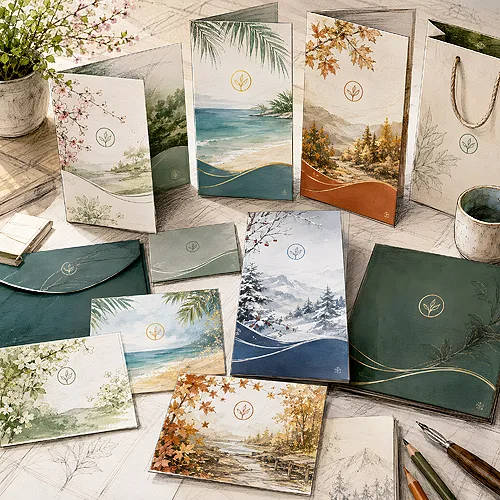
It is not about luxury, but about neatness and consistency. A tasteful box, paper in company colours or a simple wrap make the gift a good first impression before the recipient even sees what is inside. It is a sign that you put a bit of attention into it.
The finishing touch is a personal accent - a short handwritten note or a named card. A few warm words turn a standard item into a gift aimed at a particular person. We write more about how gifts build relationships over time in the post on corporate gifts at the end of the year that build relationships. And when you pick specific things, the post on how to choose promotional items your clients will actually use will help - and you can calmly place an order in the pens, USB drives and lighters sections.