A gift set either looks considered or looks thrown together in a hurry - and the difference rarely comes from how much the individual items cost. It comes from whether someone thought about them together. Three objects dropped into a box are a parcel. The same three objects arranged in a chosen order, in packaging cut to fit them, are a gift.
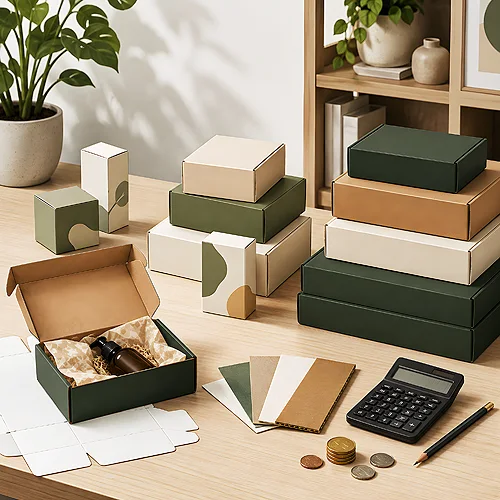
The good news for small brands and companies is that you no longer need to order hundreds of boxes at once. Flatbed plotter cutting produces packaging matched to specific contents without making a cutting die, so a set for thirty people is just as realistic as a run of three hundred. That leaves the most interesting part of the job: putting the set together so that it holds as a whole.
- A set is held together by one idea - an occasion, a story or a moment of use, not just a logo on the lid.
- Give the elements roles: a hero, one or two companions, a small thing to take away.
- Plan the interior together with the contents - the insert and the order of layers decide the first impression.
- Build variants on a shared box construction, changing the filling and the labelling, not the shape.
- Before ordering the run, assemble one set physically - it catches more than any preview on screen.
The idea first, the shopping second
The most common mistake when putting a set together is starting from a list of items. What comes out is a collection of things linked mainly by the fact that they happened to be at hand. Start with a sentence describing the whole: this is a set for the first day in a new job, this is a set for a quiet evening with good coffee, this is a set for a client who has just signed. Only from such a sentence does it follow what belongs inside.
The idea also works the other way round - it tells you what to leave out. If the set is meant to be evening and calming, an energising gadget will jar in it, however good it is on its own. We write more about building a coherent look for such a set in our post on how to design a corporate gift set.
Roles instead of a shopping list
Once the idea is ready, assign roles to the elements. It is a simple way to avoid a set in which everything shouts equally loudly.
- The hero - the one item the whole set exists for. It should be visible the moment the box is opened.
- The companions - one or two elements that complement the hero or let it be used straight away. They do not compete with it visually.
- Something to take away - a small thing that stays with the recipient longer: a sticker, a tag, a card with a code.
- An informative element - a short card listing the contents or a few sentences about where the set came from.
A common denominator
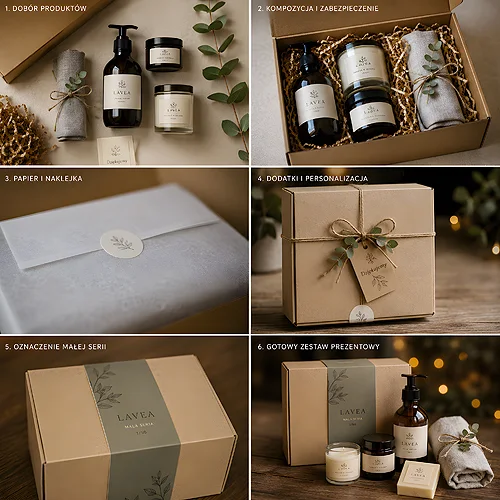
The elements need not come from one product family, but something has to link them visually. The easiest options are a shared colour, a recurring texture or one material appearing in several places. If the items inside differ a lot, the wrapping takes over as the connector: the same closing stickers, matching tags on every piece, the same tissue paper. Four small things tied with one ribbon and labelled in one style read as a set. The simplest way is to use round stickers in a single design - the same disc looks right on a box and on a pouch alike.
When a set looks accidental
The signals repeat themselves. All the elements are of similar size, so the eye does not know where to settle. The logo appears on every item separately, which makes the whole thing look like a display of company gadgets. The box is clearly too big and the contents shift when it is shaken. Each of these is fixed at the planning stage, not after the parcel arrives.
The interior, or directing the opening
Short-run packaging has the advantage of being made for specific contents - the dimensions come from the things that have to fit inside, not from a ready catalogue of formats. It is worth using that and planning the interior like a stage.
- The first layer - what you see once the lid is off: a welcome card or the hero of the set. This view ends up in the photos taken by the recipient.
- The second layer - the rest of the contents, revealed after the first element is taken out. A good place for the extras.
- Stabilisation - dividers, cut-out seats or filling. Things should not move around in transit.
- A margin of space - a few millimetres of slack, because items rarely have perfect catalogue dimensions.
If you want the box to stay with the recipient longer, plan for it from the start - a sturdier closure and a clean print inside make a difference. We develop that thread in our post on reusable packaging. Constructions and variants are waiting in the packaging category, and the smaller elements of a set are often conveniently dressed in a sleeve.
Before ordering the run, build a mock-up: take the real items, arrange them on a table in the intended layout and draw around them. The interior dimension comes from that outline, not the other way round. You will also see at once whether the set can be closed with one hand and whether it is too heavy to carry comfortably.
Several variants without multiplying the work
One set is rarely enough. Usually you need a simpler and a richer version, one for clients and a separate one for the team, or themed variants. You do not have to design several different boxes for that.
The simpler route is one construction and one box format, with the contents and labelling as the variables. The same carton with a different insert and a different label reads as a separate product, while production stays a single order. Just make sure the variants can be told apart without opening the box - a different label colour or a clear variant name on the lid is enough.
Assembling step by step
Producing the packaging is one thing, assembling several dozen sets is another. This part usually takes more time than expected.
- Set the list and the count - the contents of one set times the number of recipients, plus a few spares for damage.
- Order first what takes longest to arrive - the remaining elements usually come in faster.
- Assemble a reference set - photograph the interior layout. When several people are packing, that is the only way to keep every set looking the same.
- Weigh the finished set - weight and dimensions translate into how it ships, so it is better to know them before ordering the whole run.
- Pack in batches - all the inserts first, then the main elements, and the cards and closures last.
If the set is going to new clients or employees, take a look at our post on the corporate welcome set - it suggests what really earns its place in such a package.
Choose the material last
The substrate and the finish are the last decision, not the first - they follow from what goes inside. Heavier contents need a stiffer construction, delicate ones need padding, and cosmetics or candles sit better against surfaces that wipe clean easily. An overview of substrate types is gathered in our materials and papers section.
A short-run gift set is essentially an exercise in order: one idea, a few elements with clear roles, an interior planned around them and one construction serving every variant. When those four things are in place, even a modest set looks specially prepared - because it genuinely is.