
A gift handed over in person and a gift sent by post are two completely different tasks. In the first case the moment matters: passing the box across, the handshake, the recipient's reaction. In the second, a few hundred kilometres, a sorting hub, several pairs of hands and the back of a delivery van stand between you and the recipient. The gift has to survive that journey first, and only then make an impression.
This changes the order of thinking. With shipping we first ask whether a given item will survive transit, and only then whether it looks impressive. The reverse order ends with a phone call from a client politely reporting that something inside leaked or crumbled - and the whole gesture turns into trouble for both sides.
Below we gather what really decides whether a festive parcel arrives in good shape: which gift to choose, how to build the packaging and what to keep in mind when it comes to addressing and scheduling.
- Items suited to posting are flat or compact, resistant to pressure and temperature swings, with no risk of leaking or crumbling.
- Outer and gift packaging serve different roles - the parcel has to arrive, the box inside has to impress on opening.
- Filling, protected corners and a secure seal are three things not worth saving on.
- The address label is the first thing the recipient sees - keep it neat, legible and ideally carrying a touch of the brand.
- Agree the address and delivery timing in advance, and plan the shipment with a margin, because in December everything moves more slowly.
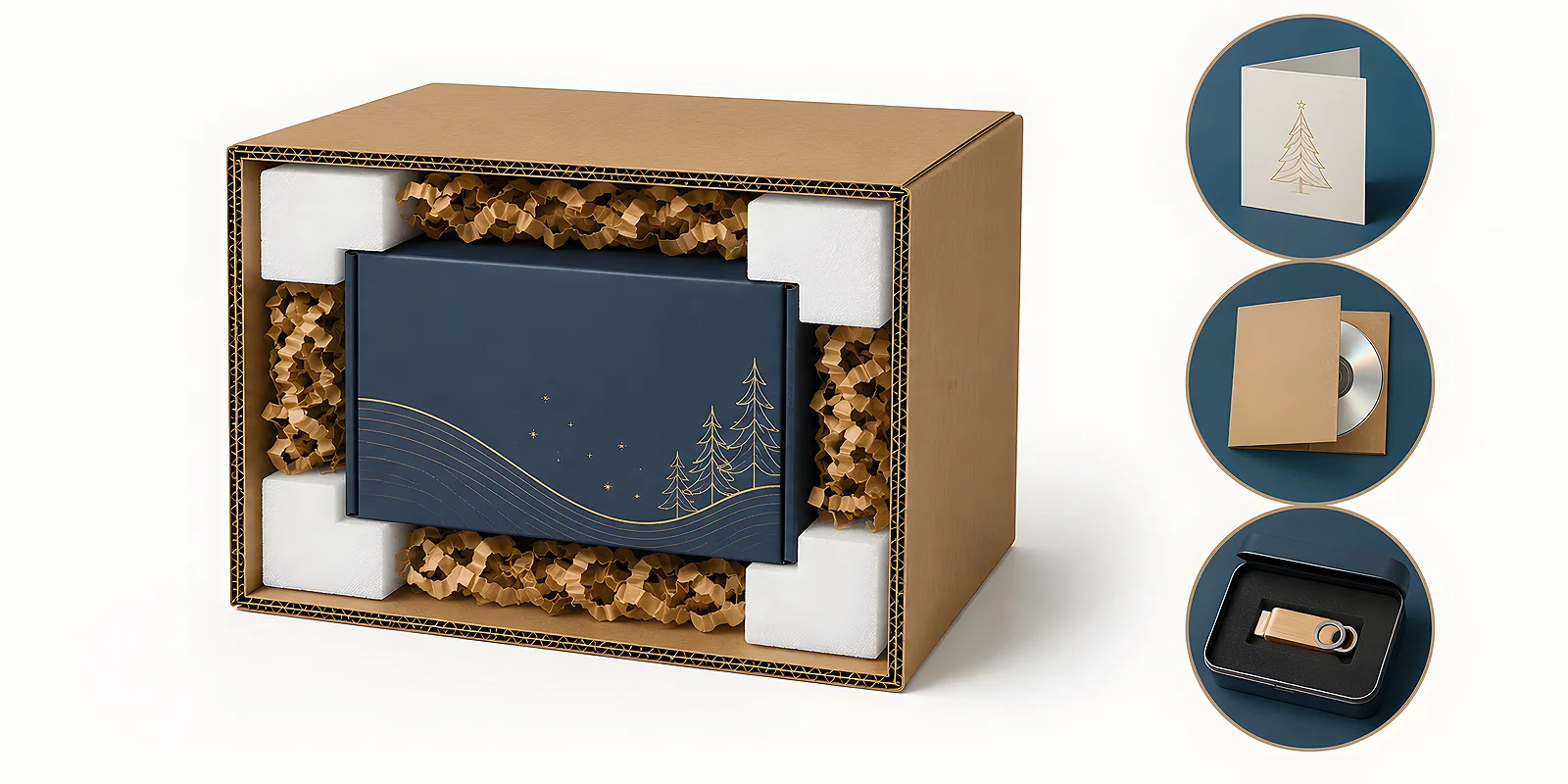
Posting is a different task from handing over
When we hand a gift over in person, we control everything: the state of the box, the moment, the order. When we post it, we hand the parcel to a system that works fast and without sentiment. A parcel gets turned over, stood on its side, pressed under a heavier package, carried in a freezing van and left for a while in an unheated warehouse.
None of this is a reason to give up on posted gifts - it is simply a different set of requirements. Shipping brings a huge advantage: it lets you reach clients you will not visit in person and teams working remotely. You just need to choose a gift that will take that journey calmly.
What makes a gift travel well
Before you start browsing ideas, it helps to have a few firm criteria in mind. A gift meant for posting should be:
- Flat or compact - the fewer protruding parts and empty spaces, the lower the risk of damage.
- Resistant to pressure - parcels get stacked on one another, so a fragile item needs solid protection or a better alternative.
- Insensitive to temperature - a December shipment means frost in the van and warmth in the warehouse, several times over during the journey.
- Free from any risk of leaking - liquids and items in glass require an entirely different level of protection.
- Free from any risk of crumbling - delicate sweets can arrive in pieces despite careful packing.
- Sensible in weight and size - a large, heavy parcel means higher cost and greater risk, and not necessarily more joy for the recipient.
These criteria narrow the choice, but they take nothing away from your ability to make something lovely. Quite the opposite - a well-designed flat set often looks more elegant than a box full of random items.
Before you order a whole run, pack one set and send it to yourself or to a colleague in another city. That single test shows more than an hour of planning: whether the carton comes back in good condition, whether the contents shift and whether everything looks the way you intended once it is opened.
Why flat sets cope best
There is a whole group of gifts that seem made for posting. They share one thing: they are flat, compact and contain nothing that could spill or scatter.
A greeting card
The simplest and most reliable element of any parcel. A festive card is not troubled by transit, and it carries the most personal content of all. In a posted set it should sit on top, so the recipient reads it before reaching for the rest.
A disc in cardboard packaging
A corporate music disc in cardboard packaging is a flat, light gift that stands up to the conditions of the road. A well-designed cover makes an impression on opening, and the format itself takes up minimal space in the parcel. It is also a gift that travels very well when sent to many recipients at once.
A flash drive in a case
Compact, resistant to pressure, insensitive to temperature. A case stops it shifting inside the parcel and lifts the impression on opening. Print or engraving with a logo means the gift stays with the recipient long after the holidays.
A voucher and a notebook
A voucher is the lightest thing you can send, and it gives the recipient real value and a choice. A notebook, in turn, is flat, firm and practical - it fills space in the box nicely and later lands on a desk, where it works for the brand all year round.
Such a set can easily be expanded: several flat elements arranged in layers look better in a box than one bulky item surrounded by filler. It is also easier to keep a shared style, because all the elements can be designed along one graphic line.
Outer packaging versus gift packaging
This distinction saves more parcels than anything else. A shipping carton and a gift box have different jobs and should not be the same element.
The outer carton has one job: to arrive. It can be plain, as long as it is rigid, well sealed and matched in size. It is the one taking the scuffs, the pressure and the damp.
The gift box inside is there to impress at the moment of opening. It carries the colour, the motif and the logo, and it is the one that stays with the recipient once the carton is thrown away. You will find more on the differences between these two roles in our post on how shipping packaging differs from gift packaging.
When choosing packaging for a disc, it is worth thinking about both layers at once. The gift box should fit into the carton with a small margin that you fill with cushioning material. Then the carton takes on the whole journey and the box inside arrives untouched. If you are after something elegant without inflating the budget, our post on choosing packaging for a premium product will help.
Filling, corners and the seal
Three things decide what condition a parcel arrives in.
- Filling - the contents should not move when you shake the carton. Tissue, paper wool, corrugated board or a shaped insert do the job and build the moment of discovery along the way.
- Protected corners - it is the corners of a carton that take the worst of it. Reinforcing them with an extra layer of board, or leaving a larger margin of filling there, solves most problems with crushed boxes inside.
- A secure seal - tape on all the edges, not only the middle one. A carton that can be opened with a finger in transit will open sooner or later.
It is also worth making sure the gift box inside has its own closure - a band, a ribbon or a sticker with your logo. That way, even if the outer carton takes a beating, the contents stay arranged exactly as you planned. A logo closure is most often ordered as round stickers - they arrive kiss-cut on sheets, so you peel them off one-handed when packing a series.
The label is part of the impression too
The address label is the first thing the recipient will see - often before they even work out who the parcel is from. Stuck on crooked, filled in by hand, with a typo in the surname, and the impression starts on a minus, even though everything inside is polished.
A few small things make a big difference here: a legible printed label, the correct form of the name and job title, a sticker with the company logo as sender and a short note that this is a festive parcel. That last point has a practical purpose - in companies, parcels are often opened at reception, and the marking reduces the risk of the gift being unwrapped by someone other than the addressee.
If you send parcels to clients regularly, it is worth adding a small printed item inside. We described how to do this without the effect of a leaflet forced in where it does not belong in our post on leaflets added to parcels.
Address, delivery timing and schedule
The most common problem with festive shipments has nothing to do with packing. It is a poorly agreed address and bad delivery timing.
- Office or home - a parcel sent to an office just before the holidays may meet a closed door or be collected by someone else. A gift meant for a specific person often works better at a home address, but that has to be agreed in advance, not assumed.
- Asking for an address does not spoil the surprise - a short message asking to confirm the details for a festive parcel is enough. Clients usually respond to this very warmly.
- Delivery timing - aim for the period before the very end of December, while there is still someone in the office. A parcel arriving in the last days of the year often waits for collection until January.
- A margin in the schedule - in December carriers work at full stretch, and printing and packing have their own pace too. Order and send earlier than seems necessary.
It is worth mapping the preparation calendar backwards: first set the date by which parcels should be with recipients, then subtract time for shipping, for packing, for assembling the sets and for printing. Only then can you see when you really need to start. The tips in our post on when to order festive cards to make it in time for shipping will help here.
A gift sent by post calls for slightly different thinking than one handed over at a table, but it comes down to a simple rule: choose something that will survive the journey, pack it in two layers with different jobs, and plan the shipment with a margin. The rest is the pleasant part - the moment the recipient lifts the lid and sees that someone genuinely thought of them.