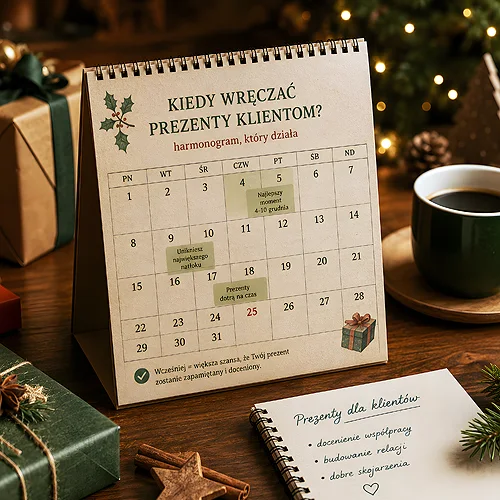
A November morning, the client list open on your second screen and the question that comes back every year: does everyone get exactly the same thing? On one hand you do not want to leave anyone out. On the other, you know that a relationship with a company that has been with you for five years and calls you about every difficult matter looks different from one with a client who placed a single order in June. Both of these can be reconciled - just not by building three separate gifts from scratch.
The most common mistake with Christmas packages is treating them as three independent projects: one large, one medium and one modest. Each has different artwork, different packaging, a different card. The result is doubly unfortunate - costs go up, because everything runs in small print quantities, and recipients who happen to compare packages see three different companies instead of one.
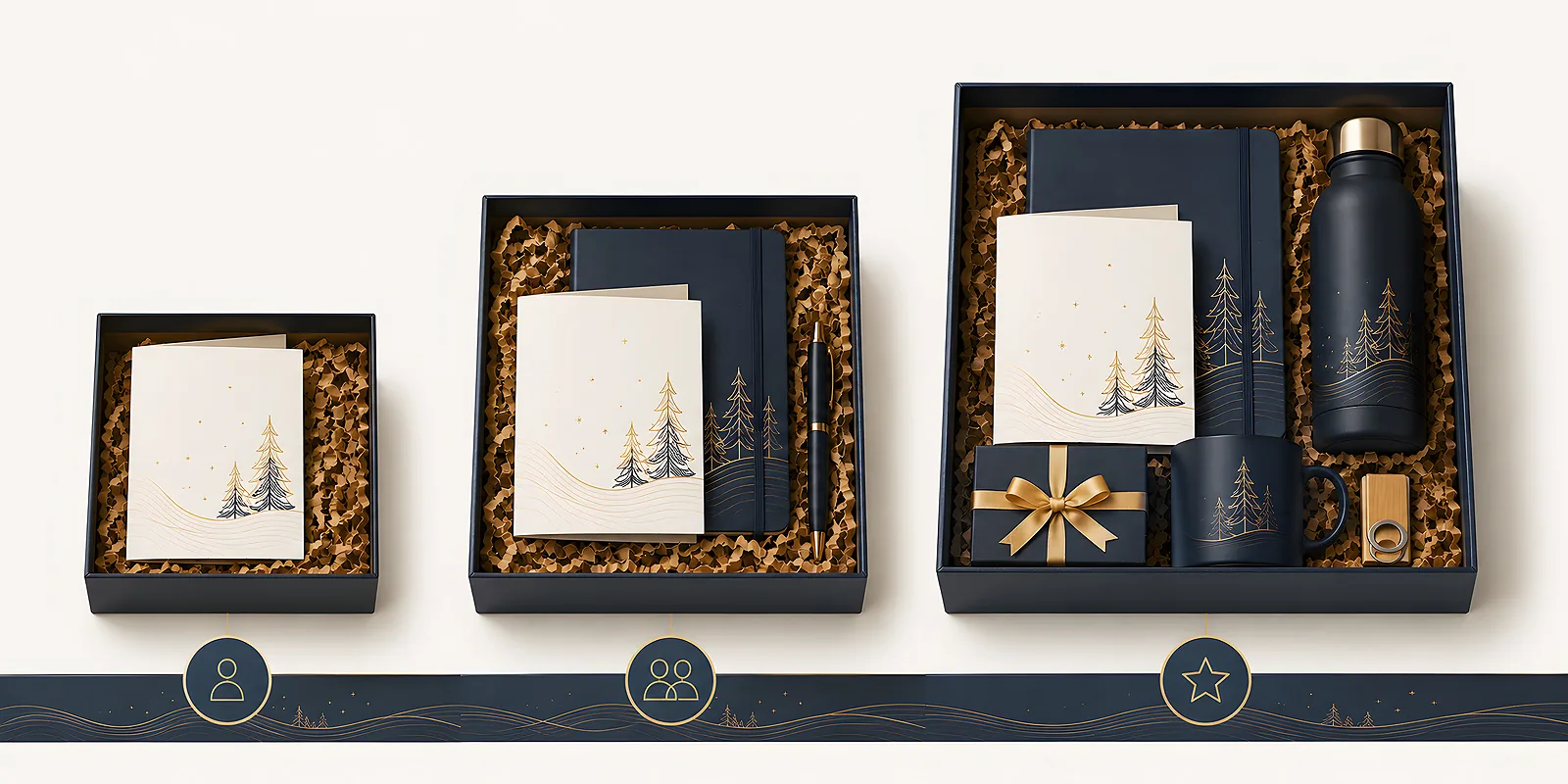
A different approach works far better: one shared graphic idea carried through every tier, with the differences hidden in what is inside and how it is packed. Below we show how to put such a structure together step by step.
- Build 2-3 package tiers on one shared graphic theme rather than on three separate projects.
- Keep everything that is seen first: the card, the branding, the colours, the motif. Vary the packaging, the number of items and the depth of personalisation.
- A shared theme protects you from awkwardness when recipients of different tiers compare their packages.
- Assign tiers calmly - look at how long the relationship has lasted, next year's plans and promising clients, not at a rigid table.
- The economics are on your side: one large shared run of cards and inserts, small runs only for the distinguishing items.
The common ground, or what you do not vary
Start by deciding what is identical across all packages. This is the foundation of the whole structure and at the same time its cheapest part, because you print it in one large run.
- The Christmas card - the same artwork, the same paper, the same finish for everyone. The card is the first thing the recipient sees after opening, so it sets the impression of the whole package.
- Branding - the logo in the same size and the same place, the same typography, the same way of signing off from the company.
- The graphic motif - the illustration, the pattern, the colour palette. If this year you are running a winter branch motif in navy and off-white, that branch comes back everywhere: on the card, on the sticker sealing the box, on the insert.
- The tone of the message - the wording of the greetings may differ, but not the style. The same warm, human language everywhere.
That is far more than it seems. A recipient opening a package judges it mostly on first impression - and the first impression is made precisely by this shared layer. If it is well crafted, every tier looks good.
What actually distinguishes the tiers
Differences should be noticeable but not loud. Four levers work best, and you can use them separately or together.
Packaging
This is the most visible difference and at the same time the easiest to introduce. The same set in a decorative envelope, in a cardboard box and in a sturdy thick-board box tied with ribbon reads as three different levels, even though much of the content repeats. It is worth staying within one family of forms - the same colour, the same sealing sticker, only the form and sturdiness differ. If a disc or a flash drive travels in the parcel, match its packaging to the same motif too.
The number of items
The basic tier is usually a card and one well-chosen small item. The middle tier is a card, several items and something for everyday use. The top tier adds an item that stays around for longer. Before deciding on proportions, it is worth reading our post on whether to go for one premium gift or several small promotional items - the answer depends on what you want remembered.
Depth of personalisation
At the lowest tier personalisation stays general - shared greetings from the company. Higher up you add a named dedication or a short line about the year gone by. At the top tier it is worth getting specific: a mention of a joint project, the name of the account manager, a handwritten signature. That costs mainly time, not print.
The distinguishing item
At the top of the structure sits one thing that appears nowhere else. It might be a more durable item, a flash drive with materials, a more carefully made notebook or a company music disc. What matters is that this item fits the rest stylistically rather than looking borrowed from another story. We produce company music discs with printing on the CD and the recording copied onto it, in a standard or a branded version.
Do the table test. Line up all the variants side by side and look at them from two metres away. They should read as one family, with differences visible only up close. If you see three different companies from a distance, go back to the shared motif and strengthen it.
Why a shared theme is your insurance
Clients do meet. At trade fairs, at conferences, over coffee. Someone will say: we got a nice package from them, what did they send you? And that is the moment when it turns out whether your tier structure was well thought through.
When every variant grows from one motif, that conversation is completely safe. Both sides see the same card and the same style - they read the differences as natural rather than as a verdict. When the packages look like entirely separate projects, however, the comparison gets awkward, because the difference stops being a matter of scale and starts to look like a matter of respect.
The same principle applies to recipient groups in general. You choose a gift for a client differently than for an employee, and differently again for a business partner - our post on how promotional gifts for clients, employees and partners differ explains this well.
How to assign clients to tiers without rigid rules
Building a table with hard thresholds is tempting. In practice such a table usually fails, because business relationships do not fit into a single number. A calm conversation with the sales team and a few guiding questions work better.
- How long has the cooperation lasted? A client who has been with you for years deserves a different gesture than one you are only just getting to know.
- How much does this cooperation really mean to you? It does not always match order volume - sometimes it is the client who brings you referrals.
- What are your plans for next year? If a joint project is coming, the package is a good way to open the conversation.
- Who is promising? A new but promising client can comfortably land higher than their history alone would suggest. That is an investment, not a reward for the past.
- Did anyone drop out by accident? At the end, go through the list once more and check that nobody important disappeared while filtering the spreadsheet.
That last point sounds trivial and yet it saves the most situations. A long-standing client left out is the only genuinely costly mistake in this whole process.
Print economics, or where you really save
Splitting into tiers only makes economic sense if you distribute the print quantities well. The rule is simple: what is shared, you print once and in volume. What sets tiers apart, you order in small quantities.
Cards, greeting inserts, sealing stickers and labels go into a single run for all the packages - which makes them work out favourably per piece and look identical at every tier. Christmas company cards are the best example here, because this is the element every single recipient gets.
Packaging and promotional items, by contrast, are varied, but you order fewer of them because they go only to selected groups. Overall it comes out cheaper than three parallel projects and looks more coherent. If you are building the basic tier, our post on how to put together an affordable promotional pack from several small items will help - the same rules apply to a Christmas package.
Schedule and assembly
Working with several variants takes a little more order than a single package for everyone. A few things are worth setting up right away.
- The list and the tiers first - before you order anything, you need the numbers. Without them you do not know how much of what to print.
- Then the shared layer - the card design and the graphic motif. It defines everything else, so it comes first.
- Next the distinguishing items - packaging and gifts split by tier, built on the finished motif.
- Assembly with a checklist - prepare a simple sheet: who, which tier, which dedication. Tick items off while packing, because a mix-up at this stage is hard to undo.
- A margin at every tier - a few packages beyond plan always come in handy when someone is added at the last minute or a parcel comes back from a wrong address.
It is also worth planning the whole thing early enough. The end of the year tends to pile up, and Christmas packages have the unforgiving quality of not being sendable after the fact. We described a well-laid-out calendar in our post on how to plan Christmas printing without stress in the fourth quarter.
Several package tiers are not about dividing clients into better and worse - it is simply an honest matching of the gesture to the relationship. When all the variants speak the same graphic language, every recipient gets something considered, and you can rest easy even when your clients end up sitting at the same table.