By mid-December, the reception desk of an average company is already stacked with parcels, and a dozen cards from suppliers, partners and the bank line the windowsill. All of them lovely, all of them kind, all of them blurring into one. The very same gift that disappears without a trace in that pile would, two weeks earlier, have landed on the desk first and been remembered along with the sender's name.
Christmas gifts for clients are usually discussed in terms of what to choose. Far less often do people talk about when to give them - and that frequently matters more than the idea behind the gift itself. Timing decides whether a present is an event or an item on a list.
Below we review the real time windows at the end of the year, show what each of them offers and whom it suits, and finally suggest how to count your schedule backwards from the day of giving, so that nothing has to be done in a hurry.
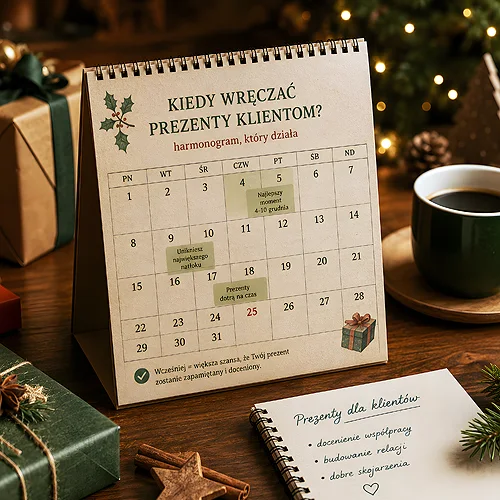
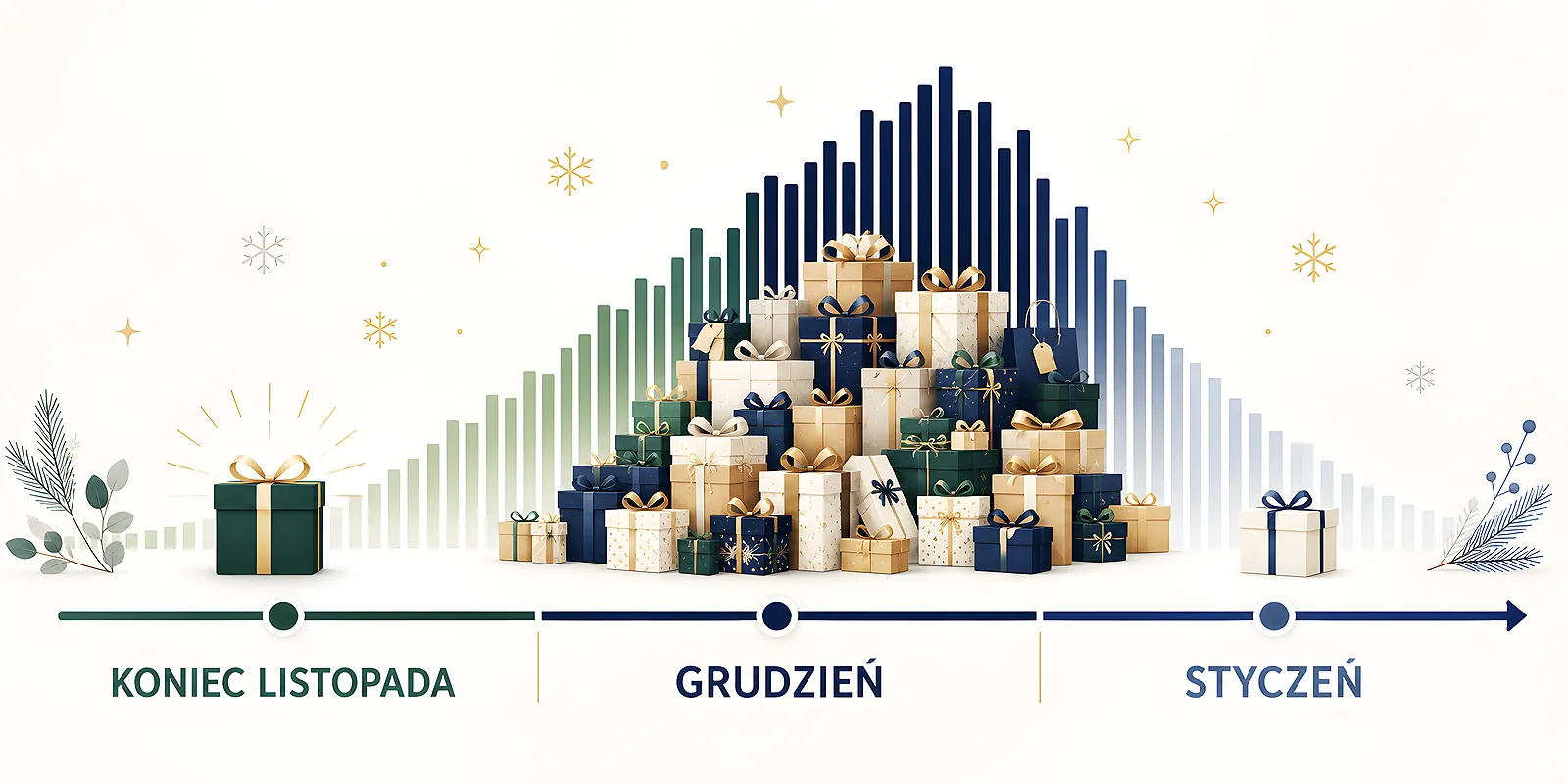
- The closer to Christmas, the stronger the competition for attention - late November brings calm and a first impression.
- Early December is the classic choice: the gift gets to sit on the desk for the whole season.
- Right before Christmas, the risk grows that nobody is left in the office to accept the delivery.
- Early January and New Year greetings are a deliberate choice that can genuinely set a company apart.
- Match the timing to the recipient's industry and count the schedule backwards: design, print, assembly, dispatch.
Why timing matters as much as the gift
A recipient's attention is a limited resource, and in December especially so. The same parcel that gets opened with curiosity and mentioned in conversation on a quiet desk tends, at the peak of the season, to be set aside until there is a moment. That moment often does not arrive before the holidays.
Then there is the comparison effect. When gifts arrive one at a time, each is judged on its own. When they arrive together, the recipient automatically lines them up and compares them. So shifting a dispatch by two weeks can be enough for the same gift to land completely differently.
A review of the time windows
Late November
The calmest moment of the whole season. Calendars are not yet full, and a parcel from a supplier is the first rather than the twelfth. This window works particularly well when you care about the conversation - a gift handed over in person in late November often ends in a meeting rather than just a thank-you email.
There is one risk: for some recipients it is still too early for a festive mood. You can work around it with the tone of your greetings - instead of writing about Christmas Eve directly, thank them for the passing year and mention the season ahead.
The first half of December
The classic and safest choice. The festive mood is already clear, and the gift gets to sit on the desk for a few weeks before offices start to empty. A card placed on a windowsill in this period usually stays there until January and reminds people of the sender every day.
This is also the moment to make it in time for postal delivery. We wrote about how to count the deadlines for cards themselves in our post on when to order Christmas cards to make it in time for dispatch.
The week before Christmas
This is where things get difficult. The volume of parcels peaks, some teams are already in countdown mode, and in many companies the holidays have begun. A parcel can sit at reception until January and be opened when Christmas greetings are no longer relevant.
If you are aiming for this window regardless, it is worth limiting it to recipients you know well and who you are sure will be around. For everyone else, it is safer to move the gift earlier or shift it to January.
Between Christmas and New Year
A very uneven period. In some companies it is a time of summaries and quiet work, in others the office stands empty. This timing mainly makes sense when you know a particular partner's rhythm - or when you hand the gift over in person at the last meeting of the year.
Early January
A deliberate choice that can set a company apart more than anything else. Inboxes and reception desks are empty, people come back rested and, at the same time, focused on planning the new year. New Year greetings instead of Christmas ones sound natural then and open a conversation about shared plans.
This works especially well in B2B relationships, where the continuity of the partnership matters more than a seasonal gesture. You will find more about the form of such greetings in our post on New Year cards and business greetings. Ready formats are in our Christmas and New Year cards section.
You do not have to pick one date for everyone. Split your list into two or three groups and assign them different windows: your closest clients in late November with the gift handed over in person, the rest in early December, and this year's new contacts in January with New Year greetings. It is the same design work, simply spread more calmly across the calendar.
Match the timing to the recipient's industry
December looks different from every industry's point of view. It is worth asking one question: for my client, is this the peak of the season or a moment to catch breath?
- Retail, hospitality, logistics, e-commerce - December is the busiest month of the year. Here it is best to deliver in late November or wait until January, once the dust settles.
- Offices, professional services, agencies - the first half of December works well, because the team is still around and has a moment to unpack a parcel.
- Manufacturing and construction - check when the site plans its festive break, as it is often longer than in offices.
- Institutions and public bodies - internal rules on gifts often apply, so a card with greetings is the safer choice.
- Winter-seasonal businesses - if your client earns precisely in December, a January thank-you for the season lands far better.
Practicalities: holidays, closed offices and the delivery address
Even the best-chosen date will not help if the parcel arrives while the recipient is away. A few things are worth settling in advance.
- Check how long the office is open - many companies close several days before Christmas Eve, and deliveries either return to the sender or wait at a pickup point.
- Find out who accepts deliveries - in larger companies parcels land in a mail room and travel onwards with a delay. The recipient's name on the label speeds this up considerably.
- Consider a home address - with remote work this is often the only sensible option, but it is polite to ask first rather than assume.
- Announce the dispatch - a short message saying the parcel is on its way increases the chance that someone will look out for it.
- Arrange in-person handovers early - December calendars fill up faster than usual, and a meeting booked in November generally goes ahead.
A schedule counted backwards
Once you have chosen the day of giving, the rest of the plan builds from the end. It is the simplest way to avoid a situation where the design is ready but there is nobody left to pack the parcels.
- The date of giving - your starting point. Write it down and treat it as fixed.
- Dispatch - work back by the time needed for delivery, adding a margin for the December pile-up at the couriers.
- Assembling the parcels - packing sets takes longer than expected, especially with personalisation and handwritten notes.
- Print and production - order cards, packaging and gifts in one go, so everything reaches you at a similar time.
- Design and approval - the most underestimated stage. Allow for a round of corrections and time for a decision on your side.
- The recipient list - the dullest task and the one most often postponed. Up-to-date addresses and names are what makes all the rest worthwhile.
If you want to map out the whole end of the year rather than a single dispatch, our post on how to plan festive printing in the fourth quarter will help. As for choosing gifts to match the client relationship, see our post on corporate end-of-year gifts, and browse the options in our promotional gifts section.
One date or several
Choosing a single date for the whole list is convenient to organise, but rarely optimal. Clients differ in their working rhythm, in how close the relationship is and in how heavily December weighs on them. Spreading the dispatch across two or three dates costs little extra work and clearly improves the odds that every parcel arrives at a calm moment.
It also takes the pressure off your own team. Instead of one day when the entire list has to be packed, you get several smaller batches spread over a few weeks. It is then far easier to look after the details that actually shape the impression: a handwritten signature, a correctly spelled name, a neatly packed box.
A Christmas gift for a client does not have to beat the whole competition on the strength of the idea. It is enough that it arrives at a moment when the recipient has time to notice it. Choose the window deliberately, check the recipient's calendar, count the schedule backwards - and leave yourself a margin, because that is usually what decides whether the parcel arrives on time.