After a wedding, a christening or an anniversary, one question remains that is not trivial at all: what should you store all the footage from the camera and photos on? A recording of a celebration is hours of material and hundreds of photos, and you want to pass it on to loved ones in a way that makes them come back to it. The choice between a flash drive and a disc looks like a small detail, yet it can decide whether the keepsake ends up in a place of honour or in a drawer.
Both media have their strengths and both can be a beautiful keepsake - the point is to match them to the situation. Below we break them down: capacity, convenience, durability, the cost of more copies and personalisation options. Without favouritism - with a focus on what will really work for your celebration.
- The flash drive wins on capacity and convenience - it holds long, high-quality films and plugs into almost anything.
- The disc is a classic with a striking print, great when you need many identical copies for guests.
- Equipment for playing discs is rarer these days - it is worth thinking about how the recipient will open it.
- The durability of both depends mainly on storage conditions and on whether you have a backup copy.
- Both media personalise and package nicely - the choice is more about the situation than the quality of the keepsake.
The flash drive - capacity and convenience
The flash drive's biggest asset is space. A recording of a whole celebration in good resolution, a full set of photos without compression, extra files from various people - all of it fits on one small medium, with no need to split the material into parts. That is a real difference with longer films, which on a disc would have to be heavily limited or broken up.
The second advantage is everyday convenience. You can plug a flash drive into a laptop, a television, a console or a car radio - most of today's equipment has a USB port. The recipient does not have to look for a drive, they simply plug in and watch. The files can also be freely copied further, so the recording is easy to move to another device or to the cloud as a backup copy.
The flash drive as an object
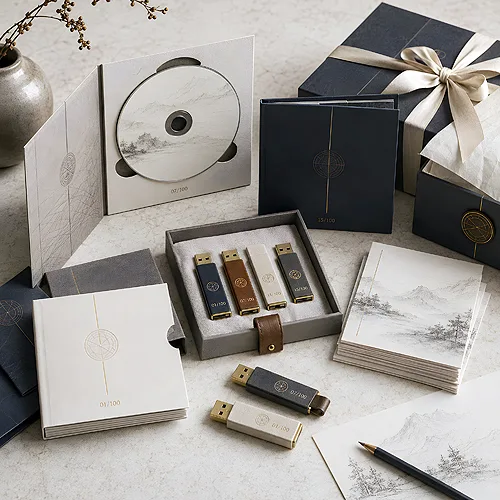
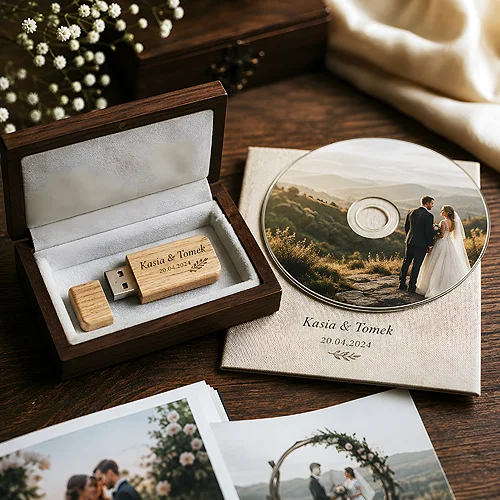
There is one more dimension that is easy to forget: a flash drive is a physical object that stays. An elegant model in wood, metal or with a strap looks like a gift, not just a data carrier. Models such as the Twister flash drive or the Click flash drive can carry a UV print with the date and names, and the Twister an engraving as well, so the keepsake itself carries emotion - before anyone even sees the photos. If you care about the recipient actually wanting to plug the drive in, it is worth taking care of what they will see once they open it - we write about this in our piece on how to design the contents of a flash drive.
The disc - a classic with character
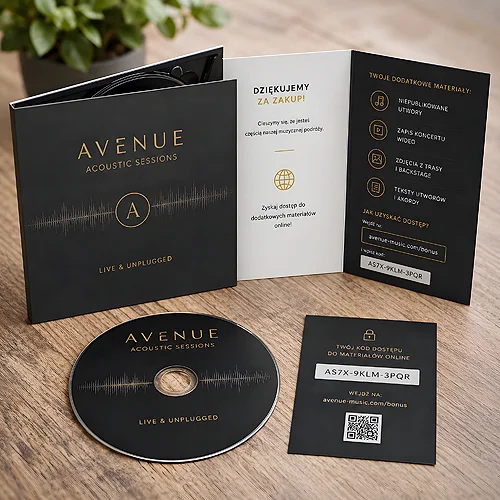
A CD or DVD has something ceremonial about it. A disc with a nice print, placed in a sleeve or a digipak, looks like a release - and many people expect exactly this form from a keepsake of an important day. It is a tried-and-tested solution that needs no explaining and fits the traditional character of family celebrations well.
The disc's strongest side shows up with a larger number of copies. When you want to hand the recording to a dozen or several dozen guests, identical discs with the same print are a simple, orderly way for everyone to get their own copy. The print on a disc is also a sizeable surface for a design - the date, names, a graphic theme consistent with the invitations. For more on using it well, see our post on the disc cover as a surface for communication.
Before you settle on a disc, check what the recipients will play it on. Fewer and fewer laptops and televisions have an optical drive. If you are giving to people who have a DVD player at home or a computer with a drive, the disc will play without a problem. If you are not sure, a flash drive or both forms at once is often the safer bet.
Durability and archiving
Both media can last for years if you treat them sensibly. Conditions are key: cool, no damp, no direct sunlight and gentle handling of the surface. A badly stored disc can get scratched or cloudy, while a flash drive dislikes moisture and hard knocks in the port. No medium is eternal, which is why the best insurance is simply a copy in a second place. The casing material makes a difference during years in a box too: Unity is made of brushed steel and its body is fused into a single piece, with no visible seams.
- Flash drive - resistant to shocks, no moving parts, easy to keep in a box. You can copy the files further at any moment.
- Disc - sensitive to scratches and high temperature, but with careful handling and storage in a sleeve it stays usable for a long time.
- Backup copy - regardless of your choice, keep a second copy of the material somewhere else. It is the simplest way not to lose your memories.
If you are thinking about protecting a family archive for longer than one celebration, it is worth taking a systematic approach - several copies, labelled media, good storage conditions. That is a separate, broader topic we develop in another post on the blog.
Personalisation and packaging
Here both forms score high, and it is often they that decide whether a keepsake looks like a considered gift. The print on a disc gives a large, visible surface for a graphic design, while a case or a digipak turns the disc into a small release with a cover and space for a description. You can keep the whole thing in the same palette as the rest of the celebration's setting, so the medium is not a detached extra.
A flash drive is personalised with a print or an engraving, and if you add an elegant box, the whole thing looks like a polished gift. For both media the rule is the same: a consistent theme, the date and names make the keepsake look lovingly planned right away. You will find variants of discs, prints and packaging in the discs and packaging category, and the full choice of models in the flash drive section.
When to choose which
There is no single right answer here - there is a match to the situation. Below is a short cheat sheet to help you decide depending on the character of the celebration and who you are giving the keepsake to.
- Wedding - a long, high-quality recording and the wish to keep everything together speak for the flash drive. For the couple and the parents it is the most convenient, roomy form.
- Christening - an intimate celebration and the wish to hand a lasting little gift to godparents and grandparents suit both an elegant flash drive and a disc in nice packaging.
- Anniversary or a larger reception - when you want to give the recording to many guests, a set of identical printed discs is a simple and tasteful solution.
- A small run, one or two copies - the flash drive wins on convenience and capacity, especially when the recipient values easy playback on any device.
- When you are hesitating - nothing stops you from preparing both forms: a flash drive for the closest family and discs for the wider circle of guests.
Choosing a medium is not about which one is better, but which fits your celebration and the people you are giving to. The flash drive leans on capacity and convenience, the disc on the classic form and a set of copies. Take care of a legible print, a consistent theme and a backup copy, and whichever you choose, you will be left with a keepsake your loved ones will gladly return to. If you are preparing material for printing or recording, take a look first at our guide on preparing files, so that everything turns out just as you imagine.