There is a difference between a gadget that ends up in a drawer and an object someone puts on a shelf and shows off to friends. That difference can be trivially simple: a small number printed on the case. "12 of 100" says more than many a description - that the item is limited, considered, and that it reached this particular person for a reason. A numbered edition is the cheapest way to make an ordinary medium work like a distinction.
A limited edition needs no huge print run or complex production. It needs one good idea for the reason it exists, a coherent design and a consistently applied number. Below we show how to plan such a series from start to finish - what to number, how to number, how to dress the whole thing in packaging and whom to give it to so it makes an impression.
- An edition number ("12 of 100") builds a sense of exclusivity and makes the recipient treat the object as something rare.
- You can number by hand, by print, with a numbered sticker, or with an attached certificate of authenticity - depending on scale and time budget.
- A coherent series design means one shared theme across all pieces plus a single variable element: the number.
- A small run is an asset, not a limitation - the smaller the series, the stronger the sense of prestige.
- Dedicated packaging and a collector card round off the whole and lift the impression by a class.
- Release the series for a specific reason: an anniversary, a launch, an event - that gives it meaning and a story.
Why an edition number builds value
A number on an object works on a simple mechanism: what is scarce seems more valuable. When a recipient sees "07 of 50", they immediately know they did not receive a mass mailing, but one of only a few pieces. That changes how they treat the object - instead of tucking it away somewhere, they usually put it on display.
Numbering also carries a message about intent. It signals that someone sat down, counted the pieces, planned the series and assigned the copy specifically to this person. In relationships with VIP clients or business partners, that gesture is often worth more than the medium itself. A well-designed numbered printed CD or flash drive can stay on a desk far longer than many a pricier gift without such personalisation.
How to number - four ways
The number does not have to be applied in one particular way. The choice depends on the size of the series, the time available and how visible you want the number to be.
- Hand numbering - a number written by hand on the case or card, for example with a fineliner or a metal marker. It creates a handcrafted feel and most strongly underlines that each piece passed through someone's hands. It suits truly small series.
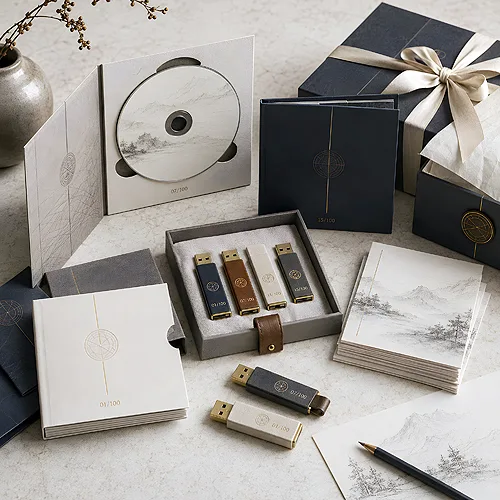
- Numbering in print - the number goes into the design itself and is printed together with the graphics on the disc or case. It looks the most coherent, but every different number means a separate file, so on a longer series a sticker or a numbered card is more practical.
- Numbered sticker - a separate, small sticker with the edition number, applied to the finished copy or packaging. A flexible solution: you add the numbering at the end, without touching the main design.
- Certificate of authenticity - a separate card included with the set, bearing the number, the series name and a signature. It gives the edition a collector's rank and works brilliantly for premium editions.
Before you settle on the size of the series, decide how you will number it. Hand-numbering hundreds of pieces is hours of work - for larger runs, a printed number or a sticker will be more practical. You can add a certificate regardless of the method, as an element that raises prestige.
A coherent series design
The secret of a good limited edition is the tension between what is shared and what is variable. All pieces are united by one theme: the same graphics, palette, logo, typography. Only one element changes - the number. This makes the series look like a considered whole, while each copy remains distinct.
The shared theme
Set a few constants and stick to them on every piece: two, at most three colours, one typeface for the series name and one for the rest, a recurring graphic detail. The same theme should return on the medium, the packaging and the collector card. Coherence between the elements does more here than the most striking single graphic.
The variable number
The number is the only thing that distinguishes the copies. It is worth planning a fixed place for it - the same corner of the case, the same field on the card - so it looks identical on every piece, with only the digit changing. The format "number of total" (for example "23 of 100") reads at a glance and clearly shows the scale of the series.
A small run means prestige
With limited editions, less means more. The shorter the edition, the stronger the sense of rarity - a series of fifty pieces sounds more exclusive than five hundred. A small run also has practical advantages: it is easier to keep control of numbering, quality and distribution, and the whole thing can be refined in details that a large production leaves no room for.
It is worth deciding in advance how many pieces the series counts, and sticking to that figure - it is part of the promise. If you say "a limited edition of one hundred copies", let there really be one hundred. That consistency builds trust and makes the number on the case mean something. You choose the format of the medium to suit the content and the occasion - replicated discs work well for larger, polished editions, and a flash drive for sets with more capacious content.
Dedicated packaging and a collector card
A numbered series deserves a setting that confirms its uniqueness. A loose medium, even with a nice number, loses half the effect. Dedicated packaging turns the handover into a small event.
- Packaging in the series theme - a digipack or a case kept in the same graphics as the medium closes the copy into a coherent whole and protects it for years.
- Collector card - a small card with the series name, the copy number, the release date and a short note about the reason the edition came about. It is what turns the object into a keepsake with a story.
- Room for the number on the packaging - if you number by sticker or by hand, plan a fixed field for the number on the packaging so it looks neat, not accidental.
The collector card is often an underrated element, yet it is frequently the one that stays with the recipient the longest. A short sentence like "Copy 12 of 100, released on the occasion of..." gives the whole thing character and explains why the item came to exist at all.
Whom to give it to and for what occasion
A limited edition works best when it reaches the right people for a specific reason. It is not a mass mailing, but a gesture directed at a chosen few.
- Set the reason for the release - a company anniversary, a product launch, an important event, an anniversary of cooperation. The reason gives the series meaning and becomes the content of the collector card.
- Choose the recipients - it works best among key clients, long-standing partners, competition winners or guests of a special event.
- Match the size of the series to the list - let the number of copies match the number of recipients, with a small margin. Then every number has its addressee.
- Plan the handover - handing it over in person or adding it to other material raises the standing of the gesture. A numbered copy calls for a moment, not an ordinary parcel.
There is no shortage of ideas for the reason: a company music disc for the holidays, an edition marking a round anniversary, a series added to a loyalty programme. If you are looking for concrete scenarios, take a look at our post on how a company music disc works as a holiday gift for contractors, and at the piece on a disc and flash drive with music in a loyalty programme. Before you start production, it is also worth checking how to prepare the graphics well - the guide to file preparation will help.
A numbered series is one of those ideas that cost little effort yet make a big impression. All it takes is one good reason, a coherent design and a small number in a fixed place - the rest happens on its own, in the mind of the recipient holding copy "12 of 100" in their hands.