A sticker looks unassuming, yet it does a surprising amount in a business. It marks the product, seals the shipment, informs, reminds people of the brand and is often the cheapest advertising carrier you have at hand. Its power comes from being everywhere the customer meets your product - and it works even when nobody consciously reads it.
- Stickers and labels mark products, packaging and shipments and support promotion.
- Choose the shape and format to fit the surface - round, square, on a sheet.
- The material decides durability and look - white self-adhesive paper, white self-adhesive film or self-adhesive kraft paper.
- The material alone changes how the same colours read - strong on white film, warm and muted on kraft.
- In the design, watch the bleed, the safe area and the readability of small elements.
What stickers are for in business
There are more uses than people usually think. The most obvious is marking - a sticker with a name, ingredients, code or date turns an anonymous product into a recognisable one. But that is only the start.
- Products and packaging - a label on a jar, bottle, box or cosmetic gives it identity and organises information about the contents.
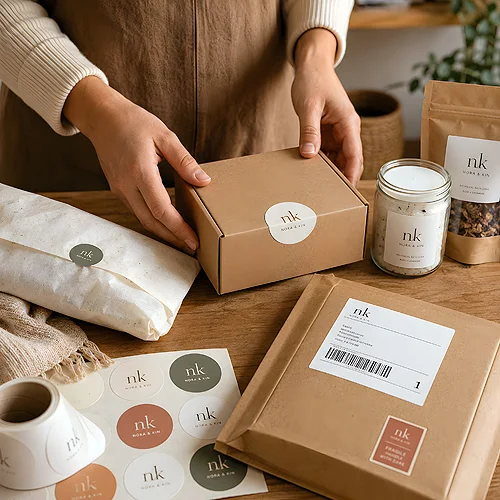
- Sealing shipments - a sticker with a logo instead of plain tape turns a parcel into part of the brand experience, and the customer remembers that detail.
- Promotion and information - stickers with a slogan, discount code or invitation added to orders, handed out at fairs or placed at the point of sale.
- Organisational marking - numbering, "fragile" and "this way up" marks, sorting goods or identifying equipment in the company.
So the same sticker can work on two fronts at once: the practical and the image one. A label on a jar tells you about the contents and at the same time builds shelf recognition for the brand.
Industries where a sticker makes the difference
Some businesses are hard to imagine without labels - and it is exactly there that you see how much depends on this small detail. In food service and with food products a sticker carries the ingredients, the date and storage instructions, and along the way builds an appetising, consistent image for takeaway dishes and jars of preserves. Anyone who sells food and seals packaging with it quickly notices that the same holds across the whole range of materials for food service and hospitality.
In cosmetics and small crafts a label is often the only packaging the customer sees - it decides whether the product looks polished. In retail and e-commerce a sticker seals the parcel, marks the contents and turns a plain shipment into a moment of contact with the brand. In services and the office, organisational marks, seals or equipment labels come in handy. There is one common denominator: everywhere there, a small carrier delivers information and impression at once.
Shapes and formats
You choose the sticker's shape mainly to fit where it will end up and the design itself. Round stickers look soft and friendly - they work great as brand stamps, package seals and cap labels. Square and rectangular ones are versatile and roomy, because they hold more text and data, which is why they are popular for product labels. Our range matches this with two versions: round stickers, where you choose the diameter, and square and rectangular stickers, where you set the format and the material - white paper, white film or kraft paper.
Stickers on a sheet are a convenient solution when you need many pieces for manual application - several or a dozen motifs on one page, ready to peel off. We print stickers on sheets only - square and rectangular ones are cut into single pieces and round ones are kiss-cut, so you peel them off the sheet. What you choose depends on the scale and the way you work - we will help you pick the right kind of stickers for a specific use.
Before you settle on a format, measure the surface and check whether it is flat or curved. On a rounded bottle a narrower label works better, as it will not wrinkle. A few minutes with a ruler saves corrections across the whole run.
Materials, films and finish
What you print on decides the sticker's durability and character. A paper material is natural and pleasant to the touch - it suits craft and food products and anywhere a warm, "homey" feel matters. Film is more resistant to moisture and abrasion, so it is chosen for cosmetics, chemicals and products that meet water or work in tough conditions for longer.
White film gives a strong, opaque background for saturated colours. Self-adhesive kraft paper gives a warm, natural background that suits craft and food products. The material itself does most of the work here: white film holds colours strongly and stands up to moisture, white paper is matte and pleasant to the touch, and kraft gives the label a natural, crafted character. The same artwork on matte and on gloss can feel completely different, so it is worth choosing consciously which mood fits the brand.
Match the material to the working conditions
Before you pick a material, think about what awaits the sticker after it is applied. A label on a product kept in the fridge will meet moisture and condensation, so paper will soon start peeling off - here film is the natural choice. A sticker on a cosmetic that travels to a handbag and back has to survive rubbing and contact with greasy hands. A mark on workshop equipment will meet dust, and sometimes solvent.
On the other hand, a label on a box of handmade goods that goes straight to the customer and lands on a shelf can happily stay on pleasant-to-touch paper - durability matters less here than impression. So the key question is not "what looks nicer", but "where and for how long does this sticker need to last". The answer usually points to the material on its own.
Match the adhesive to the working conditions too. A standard glue holds firmly on smooth, dry surfaces, but on low-grip plastics or in a cold store a stronger-tack adhesive works better. On the other hand, where the sticker will later have to come off cleanly - on glass, rented equipment or temporary marks - it is worth considering a removable version that leaves no residue. It is a detail easy to ask about when ordering, and one that can save a lot of frustration later.
A sticker is not an add-on to the product. It is the last thing the customer touches - and the first thing they remember.
The label as a branding element
A good label does not only inform - it builds the brand at the point of greatest contact with the customer. Consistent colours, the same typeface and a repeatable layout make products form a recognisable family, even if their contents differ. A customer who once remembers a distinctive label will find it on the shelf faster than they read the name.
It is worth thinking of the label as a micro-package that tells the brand's story in a few square centimetres. A detail like a sticker sealing a box or a stamp on wrapping paper can lift the reception of the whole order, even though it costs little. It is the same mechanism that works with tags and hang tags for products - small elements that together build a sense of care.
Consistency also pays off in practical terms. When the whole product family uses the same label layout and only the name or accent colour changes, designing new variants is faster and the shelf looks tidier. A recognisable label system works like a quiet salesperson - the recipient links the style before they consciously read what is in front of them.
What to watch in the design
The biggest slip-ups come not from the idea, but from technical details. Three of them are worth keeping in mind every time.
- Bleed - if the graphic is meant to reach the very edge, the background has to extend beyond the cut line. Without bleed, a thin white strip can appear at the edge after trimming.
- Safe area - keep the most important elements (logo, text, code) away from the edges. Cutting has a small tolerance, and an element pushed into a corner is easily trimmed off.
- Readability of small elements - stickers are often small, yet they carry ingredients, warnings or contact details. A font that is too thin or weak contrast means nobody will read it.
On top of that, watch the resolution of your graphics and work in a colour mode meant for print - what glows on screen can look different on film. If you are not sure how to prepare the file, see our guide on preparing files for print, where we show the bleed, safe area and the most common pitfalls step by step.
Order a small sample on the final material and stick it where it will actually work. You will see how the film behaves on a curve, whether the colours hold and whether the small text is readable. It is the cheapest way to avoid surprises with the full run.
Before you order stickers
Decide where they will be applied, how long they need to last and what brand mood they should carry - the material, shape and finish all follow from those answers. If you have a specific use in mind but do not know what to choose, get in touch - we will help you match the format and material so the sticker works well, not just looks good in the design.