
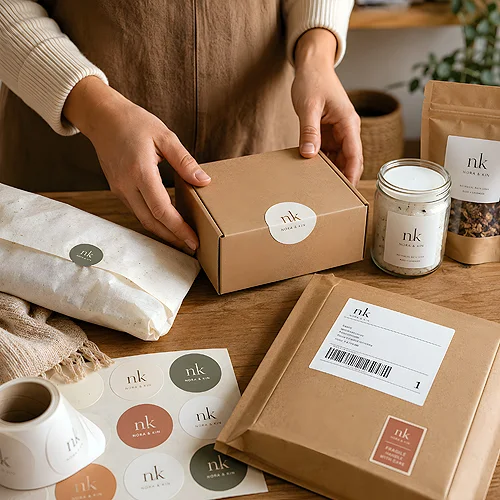
In a small business the advertising budget is often tight, yet the brand has to be visible everywhere at once - on the packaging, on the product, on the parcel, in the window. It is hard to find a tool that combines such a low cost with such versatility as a sticker. A single sheet of stickers can dress several completely different customer touchpoints in one consistent style, and you can stick them onto almost anything.
A sticker has one more advantage: it does not require changing whole packages or printing from scratch. You simply add it to what you already have, and a product or parcel instantly looks considered. In this post we go through the most important uses of stickers in a small business - from packing, through labelling products, to parcels - and suggest how to design them so they genuinely work for the brand.
- A sticker is one of the cheapest and most versatile brand carriers in a small business.
- It seals packages and parcels, labels products and builds a consistent style without replacing whole boxes.
- On a parcel it acts like a brand's business card - often the customer's first physical contact with the company.
- The choice of surface and adhesive depends on the use: one for glass, another for cardboard, another for outdoors.
- A sticker design consistent with the rest of your materials means a small element strengthens the whole brand.
Why a sticker is the ideal tool for a small business
A small business needs flexibility. The offer changes, packaging is often generic, and printing large runs of every element separately would be expensive and rigid. A sticker solves this elegantly: it lets you personalise ready-made surfaces. The same neutral box or jar turns into a branded product the moment you add a label with your logo.
Add to that scalability. You can start with a single sheet for one product line and then expand the uses as the company grows. You are not locked into one format or one idea. If you want a broader look at where stickers and labels work in a company, it is worth reading our post on the uses of stickers and labels - it lays out the full map of possibilities.
Stickers on packaging
Packaging is the first thing a customer picks up, and a sticker lets you give it character without investing in expensive, custom-designed boxes. It is the most common and most cost-effective use in a small business.
- Seal and closure - a sticker holding a box or bag closed plays two roles: it protects the contents and signals that the parcel is original and packed with care.
- Personalising neutral packaging - a plain box with a logo stuck in a visible spot looks bespoke, even though it is not.
- An accent with a story - a short "packed with you in mind" or a brand motif turns opening a parcel into a small experience.
- Seasonal versions - a separate sticker for the holidays or a promotion refreshes the packaging without changing the whole production.
A sticker on packaging is an element the customer notices in an emotional moment - while unpacking. That whole moment of unpacking counts for more than it seems, which our post on why packaging can matter more than the advert itself shows well.
Stickers as product labels
On the product itself a sticker plays not only a decorative but also an informational role. It often carries the name, the ingredients, the variant or the date - and builds image along the way. Here the design has to combine aesthetics with legibility.
Product label
On a jar, a small bottle or a box a sticker becomes the actual label - the face of the product on the shelf and in the customer's hands. It has to be legible, resistant to touch and moisture, and attractive at the same time. If you are building a product line, it is worth designing a consistent label system from the start so the whole portfolio looks like a family. You will find more on the aesthetics itself in the stickers and labels category.
Variant and batch markings
A sticker works great where the content changes - flavour, colour, batch number, date. Instead of printing dozens of packaging versions, you print one base and differentiate it with small stickers. It is a practical and cheap solution, especially for short runs.
Before ordering a large run, test the sticker in the conditions it will be used in. If it goes onto a product kept in the fridge, check whether the adhesive holds in moisture. If onto something touched daily - whether the print does not rub off with a finger. A few samples at the start save disappointment across the whole series.
Stickers on parcels
For a mail-order company a parcel is often the customer's first physical contact with the brand. A neutral box can be turned into an image carrier in seconds - precisely thanks to a sticker. It is cheap and makes a big impression.
- A company sticker on the parcel - a logo or a simple motif makes the parcel stand out in a stack of boxes and instantly associate with the brand.
- Functional stickers - "handle with care", "this way up", "fragile contents" in the company style combine practicality with branding.
- A thank-you inside - a small sticker on a card or on the parcel filler adds a human touch to an online purchase.
- A QR code to the shop or reviews - discreetly leads the customer back to the offer or asks for a review after purchase.
It is worth thinking of a sticker on a parcel as a business card that travels to the customer on its own. It costs little, yet builds the impression of a company that cares about details even beyond the product itself. On a parcel, square and rectangular stickers fit best, because a rectangular field holds a logo, a website address and a short thank-you.
POS materials and the shop window
Stickers also work great in the space of physical sales. In the window, on the counter or on the door they can direct traffic and inform without the need to print large boards. A sticker with opening hours, payment information or a current promotion is quick to replace and cheap to produce.
Here the choice of surface and place of application matters. A sticker on a window from the inside is a different material from one applied outside, exposed to sun and rain. If you want all the shop materials to speak in one tone, it is good to treat stickers as part of a larger system of the company's printed materials, consistent in colour and typography with the rest.
How to choose and design stickers - step by step
For a sticker to do its job, it is worth working through a few decisions in a sensible order. That way you avoid a situation where a nice design does not hold onto the surface or the print fades after a week.
- Define the use - packaging, product, parcel, window. The surface, adhesive and durability depend on it.
- Choose material and finish - white self-adhesive paper, white self-adhesive film or kraft. Paper for interiors and dry surfaces, film where the sticker has to cope with moisture.
- Design consistently with the brand - the same colours, logo and typography as in the rest of your materials. The sticker should reinforce the whole, not stand apart.
- Prepare files correctly - shape, bleeds and resolution. Our file preparation tips will help.
- Order a sample, then the run - a test on the target surface before a large series saves money and nerves.
A sticker is one of those tools that in a small business give the most effect for the least outlay. It dresses what you already have in the brand, works on packaging, product and parcel at once, and is easy to replace when the offer changes. If you want to choose the surface, shape and run for your specific use, just get in touch - we will suggest a solution that works for your business.


