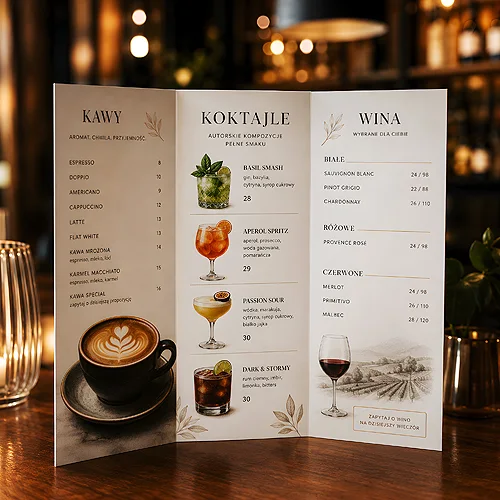
The impression of a visit is shaped not only by the food and service, but also by the dozens of small things a guest registers out of the corner of their eye. A placemat under the plate, a number on the table, a hanger on the door handle, a leaflet on the counter - individually they look like trifles, but together they create a coherent, polished world of the brand. It is precisely these prints that make a venue look thought-through rather than pieced together by accident.
- Small HoReCa accessories work together - keep one style, colours and logo across them.
- Placemats, hangers and table numbers organise the space and greet the guest at the table.
- Choosing paper and finishing is a practical decision: durability, hygiene and easy replacement.
- Make disposable and replaceable items cheap and simple - make permanent ones durable and solid.
- One design file for the whole family of prints makes consistency and later changes easier.
Why small prints create a coherent decor
A guest does not judge a venue at a single glance - they build an impression from the signals they gather throughout their stay. When the placemat, the menu card and the table number speak the same visual language, everything looks planned. When each print is from a different world, even a nice interior loses its coherence.
These little things are also a cheap marketing tool. They remind of the name and logo, hint at promotions, invite people to follow the profile online - all without being pushy, alongside the meal. A well-designed set of prints works the whole time the guest sits at the table, and it does so quietly, without taking space away from the conversation or the food. It is communication that accompanies the visit rather than interrupting it.
Table placemats - practical and promotional
A paper placemat under a plate or cup is one of the most versatile prints in gastronomy. It protects the tabletop, marks the guest's spot and greets them at once with a visual element of the brand. You can put a logo, a slogan, a location map, a code to social media or a light, interesting text to read over coffee on it. In our catalogue placemats and cup coasters are two separate products, so you pick the format of each one on its own.
Placemats can also be a clever menu carrier - especially in quick and family concepts, where the placemat card presents the offer right away. How to combine these two functions is described in the post on designing a clear dish card. Their biggest advantage is being disposable: a fresh placemat for every guest looks clean and neat, and replacement costs nothing in terms of time.
Print placemats in a larger run and in a simple, disposable finish - they wear out quickly, so cheap replacement is what counts. Treat an element meant to last, like a durable menu card, separately and more solidly.
Door and handle hangers
A door-handle hanger is a small print with a surprisingly broad use, especially in hotels and guesthouses. The classic "do not disturb" and "please clean the room" are the basics, but a hanger can also welcome the guest in the room, remind them of breakfast hours or invite them to the spa. Double-sided printing lets you fit two messages on one element.
It is also a piece of decor the guest looks at up close. Solid, stiff paper and careful finishing build the impression of the room's class. A hanger is unassuming, but it is often the first thing a guest picks up after entering - so it is worth it looking good and speaking in the brand's tone.
Table numbers, labels and counter materials
Table numbers and tent cards or pyramid presenters standing on the tabletop organise service and make waiters' lives easier, especially with orders brought to the table. They are also another surface where a logo or a short piece of information can appear - the dish of the day, a current promotion, a code to leave a review.
On the counter, materials the guest sees in the queue or while waiting for an order work well: leaflets, standing offer cards, information about a loyalty programme. It is a natural place for a message, because the guest looks there anyway. This whole family of small prints for gastronomy fits within the HoReCa offer, where it is easy to choose them so they keep one style.
Small things that are easy to forget
On top of this come elements that slip through at the planning stage yet make a difference day to day: bill trays, cards with a code to leave a review, tabletop presenters or simple labels for jars of extras. Each of them is another chance for the brand to speak in a consistent voice, instead of showing up as a random print from the office printer.
It is worth treating them as part of one set from the start. When you gather all the small prints in a single list, it is easier to plan a coherent design and avoid a situation where a missing item is printed later in a hurry, in a different style and on random paper.
A guest rarely notices a single placemat or table number - but they immediately feel it when all the prints in a venue play together.
Choosing paper and finishing
Each of these prints lives in different conditions, so the paper is chosen differently too. A placemat is disposable - here a reasonable, absorbent paper and a low replacement cost are what matters. A handle hanger or table number serve longer and are touched many times, so they need thicker, stiff paper, and often lamination that protects against soiling and moisture.
Finishing is not only protection, but also character. A matte film gives calm elegance, a glossy one boosts colours, soft-touch feels pleasant in the hand. It is best to decide on weight and enhancements by looking at specific materials and papers and at how intensively a given element will be used. When in doubt, it is worth simply consulting.
Preparing the design without surprises
Even the best idea loses out when the print file is prepared carelessly. Take care of adequate image resolution, correct colours and bleed, that is the margin that lets the print be trimmed without white strips at the edge. With door-handle hangers, remember the die-cut of the hole, and with double-sided elements - the correct placement of the front and back.
If you are designing a whole set, keep shared source files with the logo, palette and fonts in one place. That way every new print is made from the same elements and automatically matches the rest, and you do not recreate the brand from scratch with each order.
Practicality and replacement
Design HoReCa accessories with how often they will change in mind. Make elements with current prices, a seasonal menu or promotion dates in a simple, replaceable form, so an update does not mean reprinting everything. Make permanent elements - logo, table numbers, durable hangers - once and solidly.
A good practice is to separate the permanent part from the variable one in the design as well. A durable carrier and a replaceable insert is a solution that saves time and money with every update. Thanks to this the venue always shows current information, and you do not print a whole set from scratch with every change in the offer.
Think about a reserve too. Placemats and other disposable elements run out faster than you expect, especially in season. A sensible buffer means you are not left with a bare table on the busiest weekend, and with a larger run it is easier to keep even print quality between batches. With elements that carry dates or seasonal slogans, just watch that the reserve is not larger than you can use before the content goes out of date.
Plan the prints as a set, not as separate orders. By ordering placemats, hangers and table numbers together, it is easier to keep a consistent style, and it is often more convenient to finish the whole thing in one project and one production cycle.
One brand language, many prints
These accessories show their greatest value when they come from a single idea. A shared colour palette, the same font, a recurring logo and a consistent tone of message make the placemat, hanger and table number look like parts of one family rather than a set of random prints. It is this consistency that builds, in the guest's mind, the image of a brand polished in every detail.
Start with a simple basic set and expand it as needed - add further elements in the same style. If you do not know where to start or which accessories will work best in your venue, check the tips in the help section or simply write to us through the contact form - we will suggest how to finish the whole thing in a coherent way.