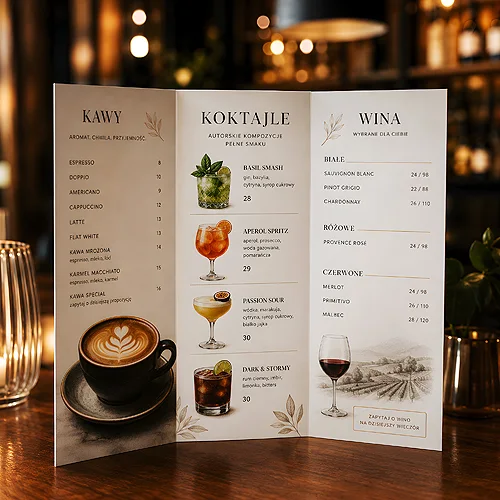
A leaflet handed out in the street has to stop somebody first. A presenter standing on a table has a different and far easier job: the guest is already seated, has already taken off their coat and is already waiting. You do not need to attract them - you need to suggest something to them right now.
That changes the whole logic of the design. A piece of print standing on a table is not competing for attention with street traffic, but with the phone in the guest's hand and with the conversation at the table. The winner is not the one that shouts loudest, but the one that offers a single concrete suggestion at the moment of waiting.
There are three solutions to choose from: the elegant presenter with two advertising faces, the triangular presenters with three, and the pyramid presenters. They differ not only in appearance, but above all in how many people at the table they show the message to.
- A presenter works on a guest who is already seated - a completely different situation from a leaflet in the street.
- The number of faces is a decision about who at the table sees the message, not a matter of taste.
- One presenter, one message. The dessert of the day or a QR code for reviews, never everything at once.
- The elegant presenter has two faces in a 2 × 176 × 200 mm format, on Arktika GC1 300 g board.
- The triangular presenter shows three faces and comes in three formats.
- Lamination is the standard here, because a presenter stands where drinks get spilled.
The guest is already seated - and waiting
Between placing an order and the dish arriving there are minutes in which the guest is doing nothing in particular. That is usually when they reach for their phone. At that moment the presenter is the only thing on the table with something to say, which is why it often gets read from start to finish.
A leaflet lying flat on the tabletop does not achieve this. It lies flat, so from a seated position it is seen at a sharp angle and has to be picked up to be read. Picking it up is a barrier, but the association can be worse: a sheet lying on the table looks like something somebody left behind. A standing presenter looks like part of the room's equipment, so it does not trigger the reflex of pushing it aside.
There is a third, less obvious benefit. A presenter lets you put an offer in front of people without involving the staff. The guest does not have to ask whether there is a dessert of the day, and the waiter does not have to recite it at every table. During the rush that is a real saving of time.
The number of faces is a design decision
The most common mistake when choosing a presenter is treating the shape as a matter of taste. The shape decides how many people at the table see the message without turning the stand around, and that is already a question of effectiveness.
- Two faces - the elegant presenter, format 2 × 176 × 200 mm. Two sides serve two people sitting opposite each other. This is the most common configuration at a table for two and at a station on the counter.
- Three faces - the triangular presenter, commonly called a toblerone. It stands in the middle of the table and serves it from three sides, so it works well at larger tables and wherever guests join freely.
- The pyramid - two faces, in a 2 × 145 × 120 mm or 2 × 200 × 120 mm format; it works best where it has one main viewing side: against a wall, on a counter, on a reception desk.
In practice it is worth starting from what your room looks like. Tables for two along a wall are a different situation from long tables in a garden. If you want one message to reach everybody, count faces rather than pieces.
One presenter, one message
The temptation is always the same: since it is standing there anyway, let it say everything. The wine list, the dessert of the day, the wi-fi, the loyalty scheme and a request for a review. The effect is the opposite of the one intended, because nobody reads five things at once.
The rule that saves most projects goes like this: one presenter carries one topic. If you have three messages, put two presenters in different parts of the venue and leave the third for another season. What works above all is the offer of the day, an addition to a dish, a loyalty scheme, wi-fi access, a request for a review and news of an event at the venue.
On a triangular presenter three faces tempt you to place three different topics. It is better to use them differently: the same message on all three sides, so that everybody at the table sees it. A similar principle governs recommendation cards, which we wrote about in our post on cards with the chef's recommendations.
Sit down at a table and look at the presenter from the guest's position rather than standing over the table. A line of text that looks perfect from above can, from seat height, be hidden behind a salt shaker or a bread basket. That one minute saves a whole print run placed in the wrong spot.
Why lamination here is a standard, not a decoration
On most printed items lamination is an aesthetic choice: gloss deepens the colours, matt calms them down, Soft Touch gives a velvety feel. On a table presenter it works above all as protection, and that is why it comes as standard.
A presenter stands in the most exposed spot in the venue. Drinks get spilled on it, children touch it, a napkin brushes against it, and when the table is cleared a cloth wipes it down - a dozen or more times a day. Uncoated board absorbs stains and after a week looks tired, which transfers straight onto the impression the whole room makes. A coated surface can be wiped and goes back to work.
The board itself matters here too. Arktika GC1 300 g is stiff enough that the stand does not go limp after a few days in the sun, and it takes full-colour printing well. On a standing product that combination of rigidity and a good printing surface counts for more than on anything lying flat.
Changing the content and planning the run
A presenter is by its nature a seasonal item. A dessert that was a hit in July sounds out of place in November, and a promotion from six months ago undermines the credibility of the whole room. That is why two shorter series a year usually work better than one large one.
A single large run looks more favourable per piece, but it has two drawbacks: the content ages faster than the stock, and the surplus sits in storage. A shorter series lets you react to what is genuinely selling from the menu. We described the same mechanism in our post on menu inserts with a seasonal offer.
- Choose one message - the one you genuinely want to sell over the coming weeks.
- Count the faces - check how many people sit at a typical table and from how many sides they should see the message.
- Match the format to the tabletop - the presenter has to be visible, but it must not take up the space meant for a plate.
- Plan a shorter series - with a date by which you will be changing the content anyway.
- Check the placement in the room - at one table, before you set out all of them.
A presenter does not sell on its own. It sells a moment - those few minutes in which the guest is looking for something to rest their eyes on anyway. The rest of the printed items that work on the floor are waiting in the HoReCa category.