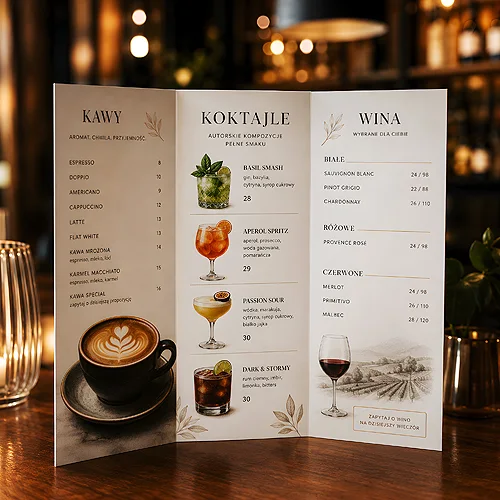
The menu is one of the first things a guest picks up after sitting down at the table. Before the waiter says a word, the guest has already formed an opinion of the venue - from how the menu looks, how it feels in the hand, whether it is clean and readable. It is a quiet ambassador for your brand, working at every table, all day long.
The question is: should you go for a disposable menu, a practical laminated one, or an elegant version in a rigid cover? Each of these options suits a different type of venue and a different pace of work. Below we compare them honestly - in terms of durability, hygiene, cost of changes and the impression they make - so you can match the menu to what really happens on your floor.
- A disposable menu works well when the offer changes often, with daily specials and seasonal menus.
- A laminated menu wins on durability and hygiene - it is easy to wipe and handles heavy traffic well.
- An elegant cover builds prestige and suits restaurants where the experience matters, not just the meal.
- Many venues combine variants: a fixed menu in a cover plus an insert for the daily specials.
- Match format, paper and finish to the rhythm of the venue, not the other way round.
The menu is part of the guest experience
A good menu does two things at once: it sells and it sets the mood. It sells because it leads the guest's eye where you want it - to the dishes you care about most. It sets the mood because its appearance signals what to expect. A menu on a thin, crumpled sheet says something entirely different from one in a solid cover of textured paper.
That is why the choice of menu form is not only a matter of aesthetics. It is a business decision that shapes how the guest perceives the whole venue - and sometimes whether they go for dessert or a second coffee. We write more about the role of details in hospitality in our post on how music in a restaurant works from breakfast to evening; a menu follows a very similar logic of atmosphere.
Disposable menu - flexibility above all
A disposable menu, or one printed in short runs, is the solution for venues where the offer is alive. If you have a different daily special every day, change the menu with the season or like to experiment with the offer, printing on demand gives you full freedom. You change one dish, print a new version and you are done - without throwing out rigid, expensive cards.
- Flexibility - change the offer in moments, without waiting and without wasting old cards.
- Freshness - always up to date, no items crossed out with a pen.
- Unit cost - low in short runs, easy to reprint any missing copies.
- Best for - bistros, cafes, business lunches, food concepts with a rotating offer.
There is one obvious downside: a paper card with no protection quickly gets dirty and worn. The answer is the right paper - thicker, coated, less prone to stains - or treating the menu as deliberately short-lived, replaced every few days. If you are after a flexible format, a folded menu works well, fitting plenty of content into a small footprint.
Laminated menu - durability and hygiene
Lamination is a hospitality classic for good reason. A thin layer of film turns an ordinary sheet into a card resistant to grease, water and everyday knocks. You can wipe such a menu with a cloth after every guest, which at the kitchen and the table matters enormously - both practically and for your image.
Matte or glossy film?
The choice of film finish is no trifle. Glossy film boosts the colours of dish photos and looks lively, but it strongly catches reflections and fingerprints. Matte film gives a subdued, elegant effect, shines less and hides touch marks better - which is why it increasingly wins in venues after a calmer character. If your menu has dish photos, order a test print in both variants, because the difference in perception can be considerable.
- Durability - resistant to moisture, grease and creasing; the card survives months of intensive use.
- Hygiene - easy to wipe, important with heavy traffic and tables with food.
- Readability - the laminate protects the print, colours stay saturated despite use.
- Best for - pizzerias, bars, family venues, spots with high guest turnover.
If you change prices or dishes in a laminated card several times a year, split the menu into a fixed part and an insert. Laminate the fixed card once, and print seasonal items on a replaceable insert. You save on reprints and always have a current offer with no crossings-out.
Elegant cover - prestige and experience
In restaurants where the guest comes not just to eat but to enjoy an evening, a menu in a rigid, elegant cover does its job the moment it is handed over. A cover of thick board, wrapped in fabric, with a gilded logo or an embossing - it is a signal: you are in a place that cares about detail. Such a card has weight, texture and character that thin paper cannot fake.
The cover pairs beautifully with a system of replaceable inserts. The rigid cover stays for years, and you print the content on cards you slide inside. That way you get prestige and flexibility at once - you change the offer without giving up the elegant form. This solution is worth considering especially for the fixed menu you present as the venue's calling card; a single-card menu in an insert works well in this role.
- Impression - prestige and attention to detail felt the moment the card is handed over.
- Cover durability - a solid cover serves for years, you only replace the inserts.
- Brand coherence - brand colour, paper and finish matched to the interior style. In our menus the same effect comes from the velvet Soft Touch film you pick in the calculator.
- Best for - fine dining restaurants, hotels, wine venues, places for special occasions.
An elegant card rounds off the impression in much the same way as a thoughtful table decoration does - which we discuss in our post on place cards and table markers in a restaurant beyond weddings. All these elements play towards the same goal: a coherent, considered guest experience.
How to choose for your venue
There is no single best menu form - there is the one that suits your pace of work and the character of the place. Instead of following fashion, go through a few simple questions.
- How often do you change the offer? - often is an argument for disposable print or an insert; rarely - for a durable card.
- What is your traffic like? - high guest turnover and food on the table argue for lamination and easy cleaning.
- What impression do you want to make? - casual and quick is one league, an evening worth remembering is quite another.
- What is your budget for launch and for changes? - a cover is a bigger upfront cost, but lower for later updates.
- Do you need coherence with the rest of your materials? - if so, design the menu together with the venue's other stationery.
In practice, hybrid thinking works best. Many venues combine variants: an elegant cover for the main menu, a laminated wine list and a printed-on-demand insert for the daily specials. This setup delivers prestige, durability and flexibility at once - each menu does what it is best at.
The menu as part of the whole
A menu does not work in a vacuum. It makes the best impression when it plays in the same style as the rest of the venue's materials - placemats, table tags, wine lists, markers. The guest rarely names it, but they feel it: everything here fits together. That coherence builds trust more effectively than any campaign.
If you are building a menu from scratch or refreshing your card, it is worth looking at the full set of hospitality materials in the HoReCa and menu category and the collected menu cards in various formats. And when you are not sure which variant will work best in your venue, simply write to us - we will help you match the menu form to the pace of work, the interior and how you want to be remembered. Because a good menu works for you at every table, long after the guest sets it down.