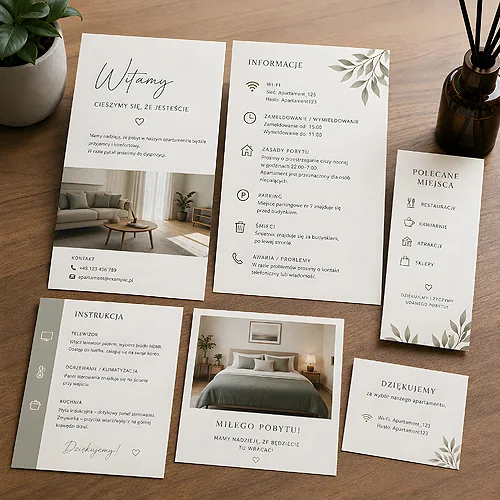
A door hanger looks like nothing much, yet it is one of the few printed pieces in a hotel that a guest picks up willingly and hangs exactly where others are meant to see it. For the next dozen hours it stands in for the reception desk, the telephone and a sign on the door.
In practice a door hanger serves not one function, but several very different ones. Some messages are requests the guest sends to the staff, others are information the property sends to the guest. Those are two opposite directions of conversation, which is why everything rarely fits onto a single piece of board.
What follows is a catalogue of the messages a hanger genuinely carries in a hotel, plus a hint about which of them may share one piece.
- Quiet and cleaning - the classic pair on the front and back of one piece, because these are two states of the same room.
- Orders from the room - breakfast with a time and a choice of dishes, and a laundry request, both need tick boxes, so they are better off on their own.
- Property information - wi-fi, quiet hours and check-out can share one piece, but one hung inside the room.
- Invitations - the restaurant, the spa area, an evening event; this message changes more often than the rest.
- Three versions are usually enough - a hanger carrying five messages never gets read to the end.
Two sides of one piece: quiet and cleaning
The oldest and still the most important function of a door hanger is the request not to be disturbed. A guest hangs it out when sleeping, working, or simply wanting the room to themselves. The reverse side of the same piece carries the opposite request: please make up the room, I am on my way out.
These two messages are combined on one hanger because they describe the same room in two states and never occur at once. The guest is not choosing between five options, only turning a piece of board around, and the staff see one side or the other from a few steps away.
Three things decide whether that pair works: a clearly different background colour on each side, type large enough to be read on the move, and unambiguous wording. "Please do not disturb" and "Please make up the room" say exactly what is meant; a bare "Do not enter" sounds like a prohibition and reads badly in a hotel.
Orders from the room: breakfast and laundry
The second group works differently. Here the guest is not signalling the state of the room, but placing an order, and an order has to be written down somewhere.
A breakfast card with a time and a choice
The breakfast hanger is essentially a form hung on a handle. The guest ticks the delivery time, the number of people and items from a short list: coffee or tea, bread, eggs, something for a child. It needs room for tick boxes and one line for notes, which is why it almost never fits alongside a request for quiet.
A practical rule: the list should be shorter than the kitchen would like. Eight clear boxes and one line for other wishes work better than a dozen choices on a card filled in half asleep before bed.
A laundry request
This one is more technical still: the number of items, the type of service, the collection time. This piece disappears from the handle and enters the property's internal circulation, so it has to leave room for a room number written in by hand.
Information the guest should have at hand
The third group covers messages the property addresses to the guest. They ask for nothing; they answer the questions that would otherwise be asked at the desk.
- Wi-fi details - the network name and password written so they can be copied without guesswork: upper and lower case clearly distinguished, the digit zero visibly different from the letter O.
- Quiet hours - the times plus one sentence about what they cover. A bare set of hours reads like house rules, while one warm sentence changes the tone.
- The check-out time - this reminder works best on the last evening, and the hanger is then where the guest will look in the morning.
These three can share one piece of board, because they flow in the same direction and none of them calls for a reaction. Do not combine them with the request for quiet, though: the guest will hang the card out into the corridor and hand the wi-fi password to everyone walking past.
An invitation to the restaurant or the spa
The fourth function comes closest to what the property itself wants to say: come down for dinner, visit the spa area, join the morning class. A hanger suits this better than a card on the desk, because the guest is holding it at the moment of deciding whether to leave the room.
This message changes every season, though, sometimes every week, so it is ordered separately and in a smaller quantity, yet on the same shape as the other versions. A shared shape matters, because the guest recognises the object before reading a word of it. You can order door hangers from us matched to the rest of the material in the room, and for properties that communicate an ecological approach it is worth looking at the eco variant.
How many versions to order and what not to combine
The biggest mistake with door hangers is not a poor design, but too much ambition. A single piece carrying five messages fails, because the guest reads it for two seconds in the doorway while the staff judge it from the corridor. Five messages mean letters five times smaller and no hierarchy.
A sensible set for a property looks like this:
- The quiet and cleaning hanger - one per room, plus a reserve. The only version that has to be everywhere, always.
- The order hanger - breakfast or laundry, depending on what the property offers. If both, then two separate pieces.
- The information hanger - wi-fi, quiet hours, check-out. One per room, hung inside.
- The seasonal hanger - an invitation to the restaurant, the spa area or an event. A smaller quantity, replaced more often.
The first three form the backbone, the fourth is optional.
Divide your versions by what happens to them. The quiet and cleaning hanger goes outside and comes back. The order hanger disappears, because a member of staff takes it away. The information hanger stays inside. That single decision also settles which of them is worth carrying the property name and a telephone number.
What belongs on the piece the guest takes away
Some hangers never end up in the bin. The breakfast card travels to the kitchen, the laundry request goes off with the linen, and the invitation is sometimes carried downstairs. On those pieces the room number, the property name and the internal telephone number make sense, because the card circulates away from the room and has to explain itself.
On a hanger that stays in the room or hangs on the handle, the same details are only noise. There, one message and one function count. Other small items handed to a guest behave the same way - it shows in the case of the hotel key card sleeve, where every extra piece of information steals room from the one that matters most. The sleeves themselves and the other printed items for the room are worth planning together with the hangers, which we described in our post on printed material for the hotel room.
A door hanger is the only printed item in a property that the guest hangs, by their own hand, exactly where it is meant to be seen. The reception can hand over a leaflet, a card can lie on the desk, but it is the guest who decides that this piece of board will end up on the handle, facing the corridor. Treat it, then, as a short message that the property and the guest exchange without a word. How to fit hangers into the rest of your small printed items we show in our post on coasters and HoReCa accessories, and the whole category is waiting in the HoReCa section.