The cooperation is coming to an end. The project is delivered, the service done, the invoice issued. For many companies this is the moment when contact simply breaks off. And yet it is right now that it is decided how the customer will think of you in a month - and whether they will come back.
The last moment of a cooperation stays in memory more strongly than it seems. A small gift handed over at the end is not a cost or a sales trick. It is a signal: we cared, we thank you, the door stays open. And it is often this gesture that decides whether the customer will recommend you further.
In this post we show why the end of a cooperation weighs so much, how to use the effect of the last impression, and which trinket will work in your industry - without an inflated budget.
- The effect of the last impression means the customer remembers the end of a cooperation particularly strongly - it is worth planning.
- A small gift at the close of a service works as a signal of care, not another attempt to sell.
- Simplicity often works better than an expensive present - what counts is the gesture and the fit, not the price.
- The best gift is tied to your industry and to what the customer has just received from you.
- Pairing the trinket with a short thank-you on paper strengthens the whole impression.
The last-impression effect - why the ending weighs as much as the peak
Psychologists have described a phenomenon called the peak-end rule. In short: when we judge an experience, we do not remember every minute of it. We remember two moments - the most intense one and the last one. Together they form the overall impression that stays.
For a service company the conclusion is simple and very practical: the way you end a cooperation will weigh on the whole memory - even if small slip-ups happened earlier. A neat, warm closing can cover many an average moment from the middle. And the other way round: an indifferent ending can spoil even well-done work.
That is why the last contact deserves to be designed as consciously as the first. A small gift is one of the simplest ways to make that ending warm rather than abrupt.
A gift as a signal of care, not a sale
There is a fundamental difference between a present at the end of a cooperation and material meant to sell something. The customer senses it instantly. A leaflet with an offer for further services says "buy more". A small gift says "thank you for trusting us".
The second message works harder precisely because it demands nothing. There is no threshold, no condition, no catch. There is a gesture - and a gesture with no expectations builds warmth and a natural wish to return. We wrote about how to design such a present so it does not end up in a drawer in our post on a company gift that does not land in a drawer.
When simplicity works better than an expensive present
It is easy to fall into thinking that the more expensive the present, the bigger the impression. In practice it is often the reverse. Too costly a gift can cause awkwardness or the suspicion that it is a hidden nudge towards something. A trinket chosen with sense is safer and often warmer in reception.
A few things matter more than price:
- The fit - an item connected to what the customer does or to what they have just received from you.
- Usefulness - something that will genuinely come in handy stays longer than a decorative gadget with no function. We wrote about why usefulness can matter more than a low price.
- Care in the making - a solid trinket with a decent print makes a better impression than an expensive thing made carelessly.
In other words: you do not have to spend a lot. You have to choose well.
It is also worth remembering that a gift does not have to surprise in itself. Sometimes the item that works best is simple and predictable, yet genuinely useful - one the customer reaches for on an ordinary Monday morning, without even thinking about where it came from. It is exactly this everyday presence, rather than the wow effect, that builds a lasting association with your brand.
Examples matched to the industry
The best gift at the end of a service follows from what you do. A few ideas to treat as inspiration:
- Photographer, video studio, agency - the finished material handed over on an elegant printed flash drive instead of an ordinary link. The carrier stays, reminds them of you and looks like the project rounded off neatly.
- Salon, clinic, local service - a small, pleasant gadget for everyday use plus a thank-you card. A warm accent on the way out stays in memory.
- Office, law firm, consultancy - a solid metal pen that is nice to sign the next documents with. Practical and suited to the character of the service.
- Workshop, service point, technical service - a handy keyring or a small set of promotional gadgets that stays on the keys or in the car and comes back to the customer daily.
The common denominator is always the same: the item should link naturally with the service performed, rather than be a random add-on from a box of gadgets. When the customer looks at the trinket and immediately sees in it a trace of your cooperation, the gesture gains meaning and stays for longer.
Pair the gift with a thank-you on paper
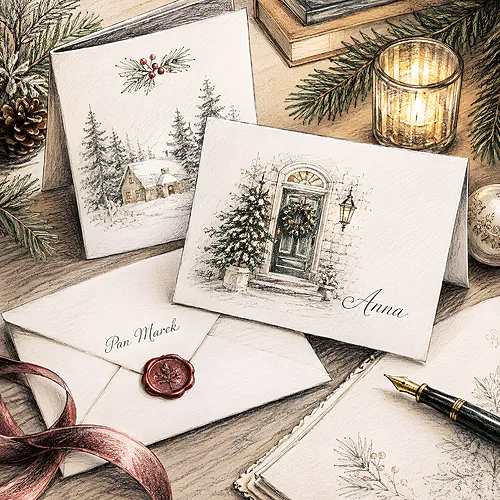
The item itself is half the gesture. The other half is the word. A short thank-you on a decent card - a few sentences, the customer's name, a signature - turns the gadget into a complete, considered gesture. It is paper that gives it the personal tone the item alone cannot carry.
Write the thank-you as if speaking to one person, not to the market. Refer to something specific: the completed project, the pleasant cooperation, what went well. One sentence that is not from a template makes the card land on the fridge rather than in the bin. Solid cardboard or a matte or velvety Soft Touch lamination finish adds durability and class.
A well-designed thank-you card is, in any case, material the customer will happily keep. You will find more about how to create advertising materials that customers happily take with them in a separate post.
The last gesture that stays for longer
A gift at the end of a cooperation works because it lands at the moment the customer sums up the whole. A well-chosen trinket with a warm word makes that summary come out in your favour - and means the customer will return or recommend you the moment an opportunity arises. We wrote about what makes such a present last for years in our post on promotional gifts kept for years.
This is not about a big outlay or a spectacular present. It is about the customer, closing the door behind them, thinking: I am glad I came here. That last image stays in memory the longest - and works for you long after the service has ended.