
Your customer is looking at your offer on a phone screen. They can see the colour, the layout, a nice photo with a soft shadow. What they cannot tell is whether the board is stiff or floppy, whether the surface is glass-smooth or lightly textured, or how the whole thing will hold up after a week in a bag. All it takes is one sample in their hand - and every one of those questions disappears within seconds, without a word from you.
This is why printed samples and demonstrators still beat the best-made presentation. Not because they look better, but because they work on a sense the screen simply does not serve. Touch is fast and beyond argument: either the material feels solid or it does not. You cannot talk your way around it.
The trouble is that most companies treat samples as an afterthought - printing a few random sheets, tucking them into a folder and forgetting about them. Meanwhile, a well-planned display set can cut a sales conversation in half and remove the customer's biggest worry: whether what arrives will look the way they imagine it. Below we show how to build such a set.
- Weight, texture and stiffness cannot be shown on a screen - a sample settles all three instantly.
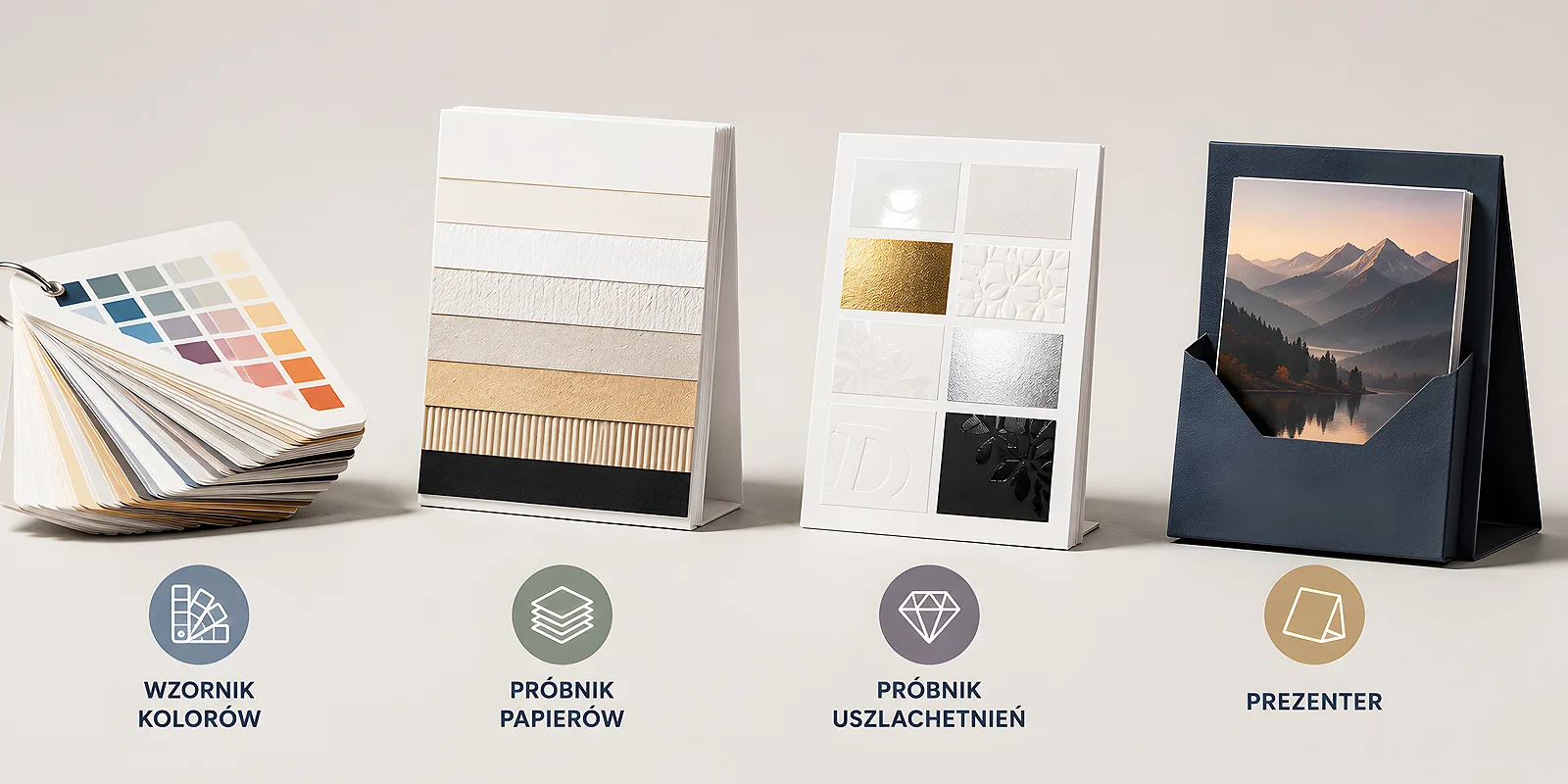
- Display materials come in four types: a material sample, a finished product sample, a demonstrator in use and a mini set sent by post.
- A good sample has a description on the back, shows the same design on different stocks and presents a real project rather than a blank sheet.
- The set is worth tailoring to the recipient's industry - a restaurant and a training company need entirely different examples.
- A sample you have sent is a natural reason to get in touch, rather than another email asking whether they have decided yet.
What a photo will never show
A screen displays two things: colour and shape. Everything that decides the impression of quality stays outside the frame. The thickness and stiffness of the stock, meaning whether a card holds itself straight in the hand. The texture, meaning whether your fingers glide over a smooth surface or pick up a gentle relief. The way paper responds to light - a matt surface scatters it softly, a glossy one reflects sharply and deepens colours. Even the sound, because stiff board bends with a completely different note than thin paper.
These are not details for aesthetes. Someone ordering folders for a meeting with investors wants to be sure the material will not buckle inside a bag. A restaurateur choosing a menu card wants to know whether the surface will survive greasy fingers. No photo answers those questions, and every sample answers them at once. We write more about how texture works on the reception of advertising in our post on tactile advertising and the material of a promotional item.
Four types of display material
Not every display material serves the same purpose. It is worth distinguishing four types, because mixing them in one set usually ends in confusion, with the customer unsure what they are actually looking at.
A single material sample
The simplest form: a piece of stock, sometimes in several weights. It answers one question only - how thick, how smooth, how stiff. It works when the conversation is about choosing paper and the design is already settled. Keep such samples in one size and one order, so the comparison stays fair.
A finished product sample
A real business card, a real leaflet, a real menu card - printed, folded and finished exactly as an order would be. This is the strongest type of sample, because it shows material, print, finishing and folding all at once. The customer has nothing left to imagine.
A demonstrator, or the product in use
A demonstrator is a sample placed in context: a menu card in its holder, a folder with documents inside, a notepad open on a written page, a flash drive in its packaging. It shows not the object itself but the situation in which it will work. That is an enormous difference, because the customer stops assessing a product and starts picturing their own company.
A mini set sent by post
A few samples in a small envelope or box, ordered and labelled, with a short card explaining what is what. This format has one advantage over all the others: it reaches the customer you will never meet in person. We cover how to arrange such a set into a coherent whole in our post on how to design a sample catalogue that helps with the buying decision.
What separates a useful sample from a pretty sheet
The most common mistake looks like this: a company prints beautiful sheets in several paper versions, the customer looks through them, nods - and cannot say which one they liked. Because nothing distinguished them beyond an impression, and impressions fade within two minutes. A useful sample has several qualities a pretty sheet lacks.
- A description on the back. The name of the material, its weight, the type of finish. Without it, the customer is left holding an anonymous piece of paper back at the office and has to call and ask what it was.
- The same design on different stocks. If you want someone to compare materials, change one thing only. The same design on three papers says everything. Three different designs on three papers say nothing.
- A real project instead of a blank surface. A sample with a genuine layout, photo and text shows how colour behaves in the shadows and how small type comes out. A blank sheet cannot do that.
- Honest finishing. If the set includes matt and gloss film, put both on the same design. The difference then becomes obvious rather than debatable.
- A sensible number. Three well-chosen samples work better than twelve, because with twelve the customer stops choosing and starts losing heart.
Before you order a display set, write down the three questions customers ask you most often when choosing a material. Then design your samples so that each one answers one of those questions. A set built around real doubts sells; a set built around what looks nice merely decorates the folder.
Match the set to the recipient's industry
The same set of samples will not work for everyone. A restaurateur wants to see a menu card that survives daily handling and a coaster that looks good on the table. A training company thinks about the folder and notepad that will reach participants. A shop is after labels and stickers. A manufacturer - packaging and inserts.
So instead of one universal set, it pays to prepare two or three themed versions and bring whichever fits the person in front of you. Customers notice immediately: if you brought examples from their world, it means you understand what they are talking about. That signal is far stronger than any declaration of industry experience.
When choosing stocks it helps to remember that the material itself can be part of the design, not merely its carrier. We develop that thread in our post on natural paper texture as an element of the design. If you want to get your bearings among the available stocks and finishes, take a look at our overview of materials and papers. The texture in question is easiest to show on eco flyers - Kraftliner, ecru Kazan with grass fibre and Flora give a warm shade and a surface you can feel, because they are never laminated.
In person or by post
A sample handed over in person works hardest, because you can see the reaction. The customer picks up the card, bends a corner, runs a finger across the surface - and usually tells you what they like all by themselves. That is the best moment for a conversation about details, because the questions arise on their own instead of being pulled out.
Sending by post has a different advantage: it reaches places you will not drive to, and it stays on a desk far longer than an email stays in an inbox. For that to work, the mini set has to be self-sufficient. A short card explaining what is inside. Descriptions on the back of every sample. One clear way to get in touch. If the customer has to guess what they are looking at after opening the envelope, the whole effort goes to waste.
A well-prepared display set also works as sensory material - colour, texture and format build an impression before anyone reads the first sentence. We write more about this in our post on sensory advertising.
When the customer decides remotely
More and more often the entire buying process happens without a single meeting. The sample then stops being an addition to the conversation and becomes a substitute for it - and has to carry that weight alone. A few things help.
- Send the set early, not at the end. A sample sent before the decision shapes the conversation. Sent afterwards, it merely confirms what the customer had already chosen.
- Narrow the choice for them. Instead of the full range of stocks, send two or three you genuinely recommend for their use. A short recommendation on the set card does more than a wide selection.
- Arrange a call for when the parcel arrives. It is the most natural reason to make contact there is: you ask about a specific object sitting in front of them, not about an abstract decision.
- Show the product in context. It is worth adding one finished example to the sample set - even a simple leaflet with a real design, which shows print, folding and material all at once.
A sample has one more, badly underrated advantage: it gives you a reason to speak up. Instead of writing yet another reminder about your offer, you ask about something tangible - whether the board turned out stiff enough, which version looked better in the company colours. The conversation becomes concrete, and you stop being the person who chases and become the person who advises.
A display set does not need to be large or costly. It needs to be considered: a handful of samples that answer real questions, labelled so they still make sense a week later, and chosen to suit what the recipient actually does. If you would like to talk through what belongs in your set, simply get in touch - we will suggest where to start.