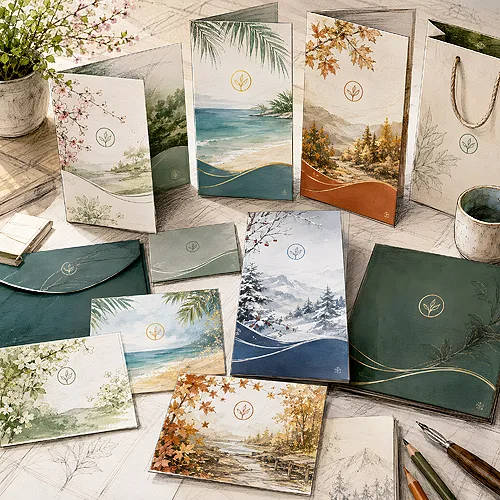
You send an offer by email and you know how it ends: the message lands in an inbox where a hundred others already wait. A postcard takes a different route. Someone lifts it from the letterbox, looks at it on the way to the desk and puts it down beside the keyboard. Not because it is prettier, but because it is the only one.
This article is not about paper being pleasant. It is about the postcard as a channel of contact: a tool like email, the telephone or a leaflet, simply with different properties. They are worth knowing, because they decide when print makes sense and when it wastes your time.
A company postcard differs from a holiday card in one respect. It works at a specific moment in a commercial relationship, it is short, it needs no opening and it stays in view. That is all it can do, and in a handful of situations it is exactly enough.
- A postcard has no wrapping - the message works immediately, with no envelope and no decision about whether to open it.
- It works after contact, not instead of it - it performs best where the recipient already knows who you are.
- Two sides mean a division of labour - the front builds an impression, the back carries the specifics.
- A small known list beats a large random one - this is a channel for dozens of people, not for five thousand.
- It will not replace material meant to be read - leaflets, catalogues and email attachments exist for that.
Why a postcard stays on the desk
An email competes with an entire inbox. A leaflet dropped through a letterbox competes with promotional flyers and looks exactly like them, so it goes into the bin along with them. A postcard belongs to neither group, and that is where its advantage lies.
The recipient picks it up because there is no way to skip it: no envelope to open, no subject line to judge. The content is visible in a second, and the decision to keep or bin it comes only after reading. That reverses the usual order, in which we reject first and read later.
The second thing is durability. An email vanishes under later messages the same day, while a card on the desk lies there for a week or two and reminds the recipient of you each time they move their papers. How print and digital channels complement one another we described in our article on local advertising.
Four moments when paper wins
A postcard is not a channel for every occasion. It is a channel for a few very specific situations in which what matters is one short sentence sent to somebody who already knows you.
After a sales meeting and after a trade fair
A thank you sent two days after a conversation achieves more than a third message with an offer. After a trade fair it works similarly: your contact came home with a bag of paperwork they will never open, and your card arrives separately, once that bag stands under the desk.
A change and an invitation for a small group
A new address, different opening hours, a new service in the range. These are one sentence messages that get lost in an email but make up the whole content of a card. The same goes for an invitation to ten or thirty people meant to feel it was addressed to them personally, not sent in bulk.
A postcard or a letter in an envelope
A letter looks more formal and sometimes that is the point, but it has three weak spots. It has to be opened, so a moment appears in which the recipient sets it aside for later. It has to be folded and packed, so the mailing takes longer to prepare. It is also heavier, which pushes up postage compared with a single card.
A postcard has none of those barriers. If what you have to pass on is one sentence and one reason to get in touch, an envelope only gets in the way. If what you have to pass on is a price list, a contract or a catalogue, a card will not do the job and it is better to reach for leaflets or an ordinary parcel.
There is one more difference that is rarely mentioned: nobody has to file a postcard. A letter goes into a folder and disappears there, while a card stays on top, because there is no obvious place for it. That small detail accounts for a good part of its effectiveness, though it never shows up in any comparison of channels.
The front makes an impression, the back carries the facts
Advertising postcards are always double sided, and in business contact that has a very practical meaning. It is not decoration but a division of labour between two surfaces. The front has one task: to make the recipient hold the card two seconds longer. A photograph, a colour, one line of copy.
The back works differently. That is where the specifics go - the reason for making contact, the name of the person sending it, a telephone number, a web address or a QR code. Separating those two roles is the simplest way to stop the card looking like a shrunken leaflet. The whole family of postcards works on the same principle.
The material builds the impression too. We print postcards on rigid coated board or on elegant Arktika card, and a film finish - gloss, matt or Soft Touch - changes what the recipient feels between their fingers before reading a word. Coated stock gives a crisp photograph and a smooth surface, while the decorative card reads more quietly and suits a message meant to feel personal. Two formats are available: the classic A6 and the slimmer DL.
When a postcard makes no sense
There are situations in which print loses, and it is better to know about them before placing an order.
Before we list those three situations, one general point: it is worth judging honestly whether you have anything to say. A card sent for no reason, simply "to stay in view", is read exactly as it looks: as a box ticked on a marketing plan. The reason need not be grand - a finished project, a change in the team or a date the recipient ought to know about will do.
The first is a mass mailing to a list you do not know. A postcard works because it is personal; sent to two thousand random addresses it stops being personal and what remains is a leaflet in an awkward format. The second is a message needing attachments, tables or a long explanation - a card has room for one sentence and one request. The third is mentioned less often: a postcard will not replace first contact with somebody who has never heard of you. How to begin that conversation is explained in our article on why good advertising starts with the customer's problem.
Before you order a print run, count your real list: how many people have a postal address you know and that is still current. That number, not your ambition, sets the size of the order. Better forty cards to people who remember your name than four hundred into the unknown.
How to plan a mailing like this
The order of work is always the same, because the most common mistake is designing the card before anyone knows who it goes to and why.
- Choose one group of recipients - customers after a meeting, contacts from a trade fair or long standing partners.
- Write the single sentence that is meant to stay in the reader's head. If it will not fit into one sentence, this is not a job for a postcard.
- Gather and check the addresses - that usually takes longer than the design.
- Design the back first, then the front - the words come before the graphics.
- Set the quantity with a margin for repeats and for copies handed over in person.
Handing them over in person is a common scenario too: a card added to a thank you card or slipped into a parcel works just as well as one sent by post.
A postcard is not better than an email. It is different: slower, limited to one sentence and demanding a decision about exactly who receives it. That is why the recipient takes it more seriously, because they can see somebody made that decision. If you want a channel for a hundred important contacts rather than a hundred thousand random ones, this is it. You only need those hundred addresses and one good reason to write. Occasional print behaves much the same way, as we wrote when discussing seasonal greeting cards.