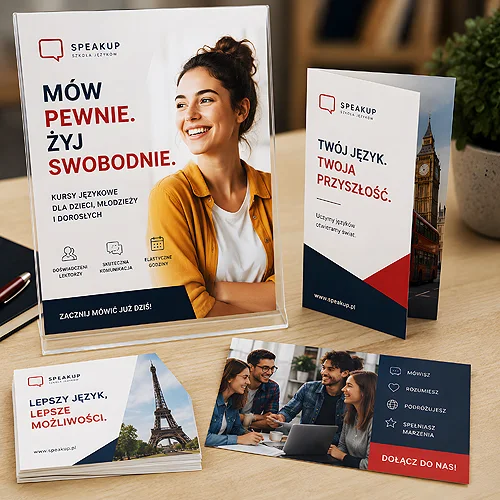
You run a cafe, a clinic, a workshop or a small shop, and you are wondering where to put your time and budget - into flyers and posters, into a social media profile, or maybe both? That is a very good question, and there is no single answer that fits everyone. But there is something that works for most local businesses in 2026 - and that is exactly what we will talk about, calmly and concretely.
- Print works locally - in your closest neighbourhood, at your point of sale, in your window. It is tangible and builds trust.
- Social and online give you quick contact, reach in local groups, reviews, events and presence on maps.
- The combination works best - print sends people to online, online keeps the relationship going and reminds them of you.
- You match the proportions to your industry, your customers' age, your budget and your goal - there is no single recipe.
- Results can be measured even with very simple methods, without expensive tools.
What print really gives a local business
Print has one great advantage - it is physical. You can hold a flyer, a poster catches the eye in a window, a business card stays in a wallet. Printed material does not vanish after a second like a post in the feed - it sits on the fridge, on the counter, on the desk, and reminds people about you for days.
In local advertising this tangibility has very concrete uses:
- Flyers to mailboxes and the nearest area - you reach exactly where your customers live, street by street.
- A poster in the window or on a notice board - it catches the attention of passers-by who are already in your area.
- Business cards and materials at the point of sale - the customer leaves with something they can pass on or keep for later.
- Reach in the neighbourhood - no algorithm decides whether your message arrives - you do, by choosing the district.
There is also something harder to measure and very important - trust. A well designed, well printed flyer or business card says: "this business takes things seriously". This works especially in local services, where the customer wants to feel they have found someone reliable. If you want your materials to truly stick in people's minds, take a look at our piece on how to design advertising materials that the customer remembers.
What social media and an online presence give you
Online has its strengths that print cannot replace. Above all - speed and live contact. In a minute you can announce that you have fresh bakes today, that there is a free slot, or that you changed your opening hours.
On a local scale, these work hardest:
- Local groups and communities - places where residents ask for recommendations and look for services nearby.
- Geotargeted ads - you can show your offer only to people from your town or district.
- Reviews and recommendations - positive ratings build credibility faster than many an ad.
- Events and maps - a business profile on maps means someone searching for "cafe nearby" lands with you.
Online is great at keeping a relationship going. A customer who visited you once can follow your profile and come back, because every now and then they see something that catches their interest. It is a channel for everyday reminders - cheap and fast.
Why combining both channels works best
Here we get to the heart of it. Print and online are not competitors - they are two parts of the same customer journey. Each does something the other cannot, and together they form a loop.
It looks like this: print builds first recognition and sends people to online. Someone gets a flyer in their mailbox, sees a QR code or a profile name on it, goes there and starts following you. From that moment online keeps the contact and reminds - without paying for print every time. The next poster or flyer refreshes the memory of those who have not gone online yet.
Print opens the door in your closest neighbourhood, and online makes the customer keep walking back through it.
Thanks to this you do not start from zero every time. People who met you through a flyer later meet you in the feed - and the other way round, people from the internet see your poster and think "ah, that is the place I know". Every encounter with the brand reinforces the previous one.
Examples of actions that combine print and online
Theory is theory, but it is best shown with specifics. Here are combinations that work in local businesses:
- A flyer with a QR code - the QR leads to your profile, a current promotion or event sign-up. The customer does not have to type an address, the phone is enough. Classic advertising flyers with a clear call to action work great here.
- A poster inviting to an event - in the window or nearby, and then a report with photos on social. Whoever did not make it will see how it went and come next time.
- A business card that links further - with a QR code to a digital card, a map or a profile. The paper card stays in the wallet, and one scan opens your whole online world.
- Point-of-sale materials with a "follow us" line - a small sticker or plate by the till that turns a one-time guest into a regular follower.
The key is simple - on every printed piece give one clear bridge to online: a QR code, a profile name or a short address. And online, every now and then, remind people that it is worth dropping by in person. Want to pick the right medium for your situation? Our guide will help: flyer, poster or business card - what works in local advertising.
Put only one, most important bridge to online on a printed piece - one QR code or one profile name. When you give three different links at once, the customer clicks none. A clear, single step works best.
How to match the proportions to your situation
There is no single golden proportion - and that is good news, because you can fit the channels to yourself, not the other way round. A few signposts:
- Customers' age - if you serve mostly younger people, lean harder on online, but do not drop print at the point of sale. With an older group, print and a presence in the area often work better than an ad in an app.
- Type of business - a place with foot traffic (cafe, hairdresser, bakery) benefits from posters and a window display. A service ordered from home benefits more from online and mailbox flyers.
- Budget - with modest means, start with a solid printed set (business cards, flyers) plus one well run profile. Better to do two things properly than five badly.
- Goal - building recognition in a new area? Print to begin with. Want to stay in touch with those who already know you? Online every day.
If you are just starting and do not know where to begin, it is worth starting with business cards, flyers and posters and seeing which materials suit your industry - often a simple, consistent set is enough to get going.
How to measure whether it works
Advertising you do not measure is guessing. Luckily, in a local business you do not need expensive tools - a little attention is enough:
- Codes and coupons - put a slogan or a short code on the flyer, so you can tell that a customer came from it.
- A separate link or QR on the material - if it leads to a specific page, you see how many people came from print.
- A simple question - "how did you hear about us?" at the till is the cheapest market research there is. Write the answers down, even on a piece of paper.
- Watching traffic after an action - handed out flyers in a certain area? Check whether guests or new followers grew in the following days.
It is not about perfection, just about direction. After a few such observations you will see which channel brings you more, and shift your attention there.
A simple mini-plan to start
Finally, the practice. Here is a light plan you can start putting into action right away - without a big budget:
- Make a consistent printed set - business cards and a flyer with one QR code leading to your profile or offer.
- Take care of one online profile - fill in the details, hours, address and add the business to maps, so you can be found nearby.
- Connect the channels - every printed piece points to online, and online invites people to visit in person.
- Hand out and show up locally - flyers in the nearest area, a poster in the window, a post in a local group.
- Measure and improve - ask customers how they heard about you, and adjust the proportions slightly each month.
That is all. Local advertising in 2026 is not a choice of "either print or the internet" - it is a skillful combination of both, tailored to you. Start simple, watch the results and grow what works. And if you need materials that make a good first impression and pull people further, we are here to help you with exactly that.