
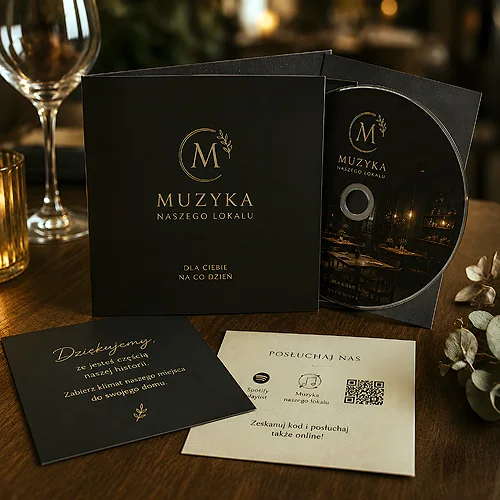
Most corporate gifts end up in a drawer. A music disc for the owner of a venue has the rare property of only starting work once it has been handed over: it plays at the recipient's place every day, and the case with your mark stands by the equipment, reminding them of the sender each time it goes on.
It is a business gift with a double action. The recipient gets it not to look at but to use - and they use it in a place where people work and clients come in.
- The recipient is the owner or manager of a venue, not the end client.
- The disc stays in daily use, so it reminds people of the sender far longer than a typical giveaway.
- The repertoire is free of fees payable to collective management organisations.
- The sender's logo works best on the disc and the rear inlay, not in the middle of the cover.
- A seasonal version is ordered in the ordering season, not in the listening season.
Who gives it to whom
This gift makes sense wherever your client is a venue.
- A catering wholesaler - to regular customers, on the autumn or pre-Christmas round.
- A roastery or coffee supplier - to cafes, along with the first delivery of the season.
- A cleaning company or laundry - to the hotels and guest houses it works with permanently.
- A cosmetics distributor - to hairdressing salons and beauty rooms.
- An agency or studio - to its clients, as an addition to the annual summary of the work done together.
There is one common denominator: the recipient runs a place where something plays all day, and has never had time to think about it. So what they get is not an ornament but a settled matter.
Why it works better than a pen
The typical promotional item has one weakness: once it has been handed over, nothing else happens. A pen joins ten others in a mug, a notepad goes on a shelf, a calendar competes with three similar ones on the same wall.
A music disc behaves differently, because it meets a real operational need. The venue has to have something to play anyway. If it is given ready-made material, that material enters the daily routine and stays there for a long time. The case sits by the equipment, in the very spot the staff walk up to every morning. It is hard to find better exposure for a company mark than the shelf next to the player.
There is also a side effect that is easy to forget: a gift like this gets talked about, because it happens so rarely. We wrote about that mechanism in our piece on whether a CD can be a more elegant gift than a standard giveaway.
The heart of it: a repertoire free of collecting society fees
What sets this gift apart from an ordinary compilation is also the most important thing about it. Our repertoire is made up of recordings by creators who do not belong to collective management organisations such as ZAiKS or STOART, and who have not registered their works with them. We hold full rights to use those recordings, which is why the repertoire is free of fees payable to those organisations.
For the recipient that means they are given material they can play at their own venue without additional fees on that account. For you as the sender it means handing over something of measurable value, not something that merely looks good. It is worth saying so plainly when you hand it over, because otherwise the recipient will treat the disc as an ordinary compilation.
One qualification for the sake of accuracy: this does not mean that the venue stops having any obligations regarding what plays there. It means that this particular material is free of those fees. That is why it is worth adding a short written note to the parcel explaining where the music comes from and what it allows - such a paper is worth more than an assurance offered on the doorstep.
What to put on the disc and the case
A disc release has several surfaces and each of them has a different job to do.
- The print on the disc itself - the name of the set and your mark; it is the only part visible every time it goes into the player. That is what printing on CD discs is for.
- The cover - the first thing the recipient sees. Calm artwork and a title work better here than a large logo in the middle.
- The spines of the rear inlay - the only part visible when the case stands sideways on a shelf. The title of the set goes there, not an ornament.
- The rear inlay - the track listing, a note on where the music comes from and the sender's details.
A complete set in a classic case, with a cover and a rear inlay with spines, is waiting with the CD-BOX cases with covers, and the whole category can be seen in the CD discs section. Discs follow the proof route: a new design is approved on a proof before production.
One logo, several places
The most common mistake on a release like this is five different versions of the mark on five surfaces. One version, repeated in several places in the same form, is enough. A logo on the cover competes with the title, so the more natural places are the print on the disc and the lower part of the rear inlay. The size that will do is usually smaller than instinct suggests.
Hand the disc to the person who actually switches the music on, not only to the owner. In a restaurant that will often be the shift manager, in a salon the reception desk. A gift that goes straight into the hands of whoever operates the equipment has a far better chance of ending up in the player the same day.
How many copies and when to hand them over
- Count the recipients - not all your clients, only the ones where music really plays all day.
- Choose the moment - the pre-Christmas period works well, but an ordinary sales round in a quieter month is often more effective, because the gift does not get lost in the crowd.
- Settle the material - a general set for the whole year or a seasonal version for a few weeks.
- Design the release - disc, cover, spines, inlay; one mark in several places instead of five versions.
- Approve the proof and only then plan the deliveries.
A Christmas version has to be closed earlier than intuition suggests. Anybody who starts on it in December is in practice ordering it for the following year - we wrote about that in our piece on a company music disc as a Christmas gift for business partners.
Where this gift works best
Not every venue is an equally good recipient. It works best where music plays quietly and for a long time: in a hotel, a cafe, a treatment room or a wellness area. We wrote about the differences between those places in our piece on where a music disc with a logo works best. If you want to discuss the run, the content and the look of the release, write to us through the contact form.
A good corporate gift is one whose role does not end at the moment of handing it over. A disc for a venue meets that condition almost literally: it starts working only once somebody switches it on, and goes on working every day the place is open.


