Picture your customer as someone on a journey. At first they do not know you at all, then they start to take a closer look, eventually they decide to buy, and if all goes well, they come back for more. At each of these stages they have different questions, different worries and a different readiness to act. Printed materials are the signposts that lead them from the first glance all the way to a repeat order.
Many companies treat print in scattered bursts - a flyer for one campaign, a business card because you are supposed to have one, a voucher dropped into a parcel with no plan. The result is that every material lives on its own and does not lead the customer any further. Yet print shows its greatest strength when the individual pieces form a sequence - one naturally leading to the next.
In this post we will break the customer journey into four stages and show which material fits each one best. Not so you print everything at once, but so you deliberately match the carrier to the moment the customer is in.
- The customer journey is conveniently split into four stages: first contact, consideration, purchase, and return and loyalty.
- Each stage has a different goal, so each needs a different material - from a flyer and poster to a loyalty card and voucher.
- A material has one job: to move the customer one step further, not to say everything at once.
- Returns are built at the end of the path - a loyalty card, a voucher and a thank-you note close one visit and open the next.
- A consistent look across the whole journey means the customer recognises the brand at every stage and trusts it faster.
The customer journey - four stages in one sequence
Before you pick a specific print, it is worth seeing the whole. A customer does not go from not knowing you to buying in a single jump - they take several smaller steps, and at each one they need something different.
- First contact - the customer is only just noticing you. Goal: catch attention and leave a good first impression.
- Consideration - they already know you exist and are checking whether it is worth it. Goal: build trust and show something concrete.
- Purchase - they make the decision. Goal: make it easier and make the moment of buying pleasant.
- Return and loyalty - the customer has already bought. Goal: give them a reason and a reminder to come back.
When you look at your materials through these stages, the gaps show up at once. Maybe you have a great attention-grabbing flyer but nothing to bring the customer back. Or the other way round - you look after regulars, but new people have no way to get to know you. A map of the whole journey shows what is missing.
First contact - materials that start the conversation
At this stage the customer does not know your brand and has no reason to give it time. The material has to work in a few seconds - with one strong message, a clear headline and plain information on what comes next. This is not the place for a full description of your offer.
The go-to choices here are classic flyers and posters. A flyer reaches the hand at a trade fair, at the point of sale or in the letterbox; a poster works in a space where the customer spends a moment anyway. Both have the same job: to stop the eye and leave one thing the customer will remember - a name, a benefit or a website address.
It is worth thinking here already about keeping the flyer out of the bin. We cover how to design a material the customer sets aside rather than throws away in our post on a flyer the customer keeps for later.
Consideration - materials that build trust
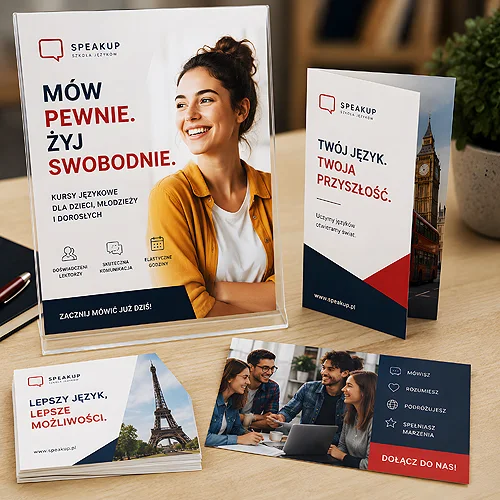
The customer already knows you exist and is starting to weigh things up. They now have more questions and are willing to spend a little longer. This is the moment for materials that speak more concretely: a folder with your offer, a product catalogue, a business card that stays in the wallet.
What to give at this stage
- A folder or catalogue - when the offer calls for showing several variants, photos and details. The customer takes it home and returns to it at leisure.
- A business card - a small carrier that stays with the customer and cements the contact. A well-made card builds the impression of a solid company all by itself.
- A folded flyer - something in between: more content than a single-card flyer, yet still handy.
At this stage the quality of execution counts. Sturdier paper, matte or soft-touch lamination makes the material feel considered - and the customer unconsciously transfers that impression to the whole company. It is a small thing that genuinely affects trust.
Purchase and the moment right after
The moment of decision is short, but this is exactly where loyalty begins. The customer has bought - and now whether they remember the brand warmly or with indifference depends on what they receive along with the purchase. A well-designed small piece added to the order can turn a plain transaction into a pleasant moment.
A flyer or a small card slipped into the parcel works brilliantly here - with a thank-you, an instruction or an invitation to the next purchase. It is a simple element that makes a big difference. We expand on this in our post on flyers inserted into parcels - where we show how one card in a package can drive a repeat sale.
Add one small material with a clear next step to every parcel - a code for the next order, an invitation to your newsletter or a request for feedback. The customer is at their happiest with the purchase right then, so it is easier for them to make the next move.
Return and loyalty - materials that bring the customer back
Winning a new customer costs more than keeping an existing one, which is why this stage is the most profitable - and often the most neglected. Here print gives the customer a tangible reason to come back.
- A loyalty card - physical proof that the relationship continues. A loyalty card in the wallet reminds them of the brand every time they reach for it, and rewards further purchases.
- A voucher - a concrete nudge to return. Handed over after a purchase, it says plainly: come back and you will gain something.
- A thank-you note - the simplest and often the strongest gesture. A short, personal thank-you stays in the memory longer than many a promotion.
A discount card only works, though, if the customer wants to keep it. We describe how to design one that does not end up in the bin in our post on a discount card the customer will not throw away. It is similar with a voucher - a well-prepared one is both a gift and an advert; more in our text on gift vouchers as a product and company advertising. Elegant thank-you vouchers combine both of these jobs in one.
Visual consistency - the thread that links the stages
You can have a great material for every stage and still fail to build a brand - if they all look as though they came from different companies. The customer recognises a brand with their eyes before they read a single word. The same colour palette, the same typeface and a recurring detail (logo, symbol, layout) make the first-contact flyer and the after-purchase voucher clearly part of one family.
Consistency also has a practical side: once you set a group of fixed elements, designing the next materials goes faster and more smoothly. You do not start from scratch every time, you simply put new content into a familiar template. The same goes for finishes - if you choose thick card or matte lamination on one material, repeat that detail on the next, and the whole will immediately look like a considered system.
The customer journey does not end with a single purchase - it is a loop that, with well-chosen materials, keeps turning by itself. Map the four stages, match the right carrier to each, tie them together with one style, and print will stop being a pile of random flyers and start working like a well-run conversation - one that smoothly leads from first contact to the next order.