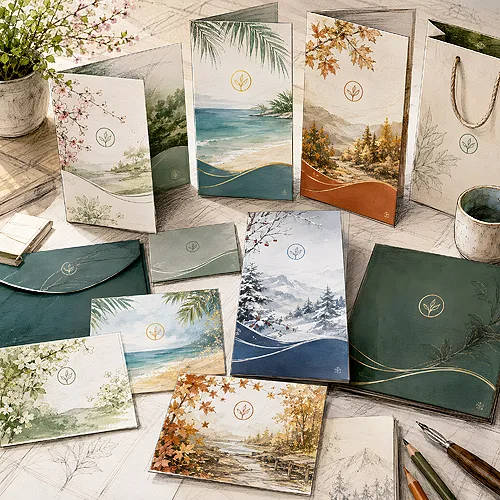
A gift voucher is one of the few printed materials that works on two fronts at the same time. On one hand it is a product in itself - the customer pays for it upfront, before receiving anything. On the other, it is a carrier of advertising that lands in the hands of a completely new person, often on the recommendation of someone they trust. Few printed items can do both these things at once.
That is exactly why a voucher is worth designing deliberately - not as an ordinary card with some text, but as a tool meant to sell something and attract someone. Below we take an advisory approach: what a voucher should contain, how it should look to be worthy of a gift, and what to keep in mind so that it stays secure.
- A voucher works both as a product (prepayment, locked-in sales) and as advertising (it reaches a new person on a recommendation).
- It must clearly state the value or service, expiry date, rules of use and a unique code.
- The look should be worthy of a gift - good paper, finishing, an envelope or a sleeve make the difference.
- Consistency with the brand means the voucher advertises the company by its very appearance, even before it is redeemed.
- Numbering or a unique code protects against copying and makes tracking easier.
The voucher as a double tool
Before we get to the design, it is worth understanding why a voucher is so valuable to a company. It holds two functions that rarely go together in a single material.
The sales function
A voucher is a sale made upfront. The customer pays now and benefits later - and often not themselves, but the person they give it to. That means money in the till before you have even performed the service. What is more, some vouchers are never fully redeemed, and many of them draw in a customer who would not have found the company on their own. A voucher given as a gift is the strongest form of recommendation - someone trusted tells the recipient directly: it is worth coming here.
The advertising function
This is where the second, often underrated role begins. A voucher carries your brand and reaches the hands of someone who may never have heard of the company. All the time it sits in the recipient's wallet or on their desk, it quietly advertises the business. That is why a voucher that looks like a random card wastes this potential - while a voucher designed with thought works like a premium business card that also gives something.
What a voucher should contain
A voucher that is meant to work without misunderstandings has to be unambiguous. The recipient should know at once what they received and how to use it, and the company should have no doubts when redeeming it.
- Value or a specific service - clearly defined, stating what the voucher entitles the holder to. It can be an amount to spend or a specific service or set.
- Expiry date - a legible date by which it can be redeemed. This organises sales and encourages faster use.
- Rules of use - short, simple information on how to redeem the voucher (where, how, whether a booking is needed).
- A unique code or number - the basis for control and security, which we cover below.
- Company details - logo, contact method, address or website, so the recipient knows where to go.
It is worth keeping this information in a clear layout - the most important details on the front, the rules and fine print on the back. A voucher overloaded with text loses its elegance and stops looking like a gift.
Leave space on the voucher to write the recipient's name and a short dedication. A voucher handed over with a handwritten "For Anna, all the best" stops being an anonymous print and becomes a personal gift. It is a small thing that greatly raises the value in the eyes of the person receiving it.
A look worthy of a gift
A voucher is a gift - and it should look like one. The person buying it wants to hand over something they will not be embarrassed by. If the voucher resembles a receipt, all the magic of the gift disappears before the envelope is even opened.
The impression is decided by several things at once. Good, rigid paper gives the feeling of holding something valuable. Finishing - soft touch velvet lamination, a heavier board or a distinct colour accent - lifts the voucher from the level of a printout to the level of a product. Packaging makes a huge difference too: a simple envelope or an elegant sleeve turns handing it over into a moment, rather than passing along a slip of paper. If you want to see how much the way of presenting affects perception, our post on how the arrangement of a product in a box affects perceived value will help - the same principles apply to a voucher. The prestige effect can be carried by the paper alone - Prestige thank-you vouchers are printed on felt-marked and textured stocks that work without any film at all.
You will find ready, polished formats in our range of vouchers, and if you want to build them out with consistent materials for the brand, they pair well with elegant business cards in the same style.
Consistency with the brand
Since a voucher plays an advertising role, it must look like a part of your brand, not a detached add-on. That means: the same colours, the same logo, the same character the customer knows from your other materials.
When the voucher, business card, flyer and website all speak one visual language, each of these elements reinforces the others. A recipient holding a coherent, polished voucher subconsciously assumes that the company behind it is solid and refined too. Consistency builds trust before anyone even uses the service. That is why it is worth treating the voucher as part of a larger whole, rather than a single print ordered in isolation from the rest.
Occasion-based versions
One of the greatest advantages of vouchers is how easily they adapt to an occasion. A gift is usually bought for some reason - and a voucher that reflects that reason sells better and brings more joy.
- Festive - editions prepared ahead of time for the busiest gift season, when people are looking for present ideas.
- Birthday and name-day - warmer, more personal, easy to give at any time of year.
- Occasional - for Mother's Day, Valentine's Day, anniversaries or other moments when a gift almost asks for itself.
All it takes is preparing a few versions of the same voucher with different graphic themes, and it becomes a ready answer to the question "what should I buy" at any time of year. The same mechanism, a different setting - and a new occasion to sell.
Security and control
A voucher has value, so it is worth protecting - both against copying and against mistakes at redemption. This is where numbering and unique codes come in.
Each voucher should have its own number or code that allows it to be identified and marked as used. This gives you control over which vouchers are in circulation, which are already redeemed and which have expired. A unique code also makes simple copying harder - it is more difficult to forge a voucher that carries an individual, recorded number. For the company it means order and peace of mind, for the customer a sense of holding something authentic, rather than a printout anyone can duplicate. Put the numbers and codes into the artwork before you send it - we print exactly what is in the file. How to build such a file is described in our guide on preparing files for print, so everything comes together the first time.
A well-designed voucher is a rare case of a material that earns twice: once at the moment of sale, and again as quiet advertising in someone else's hands. Take care of clear content, a look worthy of a gift, consistency with the brand and secure numbering - and the voucher will stop being just a card with some text and become one of the hardest-working tools in your offer.