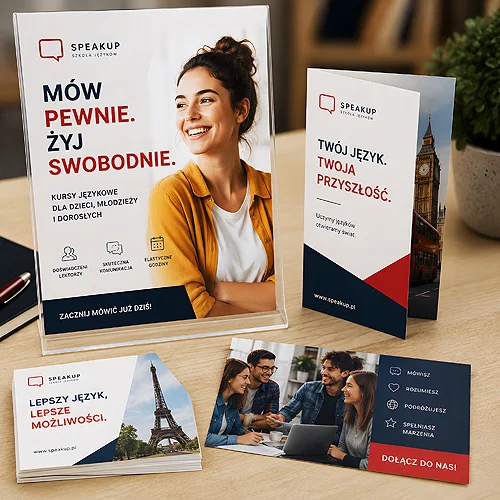
Opening a new venue, clinic or service point is a moment when everything happens at once - the fit-out, the equipment, the contracts, the first staff. It is easy to put printing off for later and wake up a week before the start with no sign, no leaflets and no business cards. Yet it is printed materials that let the neighbourhood learn you exist at all, and that make you look from day one like a company that knows what it is doing.
The good news is that you do not have to print everything at once or guess where to begin. All it takes is a simple checklist and a sensible order - first what draws attention from outside, then what informs the neighbourhood, and finally the materials that build a good impression once people are inside. Below we break it down: what to prepare, in what order, and what to think about in advance so that opening day does not catch you short.
- Arrange your pre-opening print in three layers: what is seen from the street, what reaches the neighbourhood, and what works inside.
- Start with the materials that need the most lead time - a sign and a teaser poster give neighbours time to notice you.
- Leaflets handed out locally build footfall before you even open the doors.
- Have business cards ready for day one - conversations with clients start right away.
- Keep one visual identity across everything: the same colours, logo and typeface from the first material to the last.
Layer one: what is seen from the street
Before anyone steps inside, they first see you from the pavement. That is why external materials are prepared earliest - they give the surroundings time to notice that something new is happening. An empty venue with a good window display can work for you throughout the whole preparation period.
- A teaser poster - an "opening soon" message in the shop window acts like a trailer. It builds curiosity before you even have the interior ready.
- A sign and entrance marking - the name, logo and what you do, legible from a distance. This is the element by which people will remember the place fastest.
- A poster with the date - once the date is set, "opening soon" turns into a concrete invitation to the opening day.
A good advertising poster in the window is one of the simplest ways to get passers-by talking about the new place before you even raise the shutter on day one.
Layer two: announce yourself locally
A service point lives off its neighbourhood. The people who live and work a few streets away are your first and most frequent clients - they just need to find out about you. Print that reaches people directly does this best.
Leaflets dropped into letterboxes, left with friendly neighbours or handed out on the street announce your opening exactly where your future clients actually live. A short, concrete classic leaflet with your name, address, one sentence about what you offer and an invitation to the opening does more than the prettiest post that scrolls by in a second. Paper stays on the fridge or the desk and reminds people about you for days.
It is worth thinking about this ahead of time, because distribution takes a while. A leaflet handed out a few days before the start gives people a chance to plan a visit - handed out on opening day it often arrives after the fact.
Business cards - have them from day one
On the first day something starts that is easy not to foresee: conversations. A supplier, the neighbour from next door, a client asking "do you also do this", someone who wants to recommend you further. Every time, the simplest answer is a business card pressed into a hand.
Classic business cards are a material you simply cannot be without at the start. Make sure they are ready before you open - nothing spoils a first impression like offering to jot a number on a scrap of paper. A small detail, such as matte or Soft Touch velvet lamination on the card, makes the card look solid straight away and more likely to stay in a wallet than in the bin.
Layer three: materials that work inside
Once a client is in, print keeps working - this time on the impression that everything is buttoned up. These are the materials that organise the space and show you take the place seriously.
- A price list or service card - clearly displayed information on what you do and how it works saves questions and builds trust.
- A menu or catalogue - in a restaurant or a salon this is a core sales tool - we print it as a folded menu or a flat menu.
- Signs and small plates - opening hours on the door, directions, zones - small things that make a new client feel at ease.
In sectors where trust matters, internal materials carry particular weight. If you are opening a clinic, it is worth reading our post on which printed materials work well in a medical practice, and for a dental practice - how advertising materials for a dental practice build trust. The same rules - calm, legibility, consistency - work in any point a client enters with a degree of uncertainty.
Write down all your materials on a single sheet and assign each a "ready by" date. Count back from opening day: the sign and posters earliest, leaflets early enough to distribute them, and business cards and interior materials just before the start. Such a reversed timeline keeps anything from being made in a last-minute panic.
Cards and vouchers for the opening
An opening is the one occasion to turn the curious into regulars. A small piece of print with a benefit in hand gives people a reason to come back - and on a specific day, not "someday".
- An opening card - a coupon for a small gift or extra on the first visit.
- A voucher to use later - handed out at the start, it draws the client back once the first wave passes.
- A loyalty card - a simple way to turn a first visit into a second and a third.
Such a material does not have to be lavish - what counts is a clear benefit and a look consistent with the rest. Handed out together with a business card or attached to a leaflet, it gives the opening a second life long after the first buzz fades.
Order and one consistent identity
Finally, the thing that ties all of the above together: the look. Even the best-planned list of materials falls apart if the sign is in different colours than the leaflet, and the business card in yet another set. A client will not analyse this consciously - they will simply feel something is off.
So before you start printing, set a few constants: a logo, two or three colours and one pair of fonts. Then repeat them consistently on every element - from the poster in the window to the loyalty card. If you want that look to really stick in people's minds, our post on how to design advertising materials a client will remember will help.
Opening a new place is not one big print run, but several layers that play together. Start with what is seen from the street, announce yourself locally, have business cards for day one, take care of the interior and give people a reason to return - and keep it all in one identity. Then the day you raise the shutter looks as if you had been running the place all along.