Two cafes stand on the same street. The same coffee, similar prices, both pleasant to their guests. And yet you recommend one to your friends and forget the other the moment you turn the corner. It is not the product that makes the difference - it is how the business stays in your head. For a small firm working in a crowd of similar offers, that is the best possible news: you do not need something no one else has. You need to be remembered.
When a service or product is deceptively similar to what the competition has, the customer rarely chooses the "objectively better" one - because they usually cannot see the difference. They choose what inspires trust, what feels closer, what had a face and a character. And that is good news, because such things can be built without a big budget - consistently and patiently.
Below we show what setting a small business apart really comes down to when the offer looks just like your neighbour's, and where to start if the budget is modest.
- When the offer is similar, the customer chooses what they remember and trust, not the "best" one on a spec sheet.
- Brand, customer experience and details are what set you apart - not the product itself.
- Consistent materials - a business card, a leaflet, a giveaway - create the impression of an organised, credible firm.
- Your company story and hands-on service are advantages a competitor cannot copy.
- Start with one thing done really well, rather than ten done half-heartedly.
Why a "better product" often is not enough
Small business owners easily fall into the trap of thinking that whoever has the better product wins. In practice, the customer rarely compares two similar offers as closely as an insider does. They do not know your technology, cannot tell better beans from worse ones, will not calculate how much more precise your workmanship is. What they do see are simple things: whether the firm looks solid, whether someone picked up the phone, whether they got what they expected.
That means the battle for the customer plays out not at the level of the product itself, but at the level of impression. And you build that impression everywhere the customer meets you - from the first contact, through the materials they hold in their hand, to the way you treat them after the sale.
Stand out through your brand, not a price war
The simplest reaction to similar competition is to lower the price. It is also the fastest road to trouble - because there will always be someone cheaper, and you are left with a thinner margin and a customer who will move on to someone cheaper still anyway. A brand works the other way round: it gives a reason to choose you, even though something similar sits right next door.
Character, not just a logo
A small firm's brand is not a costly rebrand. It is a character you can sense: the tone in which you speak to customers, the colours you use, the way you describe your work. Consider whether your firm is rather elegant, friendly or bold - and stick to that everywhere. If you want to break this down, our post on how a company's personality translates into design will help.
Consistency you can see
A customer will not remember one nice poster. They will remember a firm that looks the same everywhere - the same palette on the business card, on social media, on the leaflet and on the car. Consistency makes a small firm look bigger and more confident than it is. And it does not require changing your logo - you can build it on what you already have. You will find more tips in our post on how to build a consistent visual identity without a big budget.
Customer experience - that is what they remember
The product may be similar, but the way you treat a customer is yours alone. It is the cheapest and most effective advantage a small firm has, because it comes from a closeness the big players do not have time for. Call when you promised. Warn before a problem appears. Remember what the customer ordered last time. These small things cost nothing, and they make the kind of difference the customer will tell others about.
It is worth mapping out the whole customer journey - from the moment they first heard of you to the moment just after the purchase - and at every step asking: what can I do a little better, warmer, more attentively than a competitor? The sum of all those small "a little betters" is exactly what cannot be copied.
Details and materials that stay in hand
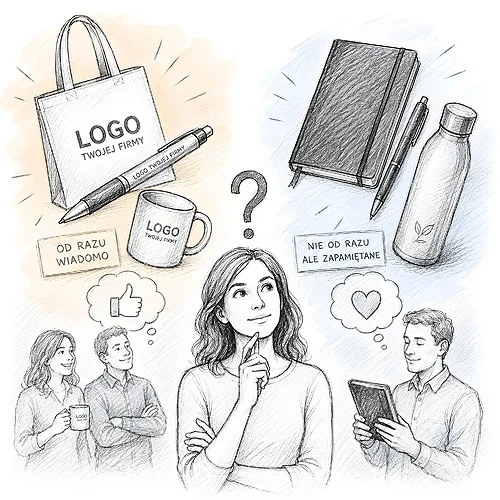
The impression of a firm is also built by physical things - the ones the customer touches and takes with them. A well-designed business card printed on decent paper says more about a firm than a long description. A leaflet you actually want to read, a giveaway that genuinely comes in handy - all of it extends your presence in the customer's mind.
- Business card - most often the first tangible trace of a firm. Thick card, matt film or a velvety Soft Touch coating keep it from landing straight in the bin.
- Leaflet or poster - a carrier of local recognition, as long as it looks consistent with the rest.
- Branded giveaway - a small thing that stays on the desk and reminds people of you every day.
A giveaway alone will not work miracles, but a well-chosen one can genuinely work for the brand. We wrote about it in our pieces on how to design a gift that will not end up in a drawer, and on whether branded pens are a cheap gadget or an effective tool. If you are after specifics, take a look at our range of business cards and promotional giveaways.
Before you order anything, set three constants: two company colours, one typeface and one recurring detail - it could be a mark, a slogan or a distinctive shape. Stick to them on every material. This simple discipline will do more for recognition than a single expensive campaign.
Your story is an advantage that cannot be copied
A competitor may have a similar product, but they do not have your story. Why did you start? What do you do differently, and why does it matter to you? Who is behind the firm? People buy more readily from people than from anonymous signage. A short, honest story - on the "about us" page, on a leaflet, in conversation - turns a similar offer into something personal.
This is not about inventing a legend, but about showing a real face. A photo of the owner instead of a stock graphic, a sentence about where the idea for the firm came from, a mention of local roots - all of it builds a closeness that big, faceless players cannot recreate.
Where to start on a modest budget
You do not have to do everything at once. It is better to do one thing properly than ten by halves. We suggest this order:
- Define the brand's character - colours, tone, one recurring detail. This is the foundation everything else rests on.
- Sort out the business card - the most common first contact, and an inexpensive place to start.
- Bring your basic materials into line - the leaflet, social media and your email signature in the same style.
- Add one well-chosen giveaway - one your customer will genuinely use.
- Refine your service - map the customer journey and improve the points where you can be warmer and more attentive.
Setting a small firm apart rarely comes from one brilliant idea. It comes from consistency - from looking and behaving everywhere like the same organised firm with a character. When the offer is similar, it is precisely that consistency that makes the customer choose you and come back. And that does not take a big budget - it takes an idea carried through to the end.