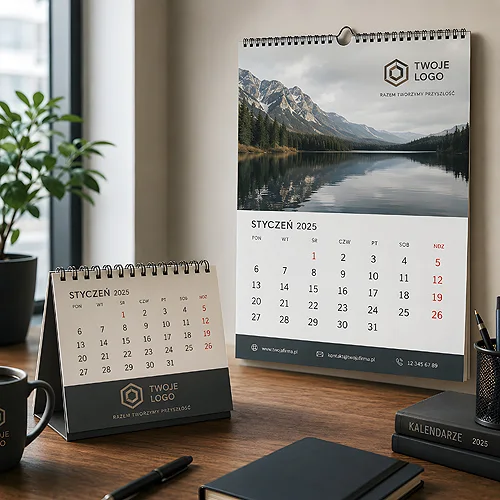
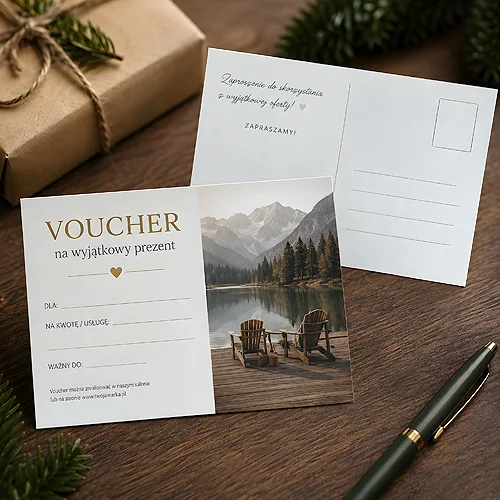
A flyer on its own has one weakness - it is light, feels cheap to receive and is easy to throw away. Yet all it takes is pairing it with something that has real value for the recipient: a product sample, a small gadget or a voucher for the next purchase, and that same piece of paper suddenly starts working in a completely different way. A person who receives something tangible pauses for a moment longer - and that moment is yours.
This is not a marketing trick, just simple psychology. When you attach something useful to a flyer, the recipient treats the whole thing as a gift rather than an advert. Below we show how to match such an add-on to your campaign goal, how to combine it with the print technically, and how to avoid overpaying when you build such a set at scale.
- A flyer with an attached element of real value stays in hand longer and less often ends up in the bin.
- A sample works when the product needs to be felt; a gadget - when you want to stay on the desk; a voucher - when you care about the return.
- Match the add-on to the goal: first impression, building a relationship or an incentive to buy.
- Keep it coherent - the flyer and the add-on should look like one set, not two random things.
- A voucher needs clear rules and a way to settle it, so the campaign does not fall apart.
Why paper alone is not enough
A classic flyer competes for attention with dozens of other stimuli. The recipient judges it in a fraction of a second and either keeps it or sets it aside. An add-on changes that maths, because it gives a reason not to throw the flyer away straight away. A cream sample worth testing, a magnet that lands on the fridge, or a voucher that would be a shame to waste - each of them buys you extra time in the customer's mind.
It is worth returning to the basics of good design here. Before you add anything, the flyer itself has to carry a concrete value and a clear message. If you are looking for a starting point, take a look at our post on how to design a flyer the customer will keep for later - an add-on reinforces a good design, but will not fix a weak one.
Three routes: sample, gadget, voucher
Each of these add-ons serves a different goal. Before you choose, answer one question: what should happen after the recipient picks the flyer up?
- Product sample - best when your product needs to be touched, smelled or tested. Cosmetics, coffee, a sweet, a material. The recipient convinces themselves rather than reading about the benefits.
- Small useful gadget - works when you want to stay longer in the customer's surroundings. A magnet, a bookmark, a sticker, a pen. It does not have to be expensive - it has to be used.
- Voucher for the next purchase - turns a one-off contact into an incentive to return. Ideal when you care about a second visit or a first online order.
How to choose the right add-on
The point is not to attach just anything. The add-on should suit the product and the moment it reaches the recipient. At a trade fair a sample works better, because people want to try things on the spot. In a parcel to a regular customer a voucher or a small gadget fits more naturally, reminding them of the brand between purchases. In local door-to-door distribution what counts is something with a chance of staying at home - a magnet or a sticker that ends up on a laptop or the fridge.
Before you order a large run, run a small test on one group of recipients. Prepare two variants - a flyer with a sample and the same flyer with a voucher - and see which set more often leads to contact. A few dozen pieces are enough to see the difference before you invest in the full campaign.
How to combine it technically
A good idea can be spoiled by sloppy execution. The set has to be convenient to hand out and look like one whole, not a flyer with a randomly attached thing. There are a few proven ways to combine print with an add-on.
- Folded flyer as a wrap - a folded flyer closes around a flat sample, a sachet or a voucher card, and a band or a bag holds the set together. The whole thing holds together and is nice to hand over.
- Voucher as part of the flyer - a tear-off coupon or a clearly separated area on a classic flyer means there is nothing to lose. One print, two functions.
- Shared packaging - a bag, a wrap or a sleeve ties the flyer and the gadget into a set that looks like a considered gift.
- Consistent graphic style - the same colours, the same style and logo on the flyer and the add-on. This is the cheapest way to make the whole thing look more expensive than it cost.
Visual coherence is exactly what matters. If the voucher or sticker is kept in the same palette as the flyer, the recipient reads it as one polished campaign. A stylistic mismatch works the opposite way - it signals the add-on was tacked on by force.
A voucher that actually works
A voucher is the most demanding of the add-ons, because beyond the design you have to think through the rules of how it works. A badly built one either will not be redeemed or will blow your budget. A good structure is simple and honest.
- A clear condition - state plainly what the recipient gets and what they have to do. The fewer asterisks and exceptions, the more people will use it.
- An expiry date - a specific date gives a reason not to put it off. Without a date the voucher lands in a drawer and stays there.
- A way to redeem - a code to enter, a coupon to hand in, or a QR code leading to a specific offer. Pick one route and make it flawless.
- Settlement - plan how you will count how many vouchers came back. That is your measure of the whole campaign's effectiveness.
If you care about a single, elegant carrier of value, ready-made vouchers work well - as a standalone voucher attached to a flyer or as the second part of a set. It is also worth reading our post on flyers inserted into parcels, because pairing a voucher with a package is one of the most effective ways to drive repeat sales.
How not to overpay at scale
A flyer-plus-add-on set sounds more expensive than a flyer alone, and sometimes it is - but it does not have to wreck the budget. A few rules keep the cost in check when you scale the campaign to a larger run.
- Choose an add-on cheap to produce but valuable to receive - a magnet or a sticker costs little, yet stays around for a long time.
- Combine the print into one order - a flyer and a voucher printed together come out better than two separate projects made at different times.
- Do not personalise everything - a named add-on makes an impression, but for a large run a consistent, well-designed set for everyone is enough.
- Order with a reasonable margin - a small reprint can cost more than one larger run up front, but do not freeze the budget in thousands of pieces you will not hand out.
If you want to compare what stays with the customer the longest and whether it is worth going for a more durable carrier, our post on what stays with the customer the longest will help. The whole idea comes down to one thing: the flyer opens the conversation, and the thing attached to it gives that conversation a chance to last. Start with the goal, choose the add-on that fits it, and make sure the whole thing looks like one considered gesture - then even the simplest print starts to work much harder.