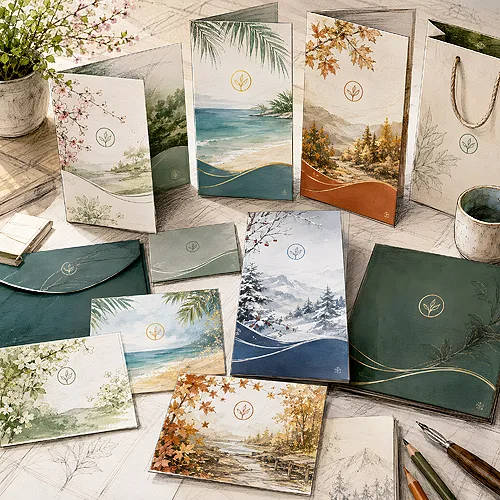
A good promotional gift does not shout. It does not have to. It sits on a desk, in a cup of pens, or slips into a bag at checkout - and quietly does its job. A customer reaches for it because it is genuinely useful, and the brand stays with them longer. That is a completely different school of thought than flooding people with a logo from every angle. In reception, the office and at the point of sale, what works best is whatever is convenient, tasteful and suited to the place.
- Usefulness beats loudness - a gift people actually use reminds them of the brand every day.
- Branding should be subtle: a tasteful logo, good finishing, consistency with your other materials.
- Match the item to the place - reception, office and point of sale follow different rules.
- Less but better: a few thoughtful items work harder than a pile of cheap advertising.
Why a discreet gift works better
People have a defensive reflex toward advertising. The more something pushes, the faster it lands in the bin. Let us flip that thinking: instead of asking "how do we make the logo as big as possible", let us ask "what will genuinely come in handy and carry the brand along the way".
A gift that gets used has one huge advantage over ordinary advertising - contact time. A notepad sits on a desk for weeks. A pen travels from bag to bag. A mug is there for the morning coffee. Each of these encounters with the brand is pleasant, because it is tied to convenience rather than nuisance.
There is a second benefit that is easy to forget: a good small item says something about the company before anyone reads the offer. Solid finishing, a pleasant material, branding done with taste - all of this hints that you have an eye for detail. And a customer who sees care in the small things is more willing to trust you with the bigger ones.
The best advertising is the kind a customer reaches for on their own - because it is useful, not because it was forced on them.
Reception and waiting area - a pleasant first impression
Reception is the point of first contact. Someone waits, looks around, reaches for a pen to jot something down. It is the perfect moment for a small item that quietly says "we are well organised and we thought of you".
What works here are things to grab right away: elegant pens with discreet engraving, notepads, sticky notes, desk pads. The point is not to bury the counter under materials. A few thoughtful pieces, arranged with taste, are enough.
- Pens and notepads - a classic that anyone waiting will reach for.
- Desk pads and sticky notes - handy when filling in forms or noting down an appointment.
- Items to take away - something a guest can grab without feeling awkward.
In reception, aim for consistency. If your pens, notepads and sticky notes share the same colours and the same branding style as the rest of your company materials, the whole thing looks professional - and that stays in memory more strongly than the biggest logo. With the pens themselves the ANI helps here - you can pick a barrel close to your company colour, and laser engraving keeps one marking style across the whole batch.
The office - everyday items
In the office a gift has two audiences: employees and guests. For both, the same thing matters - that the item is genuinely used. A mug for the morning coffee, a notepad for meeting notes, a flash drive for moving files. These are objects that fit into the rhythm of the day.
For the team, such an item is also a signal that the company cares about details. A tasteful notepad or a solid mug lifts everyday comfort and, along the way, builds a sense of belonging. A guest who receives something useful instead of yet another leaflet remembers the meeting differently.
- Mugs and desk accessories - present all day long, so visible without any effort.
- Notepads and calendars - a natural spot for discreet branding.
- Flash drives and small electronics - practical, they travel between meetings.
The key rule: quality over quantity. One solid item people want to use will do more than a pack of cheap gifts that end up in a drawer straight away. From the things we make ourselves, pens and flash drives fit this role - we brand both to match your identity.
Point of sale - a small gift with the purchase
At the till or when handing over an order there is room for a small, pleasant gesture. A little gift added to a purchase works like a thank you - and reminds people of the brand once they are back home. A receipt holder works at the till too, handing over the proof of purchase together with a voucher or a business card.
Here too usefulness wins. Something a customer will actually use will be linked with a positive feeling every time. It matters that the gift fits the character of the place and what someone has just bought - an item chosen with sense makes a better impression than a random gadget from a box.
Such a gesture has another nice quality - it surprises. Nobody expects a gift at pickup, so a small surprise stays in memory and often comes up in conversations with friends. It is advertising you cannot buy with impressions: a first-hand recommendation built on a good impression. All it takes is for the item to be sincere and considered, rather than treated as an obligatory add-on.
Match the gift to the moment and the recipient. One item suits an accessories shop, another a clinic, and yet another a restaurant. That small relevance makes the gesture look considered rather than handed out en masse.
Rules that connect all three places
Whether we are talking about reception, the office or the point of sale, a few of the same rules hold. It is worth sticking to them every time you plan branded items.
- Usefulness over loudness - if the item is handy, the brand carries itself.
- Subtle branding - a tasteful logo, good finishing, no overload.
- Consistency - colours and branding style aligned with the rest of your company materials.
- Fit to place and recipient - one item for the waiting area, another for the desk, another for the bag at checkout.
- Less but better - a few thoughtful items instead of a pile of cheap advertising.
If you want to dig into the philosophy behind this approach, take a look at the post on how to turn an everyday object into a carrier of advertising. It is also worth reading why the usefulness of a gift matters more than a low price - these are the two pillars of what we describe here.
Where to start
You do not have to plan a whole campaign at once. Pick one place - reception, for example - and think about which item would genuinely be useful there. Then choose consistent branding and see how people react. Step by step you will build a set of things that work for the brand without effort and without being pushy.
If you want to browse specific ideas or refine a design, drop by our catalogue - and when questions come up about finishing or branding, we are here to help.