
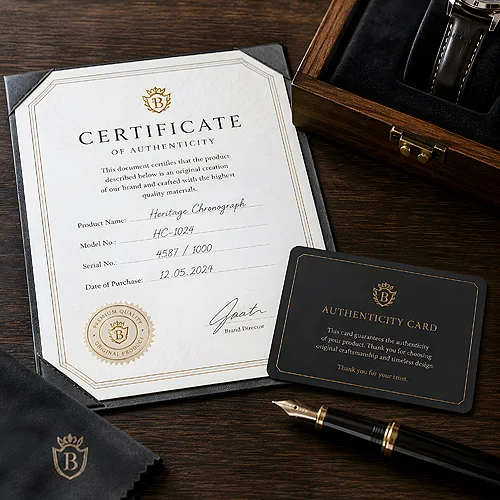
A customer holds your product and asks themselves a quiet question: is this really an original, did someone put their heart into it, was it worth paying that much? A printed certificate or authenticity card answers all three at once - with a single gesture. It is not decoration added for effect, but tangible proof that the product is what it claims to be.
But not every product needs such a document. Added without reason, it looks pretentious and spoils the impression. This post is about when a certificate truly raises value, what it should contain, which paper and finish build prestige, and how to tie it to the brand so it becomes part of the buying experience rather than a stray slip of paper.
- A certificate of authenticity makes sense where origin and uniqueness matter: premium products, handmade goods, limited editions, numbered series.
- A good certificate contains a number, a description, a signature or seal and - when needed - a security element.
- Paper and finish build prestige: texture, a velvet Soft Touch film and refined paper do more than the text itself.
- Consistency with the brand is key - the certificate should look like an extension of the logo, not a foreign print.
- A certificate works best as part of opening the package, not as an add-on stuck on after the fact.
- Basic protections (numbering, signature, hard-to-copy paper) make forgery more difficult.
When a certificate makes sense
The rule is simple: a certificate works where the customer genuinely wonders about the origin, authenticity or uniqueness of the product. If there is no such question, the document is just paper to be thrown away. There are, however, a few situations in which it raises value quite naturally.
- Premium products - when price and positioning are high, the customer expects confirmation of quality. A certificate completes the sense of paying for something thought through to the end.
- Handmade goods - with handmade items, the certificate tells a story: who made it, where and from what. It is a document of authorship that builds a bond with the maker.
- Limited editions - the information that a product belongs to a closed series changes its status. Limited availability in itself raises perceived value.
- Numbered series - a note in the style of one of a set number gives a sense of uniqueness. The customer knows they have a piece that cannot be freely reproduced.
In these contexts a certificate is not an ornament - it is an answer to a real customer need. Beyond them it is worth thinking twice, because a document without a reason can be read as an attempt to inflate value. We describe a similar mechanism when writing about collectible gadgets and limited series - there too what counts is the sense that a thing is special, not mass-produced.
What a good certificate should contain
The content of a certificate must be concrete. Generalities like we guarantee the highest quality sound empty - the customer looks for facts that confirm authenticity. It is worth sticking to a few constant elements and not cluttering the document with the rest.
- Piece or series number - the most important element. It is what turns a print into a unique document assigned to a specific item.
- Product name and description - a short, factual note on what the certificate concerns. Material, technique, date of creation, if they matter.
- Signature or seal - of the author, maker or brand. A signature carries authority and personal responsibility for quality.
- Date and place - anchor the product in time and space, which can matter for editions and for resale.
- A security element - if the product calls for it: a unique code, a holographic sticker, a special paper. We cover security below.
Less is more
A certificate that tries to say everything says nothing. It is better to leave plenty of space around the content, foreground the number and signature, and keep the rest to a minimum. Elegance comes from restraint - a densely printed card looks like a flyer, not a document.
Design the certificate around one strong element - usually the piece number. Let it draw the eye, and let the rest of the content merely support it. A clear hierarchy makes the document look serious from the first second.
Paper and finish that build prestige
Half the magic happens here. The same text printed on thin, smooth paper and on thick, textured card are two different worlds in perception. A certificate is felt in the hands before it is read - and it is touch that decides the first impression.
- Paper texture - lightly rough, refined paper immediately communicates value. Fingers sense the difference, and the product gains gravitas.
- Weight - a stiffer card holds in the hand like a document, not a sheet. Weight itself suggests quality.
- Velvet Soft Touch film - a velvety, matte finish across the whole card adds depth and makes the certificate pleasant to hold.
- Matt film - a muted, elegant finish across the whole card that does not reflect light and makes the document look discreet and serious.
It is worth matching the choice of paper to the character of the product - a different mood suits handmade goods, another a modern premium brand. If you are unsure which stock to choose, take a look at our help on materials and papers, where we explain the differences between textures and weights. The certificate itself you can order as a classic print in the form of letterhead with your identity, or as a stiffer card - in which case reach for a printed certificate, the product where a heavier stock and lamination are on the list. The classic option is a ready-made letterhead sheet - it goes through a printer and takes a stamp, so you add the piece number and the signature yourself.
Consistency with the brand
A certificate that looks different from the rest of a brand's communication arouses distrust rather than dispelling it. It should be recognisable as yours - the same palette, the same typeface, the same logo as on the packaging and materials. Then the document is not a foreign print, but a natural extension of the identity.
It is worth thinking about the certificate together with the whole presentation of the product. If the product reaches the customer in packaging with documents, it helps when the certificate, warranty card or manual share a graphic language. A practical carrier for such a set is a branded folder in the brand's colours - it holds the papers together and immediately raises the standing of the whole. The same coherence effect that builds trust we describe more broadly in the context of the difference between shipping and gift packaging.
The certificate as part of the buying experience
A certificate has the greatest value when it is woven into the moment of opening the product, not forced on as an afterthought. The order of discovery builds the impression: the customer first sees the packaging, then the product, and the certificate appears as confirmation that they made a good choice.
- Plan the certificate's place - on top, in a separate pocket or under the product. That is a design decision, not chance.
- Tie it to the rest of the presentation - a shared theme with the packaging makes the whole read as one.
- Leave it to be discovered - a certificate under tissue or in a sealed envelope works better than one lying loose on top.
- Ensure durability - a document the customer wants to keep should survive years in a drawer without yellowing or creasing.
Treated this way, a certificate stops being paper and becomes part of a story the customer tells on. It is often what remains after the product is worn out - as a keepsake and proof that the thing was special.
Protection against forgery
The more desirable the product, the greater the temptation to counterfeit. A certificate will not give one-hundred-per-cent protection, but a few simple layers make copying significantly harder and raise credibility in the customer's eyes. It is worth reaching for those that suit the scale of the product.
- Unique numbering - each piece with its own number, linked to internal records. A basic measure that in itself hinders mass copying.
- Hard-to-reproduce paper - a particular texture, weight or shade that cannot easily be matched on an ordinary printer.
- A fine background pattern - an intricate guilloche pattern, like on banknotes, is hard to reproduce on an ordinary printer and instantly reveals an attempted forgery.
- A security sticker - a hologram or a single-use label that destroys itself when someone tries to peel it off. That is a separate security measure, added outside the printing of the certificate.
The point is not to turn the certificate into a banknote - only to raise the difficulty enough that forgery stops paying off. The mere awareness that a product carries a numbered, hard-to-copy document acts as a deterrent.
A printed certificate is an unassuming element that can change how a customer sees the whole product. Do not add it on autopilot - but where origin, uniqueness and prestige matter, a well-prepared authenticity card does what no advertisement can: it says in silence that this is an original worth its price.


