Same item, same print, same logo - and yet one ends up in a drawer while the other sits on a shelf next to someone's favourite things. The difference often has nothing to do with the object itself, and everything to do with there being so few of them. A numbered, limited edition can turn an everyday item into something people ask about, look for and talk about. Let's look at when such an edition makes sense - and how not to overpay for it with emotion.
- A limited number of pieces triggers a sense of scarcity - the item becomes more desirable simply because there is so little of it.
- A limited series builds emotional value and community around a brand, not just hands out objects.
- It works best on occasions: anniversaries, events, seasonal editions and rewards for the most loyal people.
- Details decide: packaging, quality and a consistent story. Without them it is just an ordinary gadget with a "limited" label.
Why a limited series works at all
Behind the "I have to have this" reaction lies a simple mechanism - things that are scarce feel more valuable to us. When it is clear from the start that only a set number of pieces will exist, the item stops being "one of many". It becomes something you either get, or miss out on.
On top of that comes a layer of emotion. A limited item carries a story: who received it, on what occasion, why right now. Such an object is harder to throw away and easier to show to friends. And showing off is the best kind of advertising for a brand - honest, first-hand and free.
There is also a third, often underrated effect. People who own the same limited item feel they belong to a shared group. That is the seed of a community around a brand - people who identify with it, rather than just buying something from it now and then.
An ordinary gadget tells you a brand exists. A limited one makes someone want to be part of it.
When a limited edition really makes sense
A limited series is not an everyday idea - and that is a good thing. Its power comes precisely from appearing rarely, on a specific occasion. Here are the moments when it works best.
- Company anniversaries - a round number of years is a natural excuse for something special that commemorates the brand's journey.
- Events - a launch, a conference, the opening of a new place. An item with the date and theme of the event becomes a keepsake.
- Seasonal editions - holidays, the start of summer, a "one season only" version that never comes back.
- Rewards for the best clients and brand fans - something you cannot simply buy, only earn or receive as a thank you.
The common denominator of these situations is a reason. A limited series needs a story that explains why it came to be. Without one, "limited edition" sounds like a trick rather than a gesture.
Before you set the run size, write one sentence: "This series was created because...". If you cannot finish it in a way that sounds honest, it is a sign that a limited edition is still premature.
How to do it well - the details that make the difference
The "limited" label alone settles nothing. Desire is built by specifics you can see and feel in your hand. A few of them matter most.
Numbering
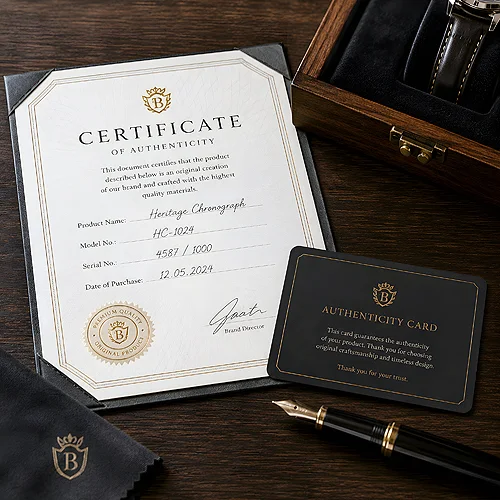
"Piece 12 of 100" is one of the strongest signals of uniqueness. A number makes the item no longer anonymous - it becomes a specific, one-of-a-kind piece. We do not print piece numbering - our variable data is limited to name personalisation on invitations, diplomas and place cards. The number can be written by hand on a card that comes with the edition, and the effect is the same.
Special packaging
The impression begins before anyone even reaches for the item itself. A solid box, a decorative band, a few words of thanks inside - all of it raises the standing of the gift. It is worth considering consistent packaging. If the edition takes the form of a release or a disc, look at the 4P digipack - cardboard packaging with a pocket that holds a booklet, a ticket or a folded poster.
Quality
A limited series has to feel noticeably better than an ordinary giveaway. A better material, more careful finishing, a print that is nicer to the touch. If the edition is meant to be a keepsake for years, it has to survive those years - both aesthetically and physically.
A consistent story and theme
The best series have a thread - a colour, a symbol, a slogan, a graphic style - that runs through every element. That way the set looks like a thought-through whole, rather than a random object with a logo stuck on.
If you are looking for a carrier that will support such a narrative well, take a look at a branded USB drive - it is an everyday item that stays with a person for a long time, and in a limited version it is easy to give it a collectible character. You will find more ideas for durable, useful brand carriers in our product catalogue.
When it is better to stick with a regular series
A limited edition is not always the best idea - and that has to be said honestly. There are situations where an ordinary, repeatable series will do the job better.
- When you are after reach, not exclusivity - if the goal is to get your logo to as many people as possible, artificially limiting the number of pieces works against you.
- When there is no real reason - a limited series without an occasion and a story quickly reveals that it is just a gimmick.
- When the item is simply meant to be practical - some gadgets are just meant to be used every day, and that is their full value.
It is also worth remembering that desire comes from usefulness and quality, not from a label on a box. We develop this thread in our piece on why a gadget's usefulness matters more than a low price. And if you are weighing up the scale of production itself, our take on when it is worth ordering gadgets in small runs will come in handy.
You do not have to choose once and for all. Many brands run a permanent, practical series for everyday communication and release one limited edition "for the occasion" once a year. The regular one builds reach, the limited one - emotion and story.
From idea to finished edition
A good limited series starts with a decision, not with a print. First the reason and the story, then the run size, and only at the end the choice of item and finishing. In that order it is hard to go wrong.
If you want to prepare the files so the edition artwork comes out perfectly, take a look at our file preparation guide. And once the idea has matured and you want to discuss the specifics - get in touch through our contact page. We will help you turn a good idea into an edition people will genuinely reach for.