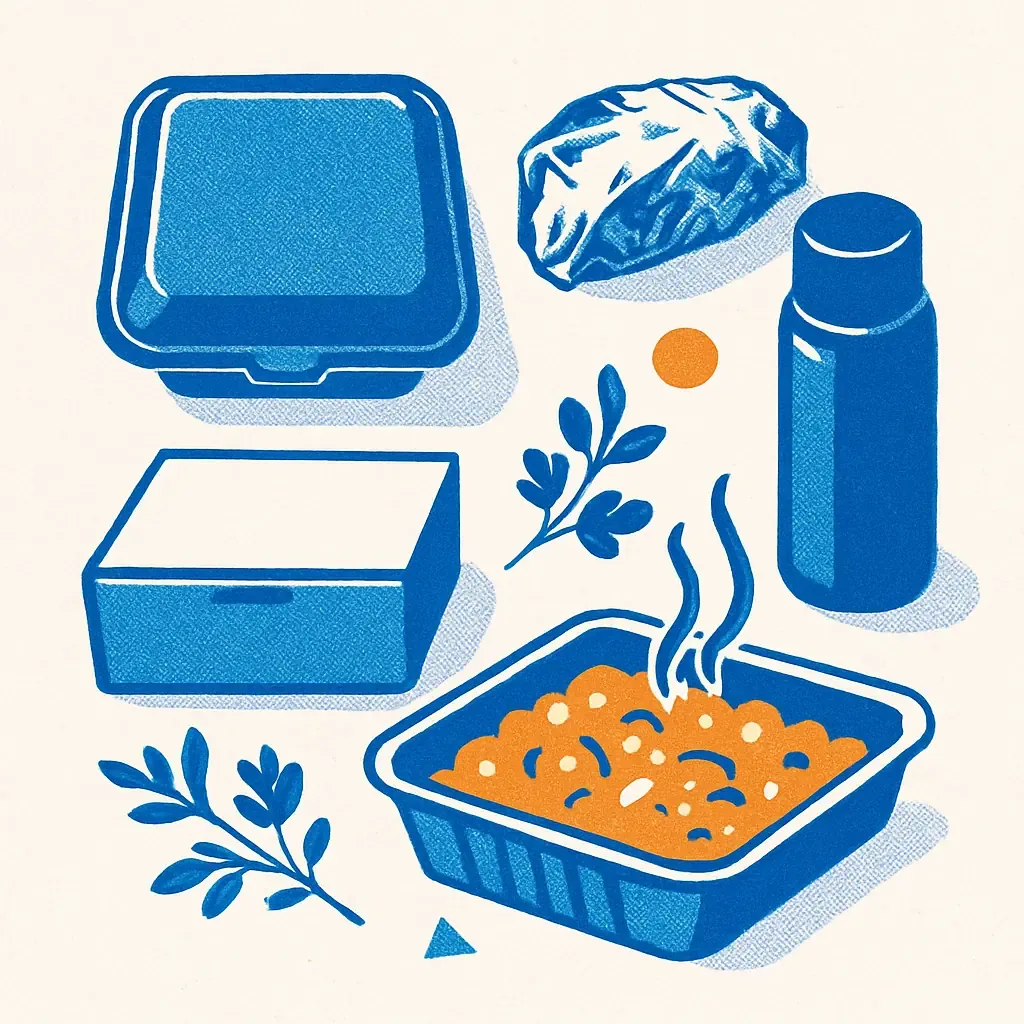
The change in legislation regarding single-use plastics has turned the gastronomic packaging market upside down. Classic styrofoam (EPS), which was once the standard in every snack bar, is now simply illegal for packaging takeout food. In this text, we present five viable options that keep temperature, do not leak en route to the customer, and do not expose the establishment to penalties.
- Styrofoam EPS is banned - since May 2023, it cannot be legally used for takeout dishes.
- XPP is the legal successor to styrofoam - similar insulation, microwave safe, recyclable.
- Coated cardboard builds a premium image, but performs worse with soups and sauces.
- Aluminum works well for longer transport and baked dishes but is only cheaper with large orders.
- PP with a window is a compromise: you can see the dish, it can be sealed tightly, but you have to reckon with an additional charge for plastic.
1. Styrofoam containers: why it's no longer a choice, but a risk
Let's start with something that surprises some restaurateurs. Classic styrofoam (EPS) for takeout food has been banned in Poland since May 24, 2023, as part of the EU SUP directive. It's not that it has suddenly become "unfashionable" - it is simply illegal to introduce such packaging into circulation. If there are still boxes of old styrofoam containers in the establishment's warehouse, it's time to dispose of them, not sell them.
The good news is that there is a material that has inherited the best features of styrofoam but has not fallen under this ban. It’s XPP, or expanded polypropylene. It looks similar, insulates heat equally well, but additionally can be put in the microwave, which classic styrofoam never offered. XPP is not subject to SUP fees, and is fully recyclable. A two-compartment Menubox container made from this material costs about 1.06 PLN net per piece in wholesale when purchased in bulk packages of 50.
Who is it a good choice for? For points with lunch dishes like cutlet with potatoes and salad, where maintaining heat for 20-30 minutes of transport is most important, and visual presentation is not a priority. It performs worse where the customer pays for the experience, not just for fullness, because the aesthetics of these containers are more functional than elegant.
If "styrofoam EPS" still appears on invoices from suppliers as a description of the container for hot dishes, ask directly about the composition. Some sellers still use old trade names for new materials, which can be misleading during inspections.
2. Coated cardboard containers: an ecological alternative for premium establishments
Coated cardboard (usually PLA, which is a biodegradable laminate) is an option that tells customers "this establishment cares about details." Paper boxes with a window, in a typical size close to 23 by 15 by 5 centimeters, cost in wholesale from about 1.22 to 1.39 PLN per piece, depending on the variant and manufacturer. This is more than simple plastic, but the difference in customer perception can be worth the price.
This type of packaging works best for burgers, sandwiches, warm salads, grilled dishes, or snacks, where there is not a large amount of liquid sauce. The coating protects against soaking for a certain time, but it is not a material designed for soups or dishes flooded with tomato sauce halfway up the container. With prolonged contact with fat or moisture, the cardboard begins to soften, and that’s a straightforward path to complaints.
Establishments that opt for this material usually consistently care about the coherence of the entire visual communication, from the sign to the menu. If a restaurant decides on an elegant cardboard for takeout, it’s also worth thinking about what the eco folding menu looks like on tables in the dining area, because customers who order takeout often eat on-site beforehand and remember this same graphic style.
Regarding ecology, it is worth knowing that entrepreneurs introducing packaging to the market incur product fees dependent on the material. Plastics cost 2.7 PLN per kilogram, aluminum 1.4 PLN per kilogram, and ferrous metals 0.80 PLN per kilogram. Coated biodegradable cardboard usually performs better in this comparison than pure plastic, which is of real financial significance for establishments with a high volume of orders, not just image.
3. Aluminum containers: quick cooling, heating, and long-distance transport
Aluminum has its specific physics that must be taken into account. On the one hand, it conducts heat excellently, so a dish can be quickly heated in the oven along with the container, which is a huge advantage for baked dishes, lasagna, or larger portions of meat cooked in its own sauce. On the other hand, this same property means that a dish cools just as quickly if the container is not tightly covered with a lid, preferably with sealing foam.
This makes aluminum best suited for situations where transport takes longer, for example, for catering deliveries across the city or for corporate orders of dozens of portions at once. In such cases, the containers travel in thermal boxes or thermal bags, which mitigate the drawback of rapid cooling, and the advantage is that the dish can be placed directly in the customer’s oven without transfer.
It’s also worth looking at this from the perspective of environmental fees. Aluminum packaging is subject to a product fee of 1.4 PLN per kilogram, which is significantly less than plastic at 2.7 PLN per kilogram. For a restaurant that accounts for packaging costs on a monthly scale, this can realistically influence the pricing calculation for takeout dishes, especially with large container formats used in catering.
The downside is that aluminum is not suitable for microwaving (metal in a microwave is a simple recipe for trouble), so if a customer wants to quickly reheat a dish in the office, they must transfer it to a plate. This should be noted on the label or in the description of the takeout dish to avoid unnecessary questions for the staff.
4. PP containers with a window: presentation of the dish and sealing during delivery
Polypropylene with a transparent window is a material that solves one specific problem: the customer wants to see what they are buying before opening the container. Salads, pastas, Asian dishes with vegetables in colorful sauce, poke bowls, all look appetizing through the clear lid, which is especially important for orders made through apps, where the photo of the product directly influences the purchasing decision.
In terms of price, it is one of the cheaper options on the market. Simple rectangular plastic containers with a capacity of 500 milliliters, in packages of 100, wholesale cost about 21.30 PLN per package, which is less than 25 groszy per piece. The low unit price is the main reason this material still dominates in the fast-food segment.
However, one must account for additional costs that are not immediately visible in the wholesaler's price list. A fee of 25 groszy per piece for each disposable plastic container with a lid is charged to the customer’s bill. Additionally, there is the aforementioned product fee of 2.7 PLN per kilogram for the manufacturer introducing the packaging to the market. In practice, this means that a seemingly cheap PP container does not necessarily have to be the cheapest in total calculations when these two items are added.
It’s also worth looking at the long-term perspective. The roadmap of the EU plastic directive assumes that by the end of 2026, the consumption of certain single-use plastic packaging, including food containers, will measurably decrease compared to the 2022 level. This is a signal that the gastronomic industry will sooner or later have to limit the share of plastic in its packaging assortment, regardless of how convenient and cheap it is today.
5. How to match the packaging to the type of dish, transport time, and brand image
There is no one universal packaging that fits every dish. Soup requires something completely different than a burger, and corporate catering for fifty people operates under different rules than delivering a single portion of pad thai across the city. Here’s a practical decision-making key:
- Soups and dishes with a lot of liquid - opt for a tight closure type clic in PP containers or aluminum with a well-pressed lid. Cardboard is out of the question, as it will leak sooner or later.
- Burgers, sandwiches, grilled dishes - coated cardboard or a light box with a window, as the breathable material prevents the bun from softening from steam.
- Asian dishes, pastas, salads - PP with a window works best, as the customer can see the product, and the structure allows for tight sealing while maintaining low weight.
- Baked and casserole dishes for longer transport - aluminum, preferably in a thermal box, keeping in mind that the customer may place it directly in the oven.
- Short trips up to 15 minutes within one district - almost any packaging suffices, so here price and image matter more than thermal insulation itself.
Transport time is an underestimated parameter altogether. For a delivery lasting several minutes, even a standard container will maintain the appropriate temperature, but for routes longer than half an hour, the difference between XPP and thin plastic becomes noticeable, especially in winter. It’s worth testing this on a trial batch of orders before deciding on a single delivery standard for the entire establishment.
Planning packaging orders should be spread out over time, similarly to other printed materials and occasion prints, where a good example is the schedule for ordering wedding invitations set well in advance to avoid shortages during the peak season. In gastronomy, this works the same: an increase in takeout orders before holidays or during the heating season can wipe out the wholesaler's stock of popular formats.
Brand image is the last, but by no means least important element of the puzzle. An establishment that invests in aesthetic packaging usually also cares about the consistency of the rest of the materials in the dining area, from elegant presenters with printing on the table, through triangular presenters with the daily specials, to simple eco non-folding menus for guests ordering on-site. A customer who receives a dish in a visually appealing, consistent packaging is more likely to associate it with a specific brand, rather than just "some restaurant from an app."
If the establishment is planning to refresh its menu at the same time, a good moment is to compare several options, such as a folded menu for the dining area and a simpler eco version for serving at the counter for takeout, along with additional pyramid displays with promotions set close to the cash register, where the customer decides on additional takeout orders.
Frequently asked questions
Are styrofoam containers for takeout completely banned in Poland?
Yes, since May 24, 2023 there has been a ban on placing styrofoam (EPS) containers and cups intended for direct consumption of food for takeout on the market. The equivalent with similar thermal insulation properties is XPP, or expanded polypropylene, which is not subject to this ban.
Is there an additional fee for every plastic takeout container?
Yes, for disposable plastic food containers with lids, there is a fee of 25 groszy per piece, and for disposable cups for drinks with lids, 20 groszy per piece. This fee is charged to the customer upon purchase and is usually visible separately on the receipt.
Which packaging best retains heat for a longer time?
XPP and aluminum containers perform best in this regard, especially with the additional use of a thermal bag during transport. Coated cardboard and PP plastics have worse thermal insulation and perform better over short delivery distances.
Can aluminum containers be placed in the microwave?
No, metal in a microwave is dangerous and can damage the appliance. Dishes in aluminum must be heated in a conventional oven or transferred to a plate before microwaving.
When choosing packaging, it is worth looking at three things simultaneously: what we are packaging, how long it takes to get to the customer, and what image we want to be associated with. If I had to point out the three safest options to start with, they would be: XPP for lunch dishes requiring good insulation, coated cardboard for establishments focusing on aesthetics and simpler items, and PP with a window for Asian dishes and salads, where quick and cheap presentation of the product matters. Let’s leave aluminum for where it is really needed, namely for longer transport and dishes that require reheating in the oven.