Wedding invitations are one of those preparation elements that are easy to postpone, and then regret it later. Below is a schedule that shows when to order the design, printing, and sending so that no one has to call the printer asking, "Can this still be done on time?".
When to start planning wedding invitation printing: general schedule 12 months before the wedding
Most couples make the same mistake: treating invitations as something that can be done "right before the wedding". Meanwhile, the entire process, from the design idea to the envelope in the guest's mailbox, has its stages, and each one takes time.
The optimal time to place an order is 6-8 months before the wedding date. This margin allows for a relaxed choice of paper style, perfecting personalization, and avoiding nervous haste in the last weeks before the ceremony. If a couple plans the wedding well in advance and wants to additionally send out "Save the Date" notifications, they should be sent 8-12 months before the wedding, especially if the date falls during high season or if some guests live far away and need to plan their travel.
At this stage, it’s also worth thinking about the guest list and the approximate print run. The average couple sends out about a hundred invitations, and it's good to add a buffer of about 10 percent for address mistakes or guests added last minute. Reordering invitations after the fact can be more expensive and slower than a one-time order with a buffer.
- 8-12 months before - Save the Date notifications if you plan to send them.
- 6-8 months before - Place the order for the design and printing of invitations.
- 4-5 months before - final, non-postponable deadline for ordering if you haven’t done it before.
- 10 percent buffer - that's how much you should add to the print run for mistakes and additional guests.
It's also important to remember that the schedule doesn’t end at the date of receiving the invitations. Just like when planning corporate publications for the whole year, such as a tri-fold corporate calendar, desk calendar or planner, it's crucial to establish boundary points at the start, not halfway through the process. If a couple has just started planning, it’s wise to immediately reserve dates in the calendar for design approval, printing pickup, and shipping, rather than relying on "it'll work out somehow".
Graphic design and approval stage: how much time to reserve for corrections and proofreading
The graphic design is often the part of the process that takes the longest because it involves emotions, tastes, and sometimes differing opinions between the couple and their families. It's worth reserving 2-4 weeks for this stage, counting from the first contact with the designer or printer to the approval of the final version.
An individual graphic design for a wedding invitation costs around 300-600 PLN, regardless of how many copies ultimately go to print. This is important information when planning the budget because the design cost is fixed, while the cost of printing increases with the print run.
The approval process usually looks like this:
- Sending the invitation text, details of the couple, and the ceremony venue.
- Receiving the first version of the design (mockup) for review.
- Submitting corrections, usually regarding color, font, or text layout.
- A second round of corrections if the first was insufficient.
- Final approval of the file for printing.
Each round of corrections typically takes 1-3 business days, so two rounds of proofreading can easily take a week, and if consultations with parents or witnesses are also involved, count on two weeks. It’s good to establish with the printer a limit on free corrections to avoid surprises in the bill.
Before you approve the entire print run, ask for a sample print of one piece. This allows you to check the colors, paper quality, and the look of the project in real form, not just on the monitor screen, where colors can be misleading.
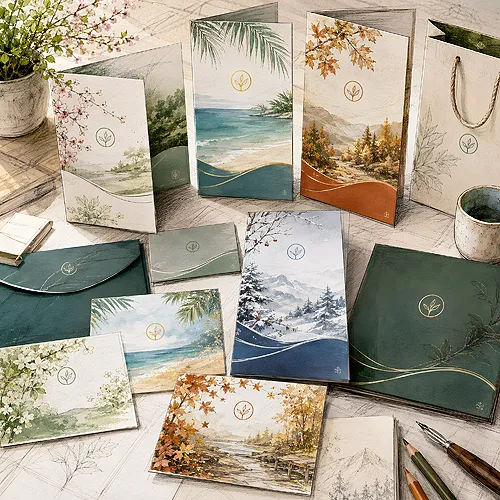
It’s also worth thinking about the consistency of the stationery with the rest of the wedding’s visual decoration. If the couple plans additional place cards, menus, or thank-you gifts for guests in the form of gift tags, it's a good idea to coordinate with the printer to use one type of decorative paper for the entire series to avoid a situation where the invitation is elegant but the rest of the decorations look different.
Printing and finishing time: lamination, laser cutting, decorative elements
Once the design is approved, actual production begins, and this is often the moment when time is underestimated. The standard printing time for invitations is 7-14 business days, but at the peak of the wedding season, from May to September, it can extend to 3-4 weeks because printers have a queue of orders during this period.
Printing time is one thing, while finishing is a completely separate matter. An invitation with a simple print on offset paper will come off the machine faster than a card with gilding, laser cutting, or ribbon. Each additional embellishment is another production stage and not just an "addition" to the order:
- Lamination (glossy or matte) typically adds 1-2 days to the standard turnaround time.
- Laser cutting of lace patterns requires a separate matrix or cutting program, which adds a few days to the process.
- Embossing and gilding are the most time-consuming embellishments, as they require preparing a matrix for a specific pattern.
- Ribbons, decorative envelopes, or additional inserts (e.g., with a map for getting there) are manually assembled elements, which also adds time to the schedule.
Prices for wedding invitations in 2025 range from 4 to 20 PLN per piece: simple digitally printed invitations cost 4-5 PLN, while elegant ones with embossing or gilding can go up to 15-20 PLN. The price difference goes hand in hand with a difference in turnaround time, so when choosing lavishly decorated stationery, it's essential to consciously reserve a longer buffer.
It's also wise to remember the minimum print runs. Most stationery studios require orders of 20-30 pieces, and with larger print runs, the unit price decreases. If the guest list is still uncertain, it's better to order with a buffer rather than returning to the printer for additional copies, as reordering a smaller batch can be disproportionately more expensive.
Shipping and distributing invitations: time buffer for RSVP and addressing envelopes
The moment of receiving finished invitations is not the end of the schedule but the beginning of the next stage, which is also easy to underestimate. The handing out or sending of invitations should take place within the window of 3-6 months before the wedding, and if the couple is organizing the wedding with less than three months’ notice, the entire process needs to be expedited, shortening the buffers at each stage.
The invitations should reach guests no later than 6-8 weeks before the ceremony. This is an important number because guests usually need 4-6 weeks to prepare their RSVP responses, which is crucial for determining the final table plan, the number of portions in the menu, and the size of the venue.
Between receiving the invitations and their physical sending, several tasks need to be completed that can easily be overlooked in planning:
- manually or printed addressing of envelopes (with a hundred addresses this realistically takes several hours of work),
- purchasing stamps and possibly decorative envelopes if they are not part of the ordered set,
- verifying addresses, especially if some guests live abroad and the shipping will take longer,
- establishing a deadline for RSVP responses, so there is still some time to finalize the number of guests with the wedding venue.
If the guest list includes people from abroad, send them the invitation with an additional week buffer. International shipments can take longer than domestic ones, and a last-minute correction may be impossible.
It's also worth thinking about planning ahead in a broader sense, just like with any significant undertaking with a clear deadline. In other industries, for instance, when preparing for the holidays, the rule is that the earlier you outline the next steps, the less stress there will be at the finish line, which can be read about in the Christmas planning guide as early as September. The principle is the same: a schedule works only if it is adhered to from day one, and not just when the deadline starts to loom.
What to do when the deadline is approaching: express printing options and their limitations
Sometimes couples find out about an available date for the wedding venue with much shorter notice than the standard several months, or they simply postpone invitations because other matters seem more urgent. In such a situation, you need to act quickly, but it's worth knowing what compromises you may have to make.
Some studios offer an express service that shortens the production time from 7-10 business days to 3-4 business days, usually for an additional fee of around 30 percent of the order's value. This is a viable option but has its limitations:
- Limited choice of embellishments. Embossing, gilding, or laser cutting usually aren’t feasible with express orders, as they require matrix preparation, which simply isn’t enough time for.
- Fewer rounds of corrections. The design must be approved more quickly, often without time for a second round of consultations with family.
- Higher unit cost. The surcharge for express service is calculated based on the total order, so with a larger print run, it makes a real difference in the budget.
- Risk during high season. From May to September, queues at printers are longer, so even express service may have its own extended wait times.
If time is really short, a good solution might be to forgo non-standard formats in favor of ready-made, simpler designs that don’t require custom designing from scratch. Just like with designing materials on a short deadline in other industries, for example, when designing Halloween gadgets with prints on black backgrounds, the pace of work increases when one skips experiments in favor of proven, simple graphic solutions.
One last thing: if the deadline is truly pressing, it’s worth asking the printer straight away about the real, not approximate, time required to fulfill a specific order. General timelines of 7-14 business days are a starting point, but the season, the chosen finish, and current production load can change this number either way.
Frequently Asked Questions
How long before the wedding should one order invitations?
Ideally, 6-8 months before the wedding date. This margin allows for a calm transition through design, corrections, printing, and shipping without rushing in the last weeks.
What is the absolute final deadline for ordering invitations?
At least 4-5 months before the wedding if the order hasn’t been placed earlier. Below this threshold, one should anticipate having to choose simpler designs or opt for express service.
When is the latest one should send invitations to guests?
Invitations should reach guests 6-8 weeks before the wedding, to give them enough time to RSVP, which usually takes 4-6 weeks.
Is express printing of invitations more expensive?
Yes, the surcharge for express service is usually around 30 percent of the order's value, and production time is reduced from 7-10 business days to 3-4 business days. There can also be a limited choice of embellishments.
How many invitations should one order if the guest list isn’t final yet?
It’s advisable to add about 10 percent as a buffer to the estimated number of guests, in case of address errors or last-minute additions. Reordering a smaller batch later can be more expensive and slower.