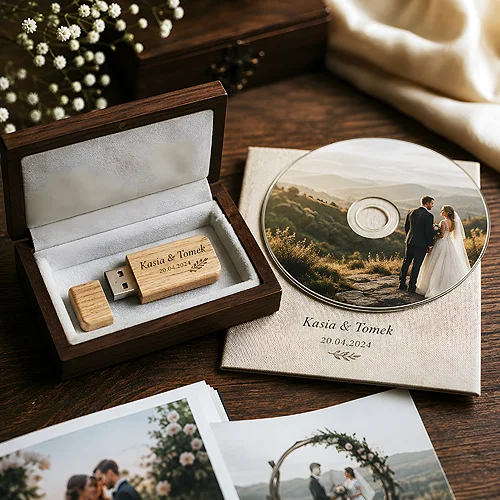
There is a difference between handing someone a flash drive in a plastic bag and offering an elegant box in which a keepsake unfolds under your fingers: a drive with files, a few printed photos and a card with a warm thank-you. The first is a data transfer. The second is a gesture that stays in memory. And the difference between them is usually half an hour of thought and a few small decisions.
This post is about that second approach - how to assemble individual elements into a keepsake set that looks and works like a considered whole. We will go through choosing the components, a coherent graphic theme, picking the packaging, layers of opening and personalisation. Without a big budget, but with care for the impression.
- A complete set is usually a trio: a flash drive with files, a few printed photos or a mini-book, and a thank-you card.
- Coherence comes from one theme - the same palette, font and detail on the drive, photos and card.
- Packaging with dividers or a case keeps the elements in place and builds a sense of order.
- Layers of opening let the recipient discover the contents one by one - a little unboxing theatre.
- Personalisation (name, date, a short dedication) turns a good set into a real keepsake.
- The set is appreciated by a photographer's clients, celebration guests and anyone who receives more than a file.
Three elements that make a whole
A keepsake set does not have to be elaborate. The strength lies in a few well-chosen elements playing together. Instead of adding everything that comes to mind, it is worth building the whole around three roles: the carrier, the print and the word.
- A flash drive with files - the heart of the set. It carries the actual content: the full gallery of photos, video, scans. An elegant promotional flash drive with an engraving or print immediately looks like part of the gift, not a random gadget from a drawer.
- Printed photos or a mini-book - a counterpoint to the digital file. A few of the best frames on paper, or a small album, makes the keepsake exist physically, here and now, without turning on a computer.
- A thank-you card - the element that gives the whole thing meaning. A short, personal word turns a package of data into a gesture. It is what stays in memory the longest.
This trio covers two needs at once: the practical one (you have all the files) and the emotional one (you have something to hold and read). The rest - tags, stickers, small extras - is optional and is added only when it fits the character of the occasion.
One theme across all elements
A set looks considered when the elements speak the same language. It is the same mechanism as with celebration stationery: coherence comes from repetition, not from abundance. A few constants carried consistently are enough.
Palette, font, detail
Set two, at most three colours and one typeface for the lettering. The same palette on the flash drive print, on the mini-book cover and on the card does more for coherence than the prettiest graphic used only once. Add one recurring detail - an initial, a date, a delicate symbol - that appears on every element like the signature of the whole set. If the photos have a warm, muted colour scheme, match the paper and the card background to a similar mood so nothing clashes. The drive can be matched too: the Colour comes with a choice of body colours, so it does not clash with the paper and the card.
Before you order anything, gather a small set of constants: two colours, one font and one detail. Write them down and keep them at hand for every element. That way even a card or sticker made last will fit in with the rest without looking accidental.
Packaging that holds and presents
Packaging does double duty in this set: it protects the contents and builds the impression at the moment of opening. A good box keeps the elements from rattling around loose, and the recipient immediately sees that someone thought it through.
- A box with dividers - the most versatile. A shaped slot for the flash drive, a compartment for the prints, a pocket for the card. Every element has its place, nothing shifts, and lifting the lid reveals an orderly whole.
- A case for the carrier - when the set is meant to be slim and handy. It works well when the flash drive and card are the heroes and there are only a few prints.
- Disc packaging - if instead of, or alongside, the flash drive you include a disc, it is worth reaching for an elegant digipack, which looks like part of the gift in itself. On when a digipack is better and when a simpler form suits, we write in the post digipack or CD sleeve.
How the elements sit in the box matters more than it seems. A thoughtful arrangement - the carrier on top, the card first to read, the photos underneath - raises the perceived value of the whole. We develop this thread in the piece on how the arrangement of a product in a box affects perceived value.
Layers of opening - the unboxing moment
The best sets reveal themselves one step at a time. Instead of showing everything at once, they lead the recipient through a few layers - and that is exactly where the memorable impression lies. It is no accident that unpacking has become a ritual of its own.
- The lid and first impression - the outside of the box, perhaps a band or a sticker with the theme's detail. The first signal that something prepared with care is inside.
- The thank-you card on top - so the recipient reads the word first and only then discovers the rest. Order matters: emotion first, contents second.
- Printed photos or a mini-book - the second layer, to touch and browse. This is where the keepsake becomes tangible.
- The flash drive last - as a promise of everything else: the full gallery to view at leisure.
It is not about theatrical complication, but about a deliberate order. Even a simple band or a sheet of tissue you have to lift turns opening from taking out an object into discovering a keepsake.
Personalisation and who will appreciate it
Personalisation is what sets a pretty set apart from a real keepsake. A name, a date, a place, a short dedication - these little things make the whole thing speak to a specific person, not a random recipient. An engraved name on the flash drive, a date on the card, a delicate signature on the mini-book cover - each of these details costs little effort and makes an enormous difference in how it is received.
It is worth planning in advance what goes where, and keeping a shared template for the whole set - that way adding another copy or making a small change goes smoothly. If you are assembling the print files yourself, take a look at our help on preparing files, so the prints and the card come out exactly as you see them on screen.
Who will appreciate such a set most? Above all a photographer's clients - for them an elegantly packaged session is not just a gallery, but tangible proof that they hired someone who cares about detail. Celebration guests who receive a keepsake from a shared day will value it too, as will anyone to whom you want to give more than a bare file: a thank-you for a colleague, a gift for a loved one, a token at the end of a project.
The secret of a good set lies not in the number of elements or in the budget. It lies in coherence and in the order of discovery. Choose three components, dress them in one theme, arrange them thoughtfully in elegant packaging and add a word of your own - and a plain handover of files will turn into a gesture the recipient keeps coming back to.