There is something magnetic about the word limited. A thing you cannot get always and everywhere instantly seems more valuable - and if you add successive editions that appear every now and then, you build more than a single item. You build a story people want to return to. Instead of handing out a large run once and forgetting about it, you give recipients a reason to wait for what comes next.
A limited series of promotional items is a strategy used by both big brands and small local businesses - because it works regardless of scale. The point is not to hand out as many as possible, but to make each edition mean something. Below we show how to plan such a series so that it genuinely sparks interest in the brand, rather than ending with a one-off giveaway.
- Limited availability raises an item's value - what is scarce draws attention more strongly than an unlimited run.
- A series builds curiosity: each new edition gives a reason to come back and to talk about the brand.
- The key is a common thread - a motif, numbering or theme that ties all the parts into one story.
- Numbering and a date on the item strengthen the sense of exclusivity and collectible value.
- Start with a small run, watch the reactions and grow the series where interest shows.
Why a limited series works better than one large run
A large run of a single item has one flaw: when there is a lot of something and it is always available, its value drops. A limited item works the opposite way - the very awareness that there are only a few copies makes people value it more and reach for it more eagerly. This is not a marketing trick, but the way our perception of value works.
When you add a continuation to limited availability, a second mechanism appears - anticipation. People who received the first edition start wondering what comes next. Those who missed it want to catch the next one. In this way a single item turns into a reason for regular contact with the brand, and you gain something no one-off run can give: continuity of attention.
How to plan a series that holds together
A series without a common thread is simply a few unrelated items released at different times. For the whole thing to work, you need an element that binds the editions into one story. It is this common thread that makes the recipient recognise the next part and want it next to the previous one.
- A leading motif - one palette, one graphic style and a recurring detail that instantly shows it is the same family.
- Edition numbering - marking 1 of 3, 2 of 3 gives a clear signal that it is a series and stirs the wish to complete the whole.
- A shared theme - editions devoted to the seasons, to city districts, to the brand's values or to successive company anniversaries.
- A fixed format, changing content - the same type of item in each edition, only with a different motif, makes recognition and collecting easier.
A good carrier for such a series is objects people are happy to keep. Personalised stickers released in successive designs, tasteful pens in changing colours or promotional flash drives printed with the edition all work well here - each is easy to vary between parts of the series while keeping a shared character.
Numbering and a date - small things that make a difference
If you want the series to truly feel like a collection, take care of two details that cost little but mean a lot. The first is a clear edition mark - even something as simple as "second edition" printed across the whole batch. An item with a visible number instantly feels more special than the same one without a mark, because it stresses that it is one of the few.
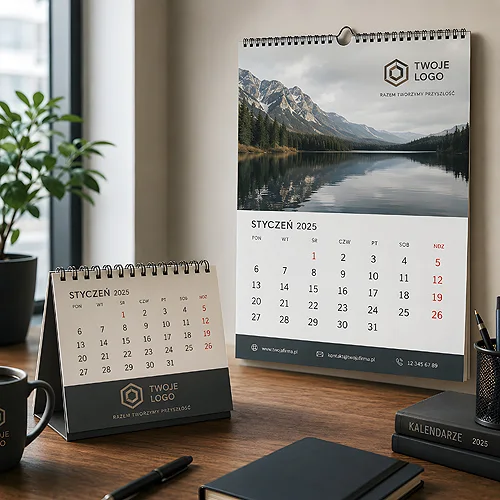
A date and edition mark
The second detail is a date or edition name. Placing on the item the year, season or the name of the occasion it was made for turns it into a keepsake of a specific moment. Years later such an object recalls not only the brand but also the time it reached the recipient - and that builds a sentiment a plain print does not give. A date also says clearly: this was a separate, closed edition, there will not be another like it.
Do not reveal in advance how many editions you plan. Keep an element of surprise for yourself and your recipients. If the first part hits the mark, you can develop the series with flair. If the reaction is cool, you can end it elegantly on two editions, without the feeling that something broke off halfway through an announced trio.
How to keep interest alive between editions
The series alone is not enough - what counts is the rhythm and the way you tell its story. The gaps between editions should be big enough to build anticipation and small enough that no one has time to forget. It is worth framing each part with a short teaser and a closing that gently leads to the next.
- A teaser - signal that something is coming before the edition appears. The mere news of an upcoming limited part sparks curiosity.
- The launch - release the edition in a limited number and clearly mark that it is limited. The limit is part of the appeal, not an obstacle.
- Reaction and conversation - encourage recipients to show they got a copy. The collectible nature of the series drives brand talk by itself.
- A bridge to the next part - close the edition with a gentle hint of the next one, so that anticipation does not fade.
This rhythm keeps the brand regularly returning to recipients' awareness without nagging reminders. We write more about choosing objects people actually want to keep in our post on why a gadget's usefulness matters more than a low price. It is also worth reaching for the tips in the piece on when it pays to go for collectible items with a logo.
Start small - and grow what works
The greatest advantage of a series is that you do not have to invest in the whole at once. You can start with one, intimate edition in a small run, observe the reactions and only then decide how far you want to go. This approach works especially well at small quantities, which we cover more in the piece on when ordering items in small runs makes sense.
- Test on one edition - before you map out a whole series, check whether the first item catches on at all.
- Listen to recipients - the part they ask about most often hints at which way to grow the series.
- Do not overstretch it - it is better to close the series on a high note than to drag it until it loses freshness.
- Value quality over quantity - one well-made edition is remembered better than five mediocre ones.
A limited series of items is one of those ideas that give a lot for a reasonable amount of work - provided you run it consistently. Set a common thread, care for details like numbering and a date, keep the rhythm of editions and start small. And if you want to discuss which object would work best as the carrier of your series, take a look at our products or write to us through contact.