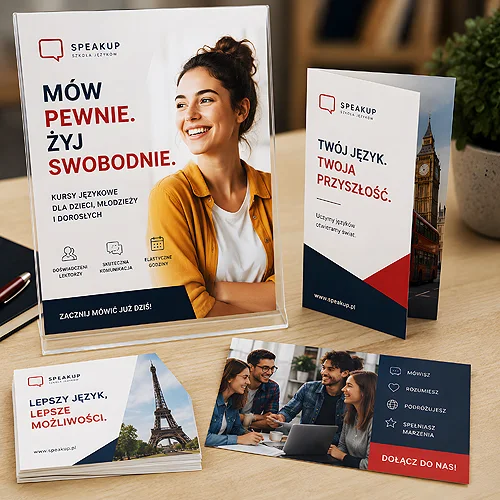
Most advertising disappears the moment the customer stops looking at it - the banner scrolled past, the ad skipped, the flyer thrown away on the way out. But some materials the customer takes home themselves, sets on the desk or tucks into a drawer and pulls out months later. This is advertising that does not end at the door - it works long after the customer has left.
We call them take-home materials - things that stay with the customer after a visit, a purchase or a meeting. Their strength is not in shouting the loudest, but in being at hand exactly when the customer needs you again. A flash drive with a project, a notebook on the desk, a voucher in the wallet, a disc with content - each of these extends contact with the brand for weeks or years.
The catch is that not every such material earns its place. Some end up in the bin before they cross the threshold. In this post we show what decides that a thing stays - and how to plan a carrier that genuinely extends contact with your brand.
- Take-home materials are things the customer carries away and that keep working long after the visit ends.
- Whether a thing stays comes down to three factors: usefulness, quality of execution and real value for the recipient.
- The longest-lasting are carriers with content (disc, flash drive), everyday items (a notebook, a gadget) and materials with a deferred benefit (a voucher).
- A good take-home is chosen to fit the industry and how the customer actually uses your services.
- Quality of execution is a signal - a solid material the customer takes seriously, a shoddy one they throw out at once.
Why advertising you take home works longer
Classic advertising fights for attention in a single moment and ends in that same moment. A take-home material works differently - it stays in the customer's surroundings and reminds them of the brand when they brush against it on their own. It does not have to persuade by force, because it appears at a natural moment: when the customer reaches for a notebook, opens a drawer or looks in their wallet for a voucher. The PCC works on the very same principle - a drive in credit card format sits in the wallet next to cards and vouchers, so it comes to hand at exactly such a moment.
This changes the way you count. A one-off flyer has a few seconds to work. A flash drive with your logo that the customer uses every day at work reminds them of the brand hundreds of times over many months. The cost is higher, but the contact time is beyond comparison. That is why with take-home materials we do not only ask "how much it costs", but "how long it will stay with the customer".
What decides that a thing does not end up in the bin
Not every gadget or print survives the trip home. The line between a thing the customer keeps and one they throw away along the way comes down to three things.
Usefulness
A thing that is good for something stays. A notebook you can write in, a flash drive you can store files on, a voucher to use - each has a function beyond being an advert. The more often the customer reaches for it, the more often they see the brand. An object with no use is just junk with a logo.
Quality of execution
Within a few seconds the customer senses whether they are holding something solid or something shoddy. A well-made thing - from decent material, with a clean print - earns respect and stays. A poor one goes to the bin, and along the way leaves a worse impression of the brand than if it had never existed.
Value for the recipient
The best take-home gives the customer something for them, not only for you. A voucher is a concrete benefit. A disc or flash drive with useful content - a guide, a project, materials - is real help. When the customer feels they got value rather than a flyer in disguise, they happily keep it.
We say more about why some gifts stay for years while others go straight into a drawer in our post on a company gift that does not end up in a drawer.
The materials that stay the longest
In practice a few kinds of carrier work best. Each behaves a little differently and suits a different situation.
- A carrier with content - a disc or flash drive - stays the longest, because the customer keeps their own files on it or returns to the materials you handed over. The brand rides along every time they use it.
- A notebook - lands on the desk and works there for months. An everyday object the customer chooses to pick up.
- A voucher - a benefit deferred in time. The customer keeps it to use, and at every glance recalls the brand.
- A useful gadget - a small thing that enters the customer's daily life - a printed pen or a branded lighter. The closer to a real need, the longer it stays.
- A flyer worth keeping - yes, a flyer can stay too, if it carries content the customer returns to: a guide, a service list, a calendar. A classic flyer designed to be set aside, rather than for a single glance, fills this role beautifully.
Which of them stays with the customer the longest? That depends on the industry and how they use your services - we break it down in our post on whether a disc, a catalogue or a useful gadget stays the longest. And on how to design the flyer itself so the customer does not throw it away, we write in our text on a flyer the customer keeps for later.
How to choose a carrier for your industry
There is no single best take-home material - there is the best one for your customer. The starting point is a question: what does the customer really need after contact with you, and what will they have at hand exactly when they need you again.
- Creative services, photo, video - the natural carrier is a flash drive or disc with the finished material. The customer has to receive the files anyway, so wrap them in the brand.
- Hospitality, local services - a voucher for the next visit and a thank-you card lead straight back to a repeat purchase.
- Offices, consulting, education - a notebook and printed materials the customer reaches for at work keep the brand on the desk.
- Retail and e-commerce - a small gadget or a flyer with a benefit added to the parcel extends contact after the purchase.
The rule is simple: the closer a material lands to the customer's real situation, the longer it stays with them. A gift detached from a need is an expense that quickly goes into a drawer - we write about what decides that a thing is kept for years in our text on promotional gifts kept for years.
Before you order a take-home carrier, picture the specific moment the customer will use it - which day it is, where the thing lies, what they reach for it for. If you can describe that moment, the material makes sense. If you cannot, it will probably end up in the bin.
Quality of execution - a quiet signal about the brand
The same idea can be made so the customer tucks it away, or so they throw it out at once. A take-home material represents the brand in the customer's home for a long time, so its quality says more about the company than many an advert. Solid paper, good lamination, a clean print and careful finishing - the customer reads all of it subconsciously as "this company cares about details".
Details make the difference. Thick card instead of thin, a matte or gloss film matched to the character of the brand, rounded corners or an unusual shape cut with a die make a material worth keeping. It is not about opulence, but about a coherent signal: if the small thing is refined, the service probably is too. It works just as strongly in reverse - a shoddy gadget can spoil the impression you built across the whole contact.
Advertising the customer takes home is one of the most cost-effective forms of brand presence - as long as it is thought through. Instead of asking how many materials to hand out, ask which of them the customer will really keep. Match the carrier to their everyday life, take care of usefulness and quality, and your brand will stay with them long after the door has closed behind them.