There is a moment when unwrapping a company gift in which everything is decided. The recipient glances inside and within a fraction of a second makes up their mind: this stays on the desk, or it lands in the drawer with things from conferences. That decision rarely concerns the value of the object. Far more often it concerns whether the recipient feels that someone thought about them specifically - or whether they got something that went out in five hundred identical copies.
The good news is that the line between the two is genuinely thin. Sometimes a name on a tag is enough, or one specific sentence about the year gone by, or the information that there were only thirty pieces. These things are cheap to do and make an enormous difference in how the gift is received.
Below we show what exactly that difference consists of, which levels of personalisation you can choose from, and why small runs often beat one big batch.
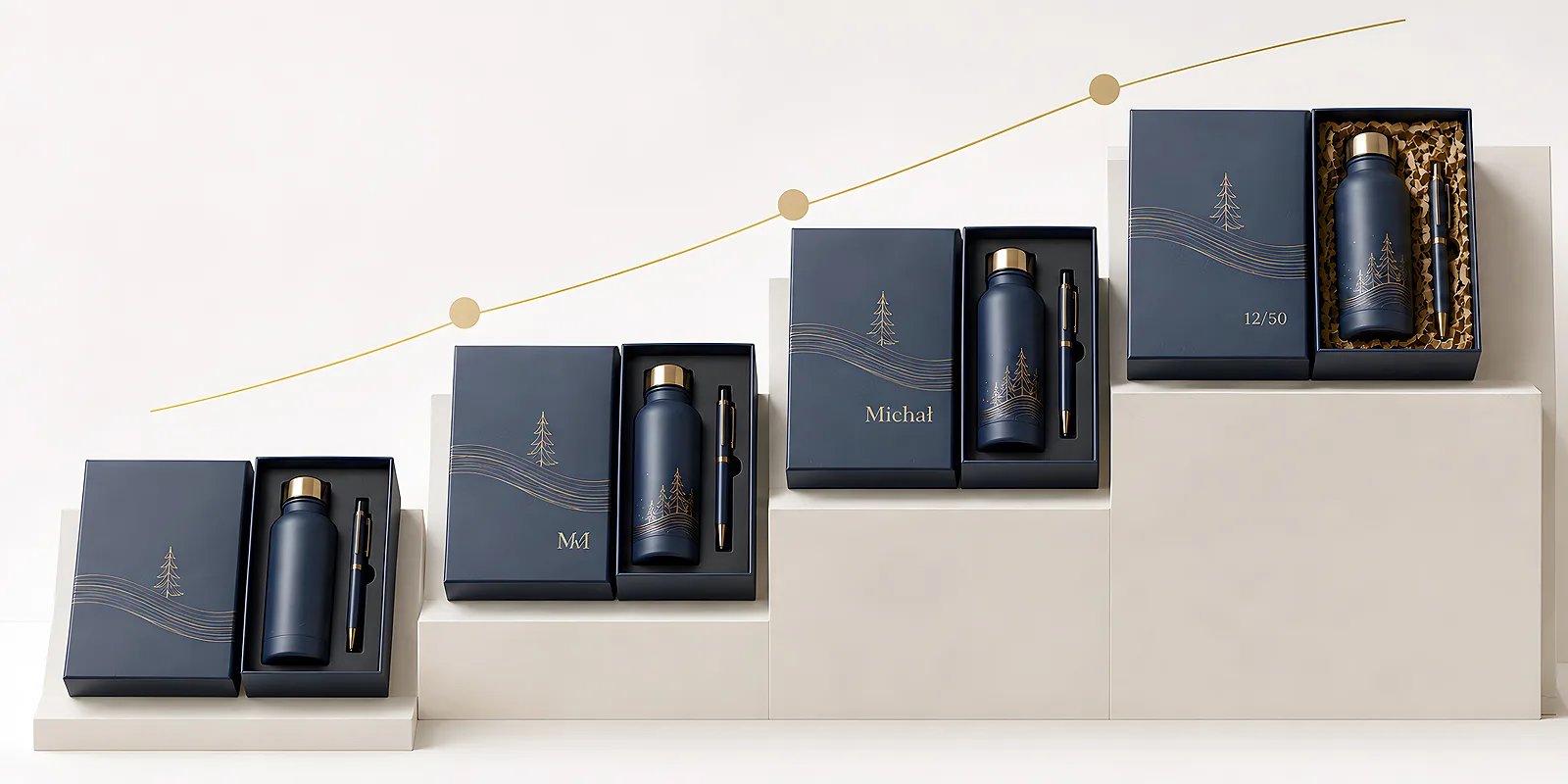
- A gift reads as chosen for a particular person when it carries a trace of a decision - a name, a specific sentence or a note about a limited series.
- Personalisation has several levels, from a name on a tag to a version made for one group of recipients. Start with the simplest one.
- Small runs mean less leftover stock, more freedom to adapt and a natural sense of a limited edition.
- Numbering the pieces and a short note about the series raise perceived value at almost no cost.
- Personalising the message can be stronger than personalising the object - a handwritten signature can do more than a printed name.
What makes a gift read as chosen for me
The recipient does not analyse this consciously, but they react to a few signals. The strongest of them is the trace of a decision - proof that someone had to think it over. A name on a card is such a trace, because you cannot print it without checking who the parcel is going to. A sentence about a joint project is stronger still, because it requires someone to actually recall that project.
The second signal is scale. An object you have already seen with three other people automatically loses meaning. The same object with a note that it came from a short series suddenly gains - not because it changed physically, but because its position changed.
The third signal is fit. A gift that matches what the recipient does says more than a universal item for everyone. It does not have to be anything elaborate - it is enough that the thing makes sense in their daily work.
Levels of personalisation - from the simplest to the most expressive
Personalisation is not a switch that is either on or off. It is a scale you can move along depending on how much time you have and how important a given group of recipients is.
Level one: a name on the card or tag
The cheapest and fastest step. A name on a Christmas card or on a tag attached to the gift stops the parcel from being anonymous, while the print run of the main item does not change at all. If you do only one thing from this whole list, do this one.
Level two: a dedicated insert
A small card with one specific sentence, slipped into the box. It can refer to a joint project, to the number of years of cooperation, or simply to something that happened this year. The insert is a rewarding format, because you can vary the text by group while the format stays shared.
Level three: a dedicated label on the packaging
A label sealing the box - with a dedication or a motif prepared for one group of recipients - works before anyone opens anything. That makes an impression the moment the parcel is received. Stickers and labels work best here, because they let you personalise the packaging without touching the box itself. For the seal on the box itself, round stickers are the usual choice - you pick the diameter to suit the flap, and you add the recipient's name by hand, because the whole run is printed from a single design.
Level four: a version matched to the recipient's industry
One set for hospitality clients, another for offices, another for technical companies. Here it is no longer about a name but about relevance - the recipient sees that someone understands what they do.
Level five: a small run for one group
The most expressive option: a series prepared exclusively for a narrow group, with its own graphic motif. Nobody else received that version and that is exactly the point. Our post on when ordering promotional items in small runs makes sense explains how to approach it sensibly.
Do not start at the highest level. Run the first year on names and a dedicated insert, watch how recipients react, and only then invest in industry versions. Personalisation that has not been tested in practice can absorb a lot of work for very little effect.
Why small runs are often wiser than one big batch
Instinct suggests ordering everything at once, since a larger run usually works out better per piece. With gifts that instinct can mislead, and it is worth counting not only the print but also what happens afterwards.
- Less leftover stock - a gift carrying a specific year or a seasonal motif loses its point after the holidays. A box of surplus pieces sitting in storage until next winter is a cost that is easy to overlook when ordering.
- Room to adapt - with several smaller runs you can vary versions for different groups instead of making one compromise version for everyone.
- A sense of limited edition - a short series naturally reads as something special, with no extra effort at all.
- Easier correction - if something in the first series does not work, you fix it in the next one. With one big batch you are stuck with what came out.
Our post on how a series of limited promotional items builds interest in a brand develops this line of thinking well - the rules are exactly the same, only applied to a marketing goal rather than a festive one.
Numbered pieces and a note about the series
This is probably the most underrated way of raising the value of a gift. A short line such as: piece 17 of 40, placed on a tag, an insert or the bottom of the box, changes the way the recipient looks at the object.
It works for a simple reason - the number is proof that the series was finite and counted. Nobody will print themselves a few more. It is worth adding one sentence about what the series is: who it was made for, on what occasion, what ties it together. Two lines of text are enough for the object to stop being a giveaway and become part of something.
If you plan to number pieces, remember that the whole run is printed from a single design - you add the numbers yourself while packing, so set the system up before you start. A simple list of who received which number comes in handy for any later questions and when planning the next edition.
Personalising the message instead of the object
It is worth noticing that the strongest element of personalisation often does not concern the object at all. A handwritten signature under the greetings does more than a printed name on a pen. One specific sentence about what happened in your cooperation over the past year does more than both of those together.
This direction is convenient in practical terms too. You order one coherent run of company gifts and vary what you write. You do not have to split the order or make sure the right piece reaches the right person - and the recipient still gets something nobody else has.
It is also worth remembering that a name works beyond gifts. Our post on when a client's name increases the effectiveness of advertising shows this well - the attention mechanism is the same, only the context changes.
Where personalisation does not pay off
There are situations in which it is better to let personalisation go and move all your attention to the quality of the object itself.
- Very small surfaces - if the name would have to be set so small that nobody can read it, a clean form is the better choice.
- Objects that get passed on - something meant for shared office use becomes awkward with somebody's name on it.
- Large groups on a short timeline - when the deadline is pressing, personalisation tends to be the weakest link. A good universal gift then beats a rushed personalised one.
- Uncertain data - if you are unsure about the spelling of surnames, personalisation turns into a risk.
In each of these cases a solid object with a well-placed logo at a sensible size beats personalisation forced through. We covered this more broadly in our post on how named personalisation of a company gift gains in value.
Recipient data, or how not to trip over a typo
This whole structure rests on one pillar: correct data. A gift with a misspelled surname works exactly the opposite way to what you intended - instead of showing attention, it shows the lack of it. A few rules save the day.
- Collect data early - not in the packing week, but while there is still time for a calm check.
- One source of truth - one spreadsheet, one person responsible. Three lists circulating by email are a guarantee of a mistake.
- Ask about the form - not everyone wants to be addressed by first name on a card. A short question to the account manager settles it.
- Check the special characters - this is the most common source of errors when moving data between files. Go through the list specifically for this.
- Ask someone to read it over - a second pair of eyes before sending to print catches typos the author no longer sees.
- Keep a few pieces without personalisation - someone outside the list always turns up, or something needs correcting. A margin of neutral pieces saves those moments.
A gift that does not look mass-produced need not be more expensive or more elaborate than an ordinary one. It only has to carry the trace of someone sitting down with it and thinking about a particular person. A name, one true sentence, a short numbered series - and the very same object that might have ended up in a drawer stays on the desk all year.