Most company gadgets end up in a drawer or straight in the bin. A notepad is the exception. It lands on a desk, by the phone, in a bag for meetings - and stays there for weeks, sometimes months. Every time someone jots down a number, an idea or a to-do list on it, they casually see your logo. It is a gadget that does not shout, it just patiently works for the brand, day after day.
- A notepad works for a long time because it is genuinely used - that is its biggest edge over single-use gadgets.
- The choice is wide: a glued notepad, a self-adhesive block, a notebook with a cover, a company desk pad.
- It works as a gift, conference material, office supply and a touch on the reception desk.
- Personalisation is more than a logo - it is also a tagline, brand colours and even a calendar on the page.
- Usefulness decides its effectiveness: a gadget people want to use returns to the hand every day.
Why a notepad works better than most gadgets
The effectiveness of a promotional gadget does not depend on how striking it looks the moment it is handed over, but on how long it lives afterwards. A thing thrown away after a week practically does not exist. A thing reached for every day reminds people of the brand hundreds of times, with no effort at all.
A notepad is exactly like that. People still like writing by hand - a quick thought in a meeting, a phone number, a shopping list. As long as the paper lasts, the notepad stays on the desk and works. It is an inexpensive thing that gives long contact with the brand, and in advertising that counts for more than a one-off effect.
Writing by hand is still doing well
Even though many people take notes on their phone, paper has not vanished from desks. On the contrary - writing by hand helps to remember and organise thoughts, which is why many people keep a notepad at hand precisely for quick things. A short to-do list for today, a number to call back, an idea that popped up during a conversation - all of it naturally lands on paper rather than in an app.
For the brand this means one thing: the notepad is in daily circulation, not put away on a shelf "for someday". Every such reach for a sheet is another contact with the logo, and at a moment when the person is focused and attentive.
Types - from a note block to a notebook with a cover
Behind the word notepad or note block hide several different things, and each suits a slightly different situation. It is worth knowing the differences before you decide what to order:
- Glued notepad - sheets glued at the top or side, easy to tear off. A classic for the desk and the bag.
- Self-adhesive block - notes with a strip of glue that stick to a monitor, documents or a fridge. They travel and carry the logo further.
- Notebook with a cover - sturdier, with a card or board cover, looks more upmarket. Good as a gift.
- Company desk pad - a larger format, often with room for notes and a date, stays in one place and is on view every day.
There is no single best option - there is the one that fits the purpose. You will hand out one kind of notepad at a trade fair and leave another with a regular client as a nice touch.
Format and binding for a specific use
It is worth thinking about the format too. A small, pocket notepad is handy while travelling and fits in a bag or jacket - it works well as a gadget the customer carries around. A larger format tends to stay on the desk and serves longer notes, planning the day or sketching. The same graphic design can work quite differently depending on how big the notepad is.
The binding is also worth matching to how the notepad will be used. If the sheets are to be torn off and handed out, gluing at the top works well. If the notepad should stay whole, a spiral or a stitched binding that opens flat comfortably will be better. The top-glued version is what we run as notepads - for notes, orders and forms, in sizes from a small pad upwards.
Before you pick a type, think about where the notepad is meant to go and how long it should stay. For a one-off conference a light glued block in larger quantities works well. For a key client it is better to go for a notebook with a cover - one, but a good one, that will stay on the desk for longer.
Where they work well
Notepads and note blocks are rewarding because they fit many situations at once. As a gift they are a safe choice - useful to everyone, so no one puts them aside out of politeness; they also fit well into a set of company gifts for the end of the year. At a conference or training they reach participants along with the materials and go straight into use during note taking.
In the office a company notepad organises daily work and quietly reinforces the brand among staff. At the reception or in a waiting room a block on the desk is at hand for a guest who wants to write something down. In each of these places the gadget does not so much advertise as simply prove useful - and that is exactly why it works.
A notepad as part of a bigger set
A notepad rarely travels alone. Most often it reaches the recipient together with other materials - a pen, a business card, a document folder or a leaflet. When all of these things keep a common style, together they make a much better impression than each on its own. A consistent set looks considered rather than gathered from random gadgets.
That is why when designing a notepad it is worth thinking right away about what goes with it. The same colour, logo and typeface as on the other materials make the whole compose into one image of the brand. If you are building such a set, take a look at our full range of products - it is easier to pick elements that play together.
The best company gadget is not the one that dazzles when handed over, but the one people reach for long afterwards.
Personalisation - more than just a logo
A logo on the cover is the minimum, but a notepad gives more room than it seems. You can add a short brand tagline, contact details or a website address in the footer of every sheet, so they come back into view with each note. Brand colours on the cover and inside make the notepad instantly associated with the company, even from a distance.
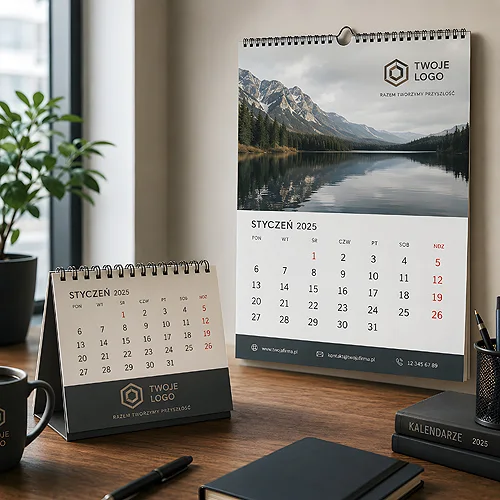
An interesting idea is a calendar - a month or a whole year printed on the first pages turns the notepad into a small planning tool. Such an addition extends the life of the gadget, because someone keeps it at hand through the whole season. Just take care not to overdo the amount of advertising content - a notepad is for writing, and the brand should accompany discreetly, not take up the whole page.
Small extras that raise the value
Beyond the logo and calendar there are a few details that make a notepad feel more refined. A faint line or dots as a helper grid for writing, a thin ribbon as a bookmark, an elastic band holding the cover closed, rounded corners - each of these is small, yet together they give the impression of a considered thing. The customer feels they received something proper, not just plain advertising.
It is also worth thinking about the first page. Instead of leaving it blank, you can place there a spot for the owner's name or a short, friendly line from the company. It is a little thing, but it makes the notepad instantly more personal and therefore more willingly used.
Leave plenty of clean space on the sheets. A notepad printed with advertising from top to bottom stops being a notepad - there is nothing to write on, so it ends up in a drawer. A logo in the corner or a discreet footer is enough for the brand to be present while the gadget stays useful.
Paper and binding
How a notepad performs also depends on what it is made of. The paper inside should be smooth and absorbent enough to take a pen well and not show through to the other side - that is the basis of usefulness. The weight of the cover decides whether the notepad looks solid or cheap; a stiffer cover protects the sheets better and sits more pleasantly in the hand.
The binding is another decision. Gluing at the top is convenient when the sheets are meant to be torn off, while a stitched or spiral binding works better when the notepad should stay whole and open flat comfortably. If you are unsure about the choice of stock, our guide to materials and papers will help, explaining how paper changes the result.
Paper that invites use
The feel of writing is often an underrated detail, yet it is what decides whether someone comes back to the notepad. Paper that is too thin shows through and creases under the pen. A slightly thicker, smooth paper gives a comfort that makes people reach for the notepad willingly - and that, after all, is the whole point of this gadget.
The cover plays a similar role, only on the outside. A stiffer material protects the sheets in a bag and keeps the notepad looking good even after a few weeks of carrying. Durability works for the brand here: the longer the notepad looks proper, the longer it speaks well of the company whose logo it carries.
How to prepare a notepad design
Before you order a run, it is worth taking care of a few things so the finished notepad looks as planned. Keep the logo and text with a margin from the edge and remember the bleed, so nothing gets trimmed when cutting. If you design a footer with contact details, check that it is legible even at a small size. Colours from the screen can come out slightly different in print, so prepare the file in the right colour space.
If the notepad is to have a printed inside - a grid, a calendar or a footer on each sheet - prepare a separate design of the inner page and check how it looks repeated across many sheets. Elements that look good on one page can tire the eye when repeated, so it is better to see it beforehand than after printing. Remember too about a margin from the binding area, so the glue or spiral does not cover the content.
You do not have to do this blindly on your own. You can order promotional note blocks from us in several formats, on 80, 90 or 120 g offset paper, with 25, 50 or 100 sheets glued at the top, and if you are looking for a broader set of company materials, take a look at our full range., and if you are looking for a broader set of company materials, take a look at our full range of products. Should any questions come up along the way about paper, binding or personalisation, simply write to us through contact - we will suggest what will work best in your case.