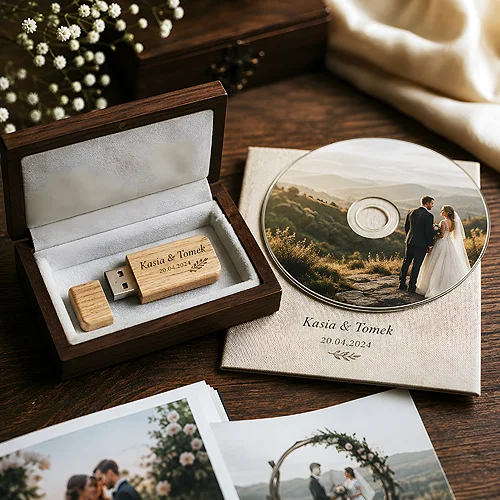
A flash drive with a logo stopped making an impression by its mere presence a long time ago. The material it is made of does, because that is the first thing a recipient feels before reading anything on it. Wood, bamboo and a biodegradable material are three different objects, not three colour variants of the same one.
If you are looking for a giveaway meant to say something about how your company works, the choice of material matters more than the choice of model. It decides how the drive looks after a year in a bag, how it can be branded and whether your logo lands on the casing in full colour or has to be simplified first.
The eco flash drive category holds proposals with entirely different characters. Below we take them apart: what you are holding, what can be done with it and who each variant genuinely suits.
- Three materials: natural merbau wood, bamboo and a 100% biodegradable material. Each looks different and takes branding differently.
- Wood and bamboo work best with laser engraving, but engraving only accepts a single-colour vector drawing.
- The biodegradable material takes full-colour UV printing, so the logo needs no simplification.
- All three models use a USB 3.2 gen.1 connector and capacities from 16 GB upwards.
- Every wooden piece has its own grain pattern - that is a feature of the material, not a fault in the batch.
- A new design is approved on a proof before production.
Three materials, three different objects
The simplest way to choose is to picture the moment of handing the drive over. The recipient takes it and spends a second judging it by touch, before even looking at the branding. In that second, these three materials give three different impressions.
- Eco3 - natural merbau wood. Dark, warm, with a pronounced grain. It looks like an object from a workshop rather than from a giveaway warehouse. Capacities of 16, 32, 64 and 128 GB.
- EcoBam3 - natural bamboo. Lighter and more uniform than wood, with a calmer structure. Bamboo is one of the fastest renewing raw materials, so that is an argument you can state outright. Capacities of 16, 32, 64 and 128 GB.
- UME3 Eco - a 100% biodegradable material. This is not wood, even though photographs can make it look similar: it has a natural warm shade and a matt finish. Light, uniform, and also available in a 256 GB version.
The difference between wood and bamboo shows best when you lay several pieces side by side. The wooden ones will differ from each other, the bamboo ones will look like siblings.
The material decides the branding
This is the most important consequence of choosing a casing and the most common surprise on a first order. Branding is not an extra glued on at the end - it follows directly from the material.
For wood and bamboo the natural solution is laser engraving. The beam burns a darker mark into the surface, one that does not rub away and looks like part of the object rather than a sticker. On the Eco3 the engraving also brings out the grain, because the wood shows through the burnt mark.
Engraving takes one colour only
Engraving works by burning, so it distinguishes only two things: burnt and unburnt. It will not reproduce colours or tonal transitions. What it needs is a vector file - a drawing saved as lines and shapes rather than a grid of pixels - in a single colour, in black.
In practice that means one thing: a multicolour logo has to be simplified. It is usually reduced to the symbol and the name in solid black, without shadows or gradients. It pays to prepare that version once and keep it in your company files, because it will be needed for every future branding job on a natural material. We write more about what genuinely fits on a small surface in our post on printing on a small giveaway.
If simplifying the logo is out of the question, because colour is this brand's signature, the natural choice is the UME3 Eco with UV printing. UV printing lays colour directly onto the casing and reproduces the full palette, so the mark stays exactly as your brand book defines it. Printing is also possible on the wooden models, but then you lose part of the effect of the natural material. Outside the eco line that split gets even sharper: the Colour takes UV print only and the metal Unity engraving only, so there is no technique left to choose.
Before you settle on a material, check your logo in a single colour. Print it in black on a white sheet, at the size of a postage stamp. If it is still legible, engraving on wood or bamboo will work. If it collapses into a blur, choose the variant with full-colour UV printing.
Every wooden piece is different
This is a feature you need to know about before ordering, not after unpacking the box. Merbau wood has a natural grain, so two pieces from the same batch will differ in shade and in the arrangement of lines. For a gift that is an advantage, because the recipient gets an object with no exact twin.
The trouble starts when somebody in the company expects identical items. If the drive is meant to join a set where everything is matched down to the shade, wood will not be the right choice - better to reach for bamboo, which is more uniform, or for the biodegradable material with its repeatable colour. It is worth saying this to whoever makes the decision before the order goes ahead.
Who each variant is for
The material should say the same thing the brand says. When the two drift apart, the giveaway looks like an accident.
- A company with an environmental policy - bamboo is the easiest to defend here, because the argument about a fast renewing raw material is concrete.
- A food or cosmetics brand from the natural shelf - merbau wood, because a warm material and a visible texture speak the same language as the packaging of such products.
- A brand with a strong, colourful logo - the biodegradable material with UV printing, because the mark stays untouched while the choice of material remains an ecological one.
- A gift for a business partner - wood, if there are only a few pieces and each is meant to be slightly its own.
- An industry event with a larger run - bamboo or the biodegradable material, because uniformity looks better when all the pieces lie side by side on a table.
If you are wondering whether a flash drive is still a sensible carrier at all, we take that question apart separately in our post on whether a branded flash drive is still a practical giveaway.
Capacity and preparing the order
Capacity is chosen to fit the content, not to make an impression. If you are loading a catalogue and a few photographs, the smallest version is plenty with room to spare. A larger capacity makes sense when the drive is to carry video material or a full set of photographs at full resolution - for example a drive handed over after a photo session.
- Choose the material - wood, bamboo or the biodegradable option. Everything else follows from this decision.
- Check your logo in a single colour - and decide whether you are going for engraving or UV printing.
- Settle the capacity - count what genuinely has to fit on the drive.
- Prepare a vector file - in black for engraving, in full colour for UV printing.
- Approve the proof before production - this is the moment when you see how the mark sits on the casing.
Choosing between wood, bamboo and a biodegradable material is not an aesthetic decision. It is a decision about what your giveaway says in the second it reaches somebody's hand - and about whether your logo can stay exactly as it is.