Trade fairs and industry events are one of the few chances to talk to a client face to face. You have a dozen seconds to catch attention and a few minutes to be remembered. Promotional materials are your silent helper here - prepared well, they do part of the work for you, while the wrong ones or the ones that run out too fast can spoil the whole impression. We have gathered a practical checklist to help you head to your stand with a full set, not just hope.
- Split your materials into three groups: what I show, what I give and what I send after the event.
- Take business cards and flyers with a surplus - better to end with a spare box than run out by midday.
- A mini-catalogue or brochure is the material a client takes home and reads later.
- Keep a folder and a more valuable carrier for key contacts, small gadgets - for everyone.
- Everything must look like one family - visual consistency builds credibility.
Start with a split: show, give, send
Before you order anything, sort your materials in your head into three piles. The first is materials for the conversation - the ones you keep on the stand and show during a talk, but do not give away. The second is materials to take - everything a visitor can take with them and go through in a quieter moment. The third is materials after the event - what you send by email or post to the people the conversation really got going with.
This split organises everything. You immediately see what you need in large quantities (small items to hand out) and what should be single and polished (a piece for a key contact). Without it, it is easy to order too much of one thing and too little of another.
Business cards - so you never run out
A business card is the absolute basics and, at the same time, the thing most often missing on the second day of a fair. Exchanging cards is still the fastest way to leave your contact details, and an empty card holder in the middle of an important conversation simply looks weak. The rule is simple: count how many conversations you realistically plan and take twice as many.
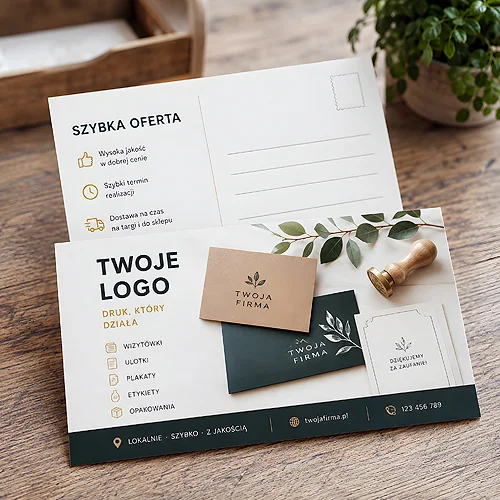
Make sure they are readable - name, role, phone, email and company must be visible at a glance. The rest is a detail meant to reinforce the brand, not distract from the data. Well-made classic business cards will do more for the impression of professionalism than many a larger material.
Take two sets of business cards to the stand and keep them in two different places. When one stash empties or goes missing, you have the other at hand and do not have to apologise that you "will bring some in a moment".
Flyers and mini-catalogues - materials to take
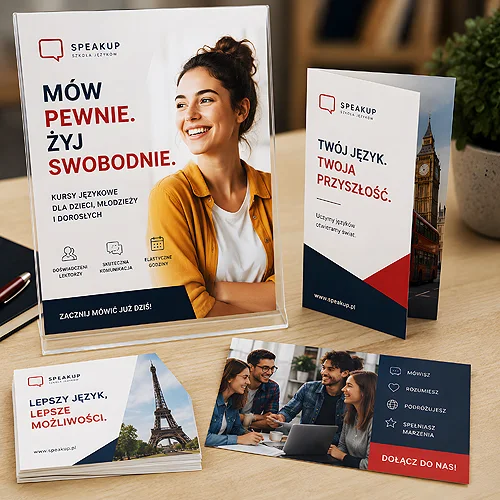
A business card says who you are. A flyer or mini-catalogue says what you do. It is the material a visitor takes and reviews later - which is why it has to be self-contained, readable and specific. A short promotional flyer works great for quick handing out: one page, the key offer, contact details and a clear call to the next step.
If your offer is richer, it is worth having something more extensive too - a brochure or mini-catalogue with an overview of your products or services. This is the material you leave with genuinely interested people, not with every passer-by. It works as something a client takes home and returns to when making a decision.
- Flyer - a quick handout, one main idea and contact details.
- Mini-catalogue / brochure - for the interested, an overview of the fuller offer.
- One call to action - visit the site, write, book a call. Do not mix several at once.
Folders - for more important contacts
Not every conversation is equal. With some visitors the talk turns to specifics, real interest in cooperation appears and you want to leave more than a single page. This is where a company folder comes in - an elegant carrier in which you gather a full set of materials: the offer, a price list, a business card, a note from the conversation.
A folder does two things at once. First, it tidies up - the client does not go back with loose pages that will get lost somewhere, but with one neat set. Second, it signals that you took this conversation seriously. It is a gesture that stays in memory and raises the standing of the meeting. Prepare a few such sets in advance so you do not have to assemble them on your knee at the crucial moment.
Gadgets - small ones to hand out and valuable ones for leads
Gadgets at fairs play two different roles and it is worth not confusing them. Small giveaways - like simple carriers with a logo or branded pens and lighters - are there to leave a trace of the brand with everyone who came up to the stand. Their strength lies in quantity and usefulness: an item someone actually uses reminds them of you long after the event.
A separate category is more valuable carriers you leave with selected contacts - the leads the conversation really got going with. Here a USB drive with a logo loaded with a presentation or an offer works brilliantly. The client gets not only an object but also ready-made material to return to at their computer. We write more about how to arrange this in our piece on how to use a promotional USB drive at trade fairs and conferences.
You hand out a small gadget to be remembered. You leave a valuable carrier so the conversation has a sequel.
Visual consistency - all from one family
The most common mistake on stands is a jumble of materials that look as if they came from five different companies. A business card in one colour scheme, a flyer in another, a folder in yet another. The client will not name it, but they will feel it - and a sense of chaos undermines trust. Visual consistency is one of the cheapest ways to look serious.
Make sure all the elements - from the business card to the gadget - speak the same language: the same colours, the same logo, the same style. Then each material reinforces the others, and your brand looks like a thought-through whole. That impression of one hand is worth more than many an extra gadget.
How much to order - simple estimating
Quantity is the question that keeps people up at night, and the answer is simpler than it seems. Start with the realistic number of visitors to your stand - the organiser usually shares attendance from previous editions. Then assign materials to the three piles from the start.
- Small giveaways and flyers - the most, because they reach many people. Take a surplus; the cost of running out is greater than the cost of a leftover.
- Mini-catalogues and valuable carriers - fewer, because they go to the interested. Estimate carefully, but not too tight.
- Folders for key contacts - the fewest, from a handful to a dozen or so. This is targeted material, not mass.
Better to return with a box of unused business cards and flyers than to run out on the first day. Printed materials taken with a surplus will come in handy at the next event, while a stand with no flyers on the second day is a loss you will not make up.
Where to start
Start with a sheet of paper and three columns: show, give, send. Fill them in with what you already have and see what is missing. Then match the quantities to attendance and set aside a separate set for key contacts. Such a plan means you do not improvise on the stand - you have everything at hand and know who to give what.
If you want to put together a set of materials for a specific event and are not sure what and in what quantity to prepare, browse our product offer or write to us. We will suggest how to arrange your business cards, flyers, folders and gadgets so that your stand works for you from the first conversation to the last.