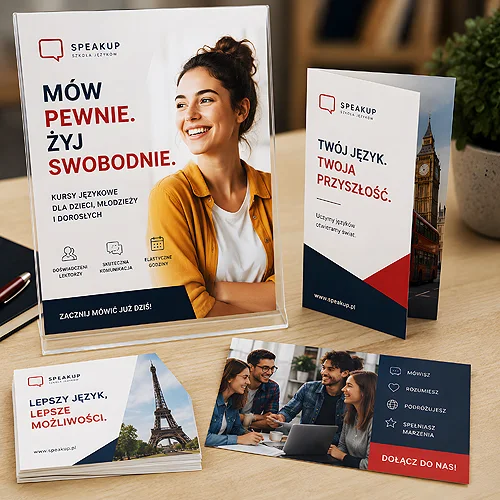
You run a small business, you type "promotional materials" into a search box, and dozens of options pop up. Business cards, flyers, posters, stickers, folders, letterhead - and you can already feel your budget evaporating. Relax. You do not need all of it. You need what actually works for your business. This guide will help you choose wisely instead of blindly.
- Start with the goal, not the product - first decide what a given material should do for you.
- The must-have starter set is short: business cards, flyers and a consistent look - the rest can wait.
- Visual consistency matters more than the number of material types - one style across everything builds recognition.
- Online and offline do not compete, they complete each other - it is best when they lead to one another.
Start with a question, not a product
The most common mistake? Ordering something because "every business has it". It should be the other way around - first the question, then the product. Before you pick anything, ask yourself: what should this material do for me? Leave contact details after a conversation? Reach mailboxes on the estate? Make someone slow down at a shop window?
Each of those goals leads to a different material. When you think in goals, you stop buying random things and start building a toolkit tailored to how your business really works. That is a completely different conversation from "what should I print".
Take an example from life. Two companies order exactly the same thing - a thousand flyers each. The first knows it wants to fill mailboxes on a new estate and invite people to an opening. The second orders them because "flyers always come in handy". Guess which one knows what text to put on them, where to distribute them and how to tell they worked? The goal is not a formality - it is what gives meaning to everything you print afterwards.
Take a sheet of paper and write down three situations in which a customer meets your business - for example: they pass your premises, they get something in hand, they call on a recommendation. Next to each, note what is missing right now. That is your shopping list, tailored to the real life of your business rather than someone else's bundles.
The must-have set everyone starts with
If you are starting out and want to buy the minimum that gives the maximum, it is simpler than it seems. Three things cover most everyday needs.
Business cards - your smallest salesperson
A business card is a piece of paper that works when you are no longer around. You leave it after a chat, place it by the counter, slip it into a parcel - and it reminds people about you a week later, when a customer is looking for a number. It is a first impression in a take-home version. Well-designed business cards can do more than many an ad, because they land right in the hands of an interested person. The basic version is enough for that job - business cards come in two formats, 90×50 mm and 85×55 mm, with as much room as a name, a phone number and an address really need.
Flyers - when you have something to tell
A business card says "it is me, this is where to find me". A flyer says more: what you do, what is on offer, why it is worth it. It is a material that goes into mailboxes, lands on the counter or is handed out at an event. If you have an offer, a seasonal campaign or a new opening, flyers are the medium that carries it further - and one you can easily tailor to a specific occasion.
A consistent image - the glue that holds it together
The third element is not a product but a principle: the same colours, the same logo and the same typeface on the business card, the flyer and on social media. Thanks to that, a customer who saw you in three places sees the same company every time - not three different ones. Consistency builds the impression that you know what you are doing.
How to match materials to your budget
A small business budget is rarely made of rubber, so the point is not to spend a lot but to spend sensibly. Instead of buying a little of everything, it is better to bet on one or two materials and do them properly. Ten different things done carelessly work worse than two done well.
A good order looks like this: first what you hold in your hands every day (business cards), then what you use to reach new people (flyers, a poster), and only at the end the extras that build a professional feel - a folder for documents, letterhead, stickers for parcels. That last layer is nice, but it does not save a business if the basics are missing.
Advertising does not have to be expensive to work. It has to hit the mark - matching the right medium to the right situation matters more than scaling up something that does not fit anyway.
Before you order a large run of anything, check on a smaller batch whether it works at all - whether the flyer brings calls, whether the poster in the window stops people. Only what has proven itself is worth scaling. We cover how to plan the size of an order sensibly in the piece on how to plan a small or large print run.
Online and offline - not a war, a team
It is easy to think that since there is Instagram and Google, paper no longer makes sense. In practice they work best when they play together. A flyer with a profile address leads people from the street to the web. A business card with a short link means that after a meeting someone can actually find you. And a poster in the window stops a passer-by who then checks you on their phone.
The secret is consistency between worlds. The same style on paper and on screen means the customer does not feel they landed on two different companies. Printed materials give something a screen cannot - they are tangible, they stay on the desk, in a pocket, on the fridge. And digital channels give reach and easy contact. Together they make a complete set.
Build it like a puzzle, not a shopping list
Once you know why you need a given material, it is worth thinking about the whole thing as a puzzle in which the pieces interlock. A customer passes your premises and sees a poster. Comes in, gets a flyer with an offer. At the till takes a business card. At home visits the profile whose address was everywhere. See how one leads to another?
You do not have to build this all at once. You can start with two elements and add more as the business grows. What matters is that each new material fits the rest and has its place in the puzzle. If you want to see how individual media perform in practice, take a look at the piece on whether a flyer, poster or business card works better in local advertising.
The most common traps to fall into
When you order promotional materials for the first time, it is easy to repeat a few mistakes that many make before you. It is worth knowing them to spare yourself disappointment and wasted money.
The first trap is cramming everything onto one material. A flyer with the whole offer, a price list, the company history and five photos actually says nothing - because the eye does not know where to look. It is better for one thought to ring out strongly than for ten to whisper. The second trap is changing the style from material to material: different colours on the business card, different on the flyer, different again on social media. The customer will not connect it into one company, and you lose the most valuable thing - recognition.
The third trap is the opposite of saving: ordering a huge run "because it is cheaper" before you check whether the material works at all. A big box of flyers in storage is not a saving if nobody responded to them. It is better to start with a smaller batch, draw conclusions and only then print more of what proved itself.
Before you send anything to print, ask someone outside the company to look at the design for three seconds and say what they remembered. If they point to what you cared about - great. If they cannot point to anything, that is a sign the material is overloaded and worth simplifying before it goes to the press.
Where to start today
If you are to do one thing after reading this text, let it be the list of three situations from the first tip. It will show you what you really need - without guessing and without buying in reserve. The rest is just choosing the format and pinning down the style.
When you are ready to move from a plan to specifics, calmly browse the full catalogue of materials and pick what fits your puzzle. Start with the basics, mind consistency and add further elements at the pace your business can afford. That is how you build recognition that lasts.