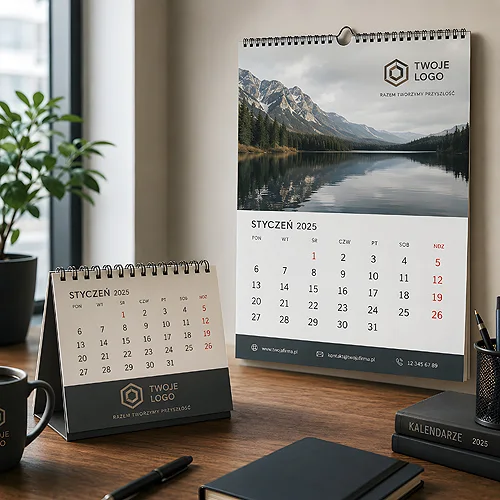
A single pen with a logo pleases for a moment. But a set of things that clearly belong to one family - a pen, a flash drive, a sticker, a notebook - works quite differently. The recipient immediately senses that the company knows what it is doing and did not just reach for the first gadget in the catalogue. A coherent collection builds the impression of a mature, well-organised brand, even if it is made of small items.
The good news: to achieve this you need neither a marketing department nor a huge budget. You need one idea carried consistently through all the items. Below we show how to plan such a series step by step - from the theme, through the choice of products, to the details that tie the whole thing into one.
- Coherence comes from repetition - one theme, a shared palette and a recurring detail on every item.
- Instead of random gadgets, choose products linked by a shared use scenario or a shared recipient.
- Set a few constants at the start: two colours, one logo layout, one accent - and keep to them for every element.
- Plan with expansion in mind - a well-designed series easily takes in further items in the same style.
- Usefulness matters more than the number of gadgets - better fewer things that someone will actually use.
Start with one theme, not with products
The most common mistake is choosing gadgets first and thinking about coherence last. What is left then is damage control - slapping the same logo onto random items. Reverse the order: set the theme first, then choose products to match it.
A theme is not just a logo. It is a few constants that will repeat everywhere: a colour palette, the way the brand mark is placed, one recurring graphic accent or a slogan. When the same elements come back on every item, the eye immediately sees a collection rather than a pile of loose things.
Palette and the logic of colour
Choose two, at most three brand colours and keep to them across all the gadgets. This need not mean every item is the same colour - sometimes a more interesting effect comes from a series where products carry different shades from the same palette but a shared detail links them. What matters is that the colours are not accidental. If the company has navy and orange in its identity, the whole series should play with those two, not add green just because that flash drive happened to be on hand.
A recurring detail
The simplest way to tie a collection together is one element that returns everywhere. It could be the logo in the same corner, a recurring pattern, a thin line in the brand colour or a short slogan. The same detail on a pen, a sticker and a notebook works like the signature of the whole series - even if the items themselves are very different. If that recurring detail is the logo colour, plastic makes it easier to hold on to - the EVE White takes digital UV printing, so the mark keeps your brand colours instead of being reduced to one.
Before you order anything, write down a small set of constants: two colours, one logo layout and one recurring accent. Note them and keep them at hand - they are your guide for every next gadget. That way an item added half a year later will fit in with the rest without friction.
Choose products that share something
A collection is not a random bag of things. The best series have an inner logic - products are linked either by a shared use scenario or a shared recipient. Instead of asking "what else can we brand", ask "what is this set meant to be useful for and to whom".
- A desk set - a pen, a notebook, stickers and a mat create a coherent work zone the recipient sees every day.
- A conference set - a badge, a pen, a flash drive with materials and a small handheld gadget, all in one theme.
- A welcome set for a new employee - things that build a sense of belonging to the team from day one.
- A client set - sturdier, more refined items that represent the company over a longer time.
At the heart of many such sets is a good promotional pen - used daily, it passes from hand to hand and carries the brand further than any banner. A conference set pairs well with a promotional flash drive holding ready materials inside - the recipient gets not just a gadget but content too. The whole thing is finished off with small stickers bearing the logo, which can go on a laptop, a notebook or a mug and which in practice stay in sight the longest.
It is worth remembering here that usefulness matters more than the number of items. We write more about this in our post on why a gadget's usefulness matters more than a low price. Better to give three things someone will actually use than eight, half of which will end up in a drawer.
Give the series a brand character
Coherence is one thing, but the collection should also say something about the company. The same set of products can be led in many directions - elegant and minimal, or lively and playful. Match the tone to how the brand communicates day to day.
If the company is serious and technical, spare graphics, muted colours and a logo without fireworks will work. A young, relaxed brand can afford stronger colours, slogans and a wink. The key is that the same character runs through all the items - a collection where one gadget is austere and another loud falls apart before your eyes.
An interesting direction is a series that does not shout advertising. Gadgets on which the logo is discreet and the object is simply pleasant and useful are ones people keep more willingly. We develop this thread in our post on promotional gadgets that do not look like advertising - and these are often the ones that work for the brand the longest.
Plan the collection for the future
A good series is not closed. Companies grow, new occasions appear, and you will want to add another item in half a year or a year. If you design the collection with expansion in mind from the start, every new gadget will slot into place without redesigning the whole thing.
- Set the foundation - palette, logo, one recurring detail. This is the set of rules you return to for every new item.
- Start with the core of the series - a few key gadgets that will most often reach recipients. Usually a pen, something to carry content and a small handheld item.
- Choose products for specific occasions - a conference, a trade fair, a welcome pack. Each draws on the same foundation but adds an element for that event.
- Leave room to grow - keep the written theme and graphic files in order so that adding another item is a matter of an hour, not designing from scratch.
If you want to choose products for a specific series idea, the simplest way is to browse the whole range on the products page and match them to the theme set earlier. And whenever you hesitate over the choice, you can always write to us via contact - we will suggest what works well in one collection.
The most common traps and how to avoid them
Finally, a few things that most often spoil a series' coherence - and simple ways to avoid them.
- Too many themes at once - when every item has a different accent, the collection blurs. Keep one recurring detail.
- Logo in random places - the same mark once in the corner, once in the middle, once at the bottom breaks the order. Set one placement rule.
- Colours by guesswork - shades chosen separately for each gadget almost never work together. Pick the palette once and watch over it everywhere.
- A pointless gadget - an item added only to make the set bigger lowers the impression of the whole. Every element should have a reason to be in the collection.
A coherent series of company gadgets is not a matter of a big budget, but of one good idea carried consistently. Set the theme, choose products that share something, repeat the detail everywhere - and the collection will start saying about your company exactly what you want people to think of it.